Get Full Government Meeting Transcripts, Videos, & Alerts Forever!
Get email alerts on the Capital Plan 2026 topic
No spam. Unsubscribe anytime.
Duluth unveils 2026 capital‑improvement and equipment plan including rolling‑stock requests
Summary
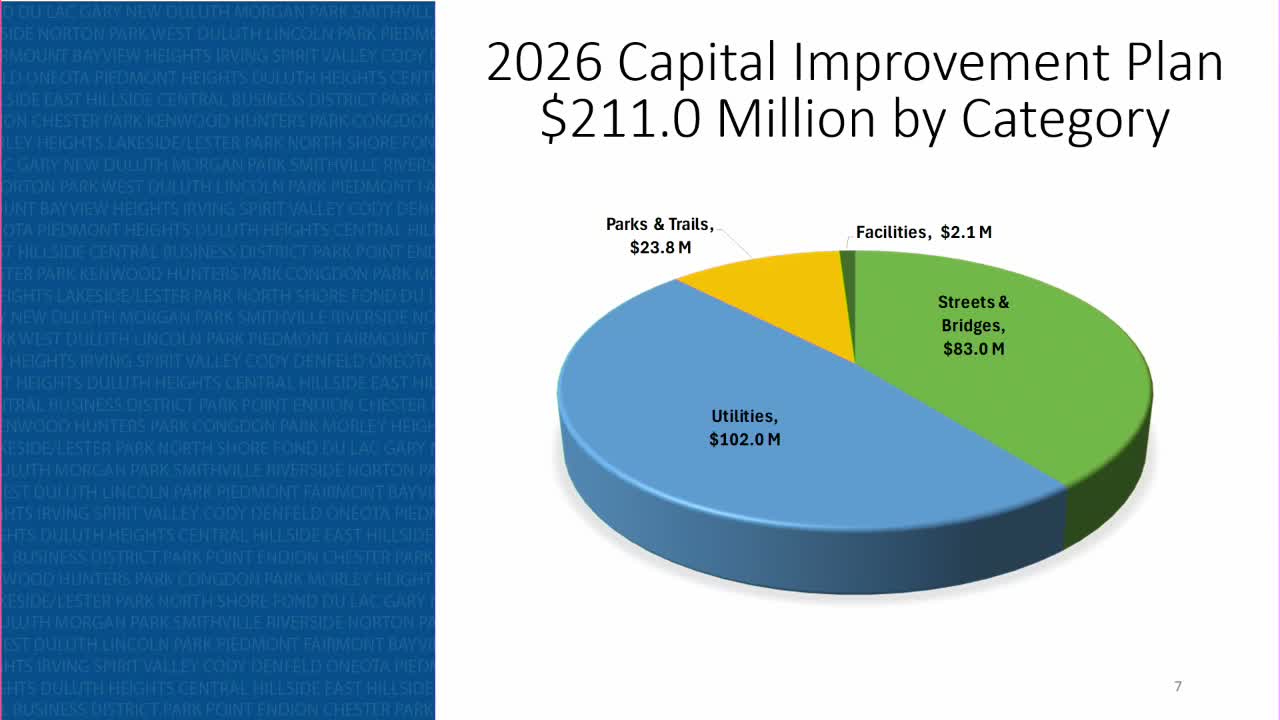
City staff presented a 2026 capital plan that includes $211 million in infrastructure improvements (five‑year plan ~ $396 million), a 2026 equipment request of about $7.2 million, and targeted rolling‑stock bonding to address a $25 million fleet backlog and long lead times for plow trucks.
City staff presented a detailed capital‑improvement and equipment plan for 2026 and the coming multi‑year horizon, outlining funding sources, priorities and targeted bond use.
Budget Manager Melissa Harold said the council is being asked to approve a plan that will be spent starting in January, with bond sales in the following fiscal cycle to reimburse eligible expenses. Harold characterized capital improvements as infrastructure projects such as facilities, roads, sewers and parks, and noted that bond‑eligible facilities include city hall, libraries, public safety and public works buildings.
Harold said the 2026 capital‑improvement universe displayed to council totaled about $211,000,000 with a five‑year pipeline just under $396,000,000, funded by a mix of grants, state and federal assistance, utility revenue and bond proceeds. She cautioned that parks facilities are not bond eligible, creating constraints for park projects.
Bill Bersa, fleet services manager, outlined rolling‑stock needs and said vehicle replacement values and inflation have driven the general‑fund equipment backlog to roughly $25,000,000. "Because of this funding gap, we've accumulated the $25,000,000 in backlog, which is 40% of our general‑fund fleet that has reached the end of its life cycle," Bersa said. He requested $2,750,000 in general‑fund bonding for 2026 and described a $5.3 million rolling‑stock package (including $2.7 million in general‑fund bonds and other special‑revenue and utilities contributions). Bersa also warned that current lead time for a new plow truck remains about 12 months and that seven plow trucks are awaiting construction at the truck builder.
An IT presentation (Director Culhane) described just‑over $1,000,000 for IT lifecycle replacements and $240,000 for innovation projects in 2026, including records digitization and upgrades to public‑safety radios and network backup systems. Harold also said the capital plan includes about $440,000 for public‑safety equipment (PPE, hose, rescue equipment, thermal imaging and partial support for a police drone program).
Public‑Works presentation (Director Benning) highlighted an $83,000,000 transportation portfolio for next year, including an aerial‑lift bridge project and three street‑preservation packages; he said the city requested $55,000,000 from the state PFA for lead‑service‑line replacement but expects an award closer to $15,000,000. Facilities director Eric Birkland said the facilities CIP will invest about $2.1 million next year and that deferred maintenance across city buildings remains significant (deferred maintenance near $50,000,000 in 2025).
Councilors asked staff for additional details about PPE and drone funding, Lake Walk RAISE grant scope and trail ADA improvements; staff committed to follow up with itemized equipment lists and further documentation.
Next steps: The council will review the plan and a public hearing and resolution process are anticipated in December.