Get Full Government Meeting Transcripts, Videos, & Alerts Forever!
Get email alerts on the Government Campus Project topic
No spam. Unsubscribe anytime.
Boca Raton council hears PFM analysis showing funding gap for proposed downtown government campus
Summary
At a Dec. 1 workshop the Boca Raton City Council reviewed an independent PFM fiscal analysis of a proposed downtown government campus P3. PFM projected long‑term net fiscal benefits but identified a near‑term funding gap (about $87.4 million) and recommended conservative assumptions for bond modeling.
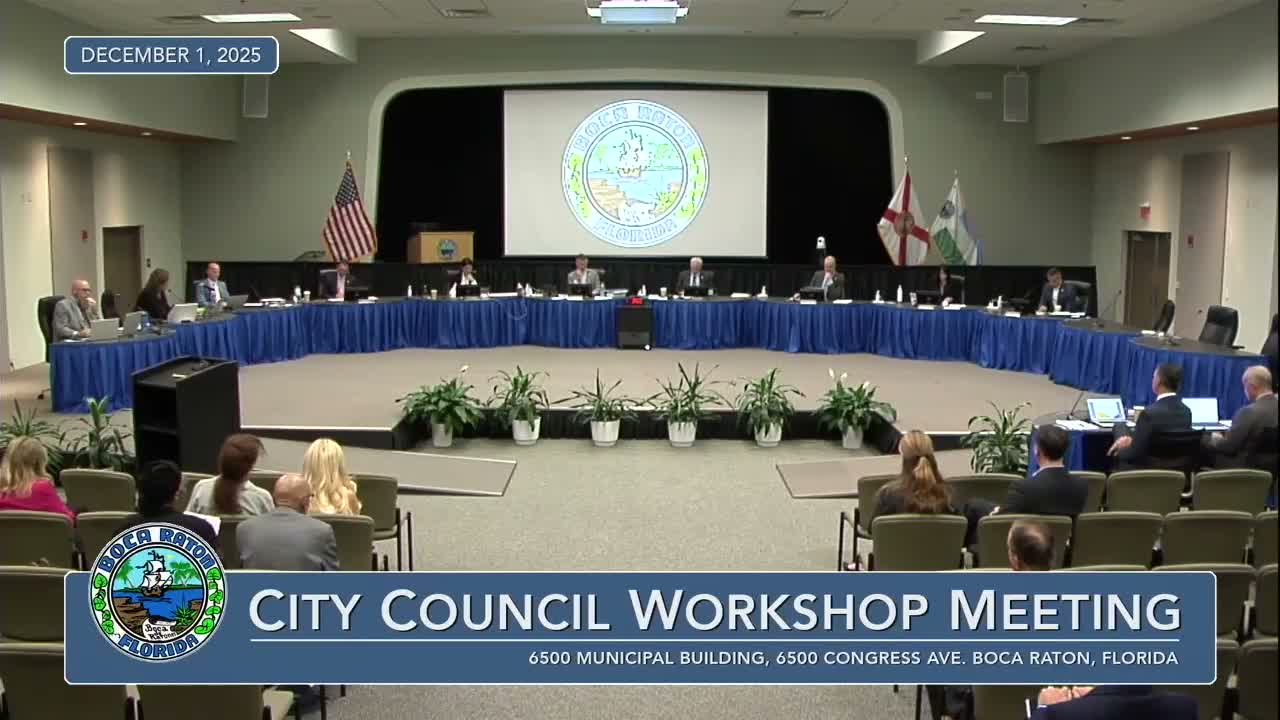
At a workshop meeting on Dec. 1, 2025, the Boca Raton City Council heard PFM Group’s independent analysis of a proposed downtown government campus public‑private partnership (P3), which showed long‑term revenues but a near‑term funding shortfall.
Kevin Plensler of PFM told the council that, focusing on the presentation’s scenario 4, the project’s full build‑out produces an annual net fiscal impact of “just under $10,000,000 a year” once stabilized. Mallory Richards, also with PFM, presented high‑level projections showing net new operating revenues of $14,800,000 against estimated operating expenditures of $6,300,000 — a projected annual net fiscal benefit of about $8,500,000 in the model used for ongoing operations.
The analysis differentiated construction‑period economic effects from ongoing operational impacts and stressed conservative assumptions for debt sizing. Plensler said PFM excluded two developer‑proposed revenue items — a 1% transfer fee on future sales and upside profit sharing — because they are not scheduled revenues and are difficult to rely on for bond repayment. He said PFM used a 5% discount rate for net present value calculations, explaining that it aligns with current long‑term rates and the city’s weighted cost of capital.
PFM and staff also summarized capital and financing assumptions: total construction costs for the city components were estimated at just over $200,000,000; PFM modeled an amount the project could support as approximately $114,000,000 in bond issuance funded strictly from project cash flows, and identified a funding gap on the order of $87,385,000 in the presentation. PFM noted a modeled upfront payment of $7,800,000 in scenario 4, which it assumed would be available to fund debt service.
Deputy City Manager and Chief Financial Officer Jim Zervis said the funding gap is driven largely by timing mismatches between long‑term project cash flows (PFM modeled up to 99 years for some metrics) and the shorter maturities available for certain bonds, and by constraints from the community redevelopment agency (CRA), which sunsets in the early 2040s. Zervis listed potential options to address the gap, including CRA bond issuance capacity, a portion of proceeds from the sale of the golf course (about $34,800,000 noted in the presentation) and available CRA cash balances (about $49,500,000), while stressing eligibility rules for those funds.
Council members pressed PFM on differences from prior analyses by CBRE. Plensler and Richards said the main divergences were (1) exclusion of non‑scheduled revenues (transfer fees and upside sharing), (2) inclusion of operational expenditures and per‑capita estimates for municipal services that CBRE did not model, and (3) a slightly higher discount rate (PFM used 5% vs. CBRE’s 4.5%). Speaking to risk, Plensler said, “reasonable people could certainly disagree on the discount rate, but we felt very comfortable that a 5% was a reasonable expectation given the riskiness of the cash flow.”
Councilmember Thompson asked whether including the $200 million in city capital costs in a net present value calculation would change the bottom line; Plensler said it would produce a net negative NPV if those upfront capital costs were treated comparably to operating revenues in the model, and cautioned that operating‑revenue models and capital expenditures are different analytic constructs.
PFM and staff said their full appendices list assumptions and comparables used to adjust developer pro formas, and staff said PFM will update a few corrections to the presentation for the next council meeting. The council did not take a vote on financing or project authorization at the workshop; staff and PFM said they will follow up on questions raised and present updated materials at the next meeting.