
Boca Raton planning board recommends Meisner Plaza Hotel IDA with conditions after residents raise safety and traffic concerns
Get AI-powered insights, summaries, and transcripts
Subscribe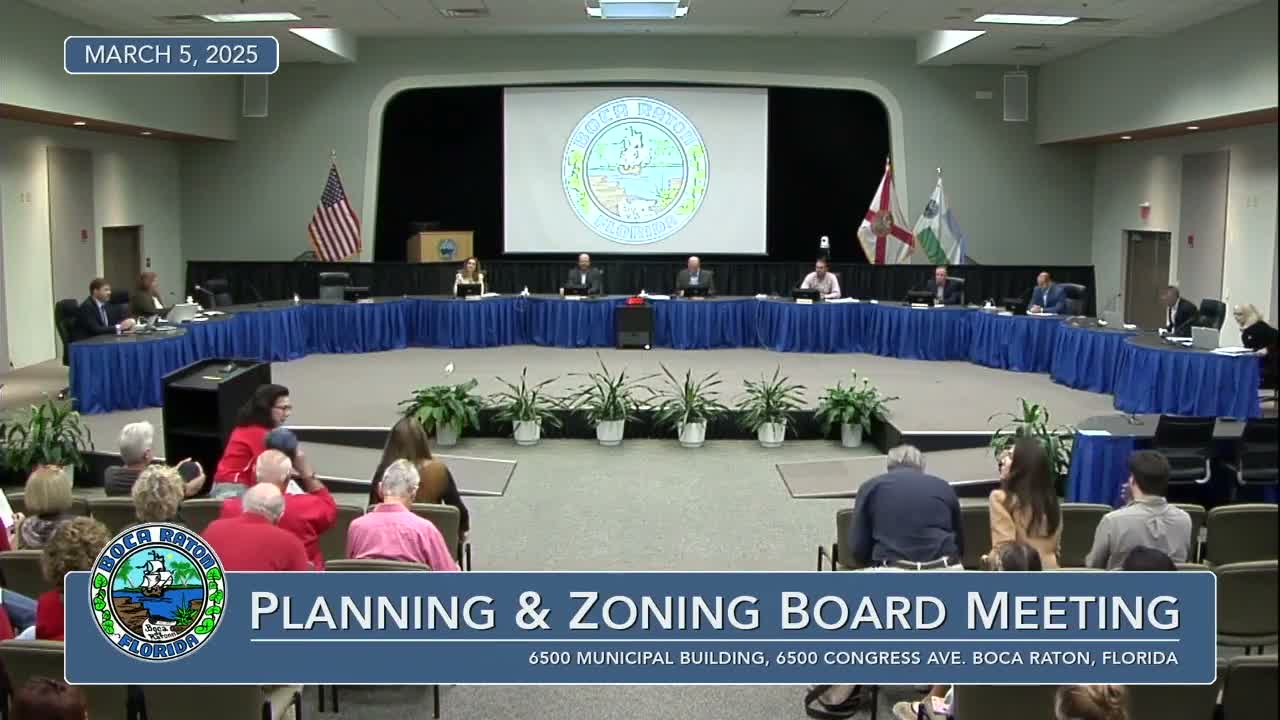
Summary
The Planning & Zoning Board voted 6-0 March 5 to recommend approval of the Meisner Plaza Hotel individual development approval, approving a 12‑story, 219‑room hotel and related retail while adding conditions requiring a structural survey of Tower 155 and vibration testing; the item advances to the CRA.
The Boca Raton Planning & Zoning Board on March 5 recommended approval of the Meisner Plaza Hotel individual development approval (IDA), voting 6-0 after adding conditions that require a structural survey of the adjacent Tower 155 condominium and ongoing vibration testing during construction.
The project before the board would redevelop about 1.65 acres at 132 and 170 Northeast 2nd Street into a two‑tower, 12‑story hotel with 219 rooms, roughly 30,840 square feet of retail and restaurant space, and internal structured parking. Senior planner Susan Lesser told the board the applicant seeks a technical deviation to reduce required off‑street parking from 557 spaces to 328 and to transfer 154,815 square feet of office‑equivalent development between downtown subareas. Lesser said the application provides 46% open space (33,248 sq ft) where 40% is required and includes a Transportation Demand Management plan that pledges a TDM coordinator, transit subsidies (50% for Tri‑Rail and PalmTran, 20% for Brightline) and an annual $27,661 contribution to downtown transit programs.
Ellie Zacharias, representing the applicant, said the team removed the previously proposed city‑owned lot and its below‑grade parking from the application, reduced the room count from 242 to 219 to account for lost parking, and emphasized pedestrian‑oriented features including wide sidewalks, a protected bike lane and a 20‑foot alley to the south for two‑way access. "This to me is the most beautiful project I've ever had the opportunity to work on," Zacharias said, describing stair‑aligned public space and retail terraces designed to connect with Meisner Park.
Residents of Tower 155 and their counsel urged the board to require additional protections. "We are in litigation," said Ellen Bogdanoff, attorney for Tower 155, and asked the board to recommend conditions including a detailed survey of the existing condominium structure and vibration monitoring and mitigation to document and limit construction impacts. Residents characterized the alley that abuts their building as narrow and expressed concern that widening it to 20 feet and authorizing two‑way traffic would create safety conflicts for delivery trucks, moving vans and emergency access. Jeffrey Weinstein, a resident, argued the proposal relies on multiple deviations and transfers of development rights and challenged whether certain stairs and second‑floor terraces should count as required ground‑level open space: "This is not an of‑right development," he said.
Other public speakers supported the project for improving downtown walkability and adding hotel inventory. Shelley Nesbitt, a nearby homeowner, said the development would bring amenities and convenience within walking distance, while some residents cautioned about the pace and character of new downtown construction.
Following public comment, Zacharias agreed to two of five proposed conditions and pledged the applicant will work with staff and counsel to craft specific language. She said the applicant would perform a preconstruction survey and vibration testing "throughout the process" and that the parties would resolve remaining details before the item goes to the Community Redevelopment Agency (CRA).
Chair Savelle moved to approve the IDA "as proposed" with the two added conditions (survey and vibration testing); Vice Chair Dornblazer seconded. The board then took a roll‑call vote: Mitchell, McDermott, Matthews, Maraboli, Savelle and Dornblazer all voted yes; the motion passed 6‑0. The recommendation will be forwarded to the CRA for consideration of the IDA and any final approvals.
The board adjourned at 7:11 p.m.
What happens next: The board's recommendation and any staff‑draft IDA conditions, including the agreed survey and vibration language, will be considered by the CRA in a subsequent meeting; the applicant and objecting residents indicated they will continue to negotiate specific condition language prior to that hearing.