Get Full Government Meeting Transcripts, Videos, & Alerts Forever!
Get email alerts on the Downtown Campus topic
No spam. Unsubscribe anytime.
Boca Raton Council introduces downtown campus ordinance amid fierce public debate over Memorial Park, finances and referendum
Summary
City staff and consultants introduced a master partnership agreement and ordinance to implement a mixed‑use downtown government campus with private development east of Northwest 2nd Avenue; residents packed public comment to oppose the plan, pressing the council for clearer referendum protections and for assurances about trees, traffic and fiscal risk.
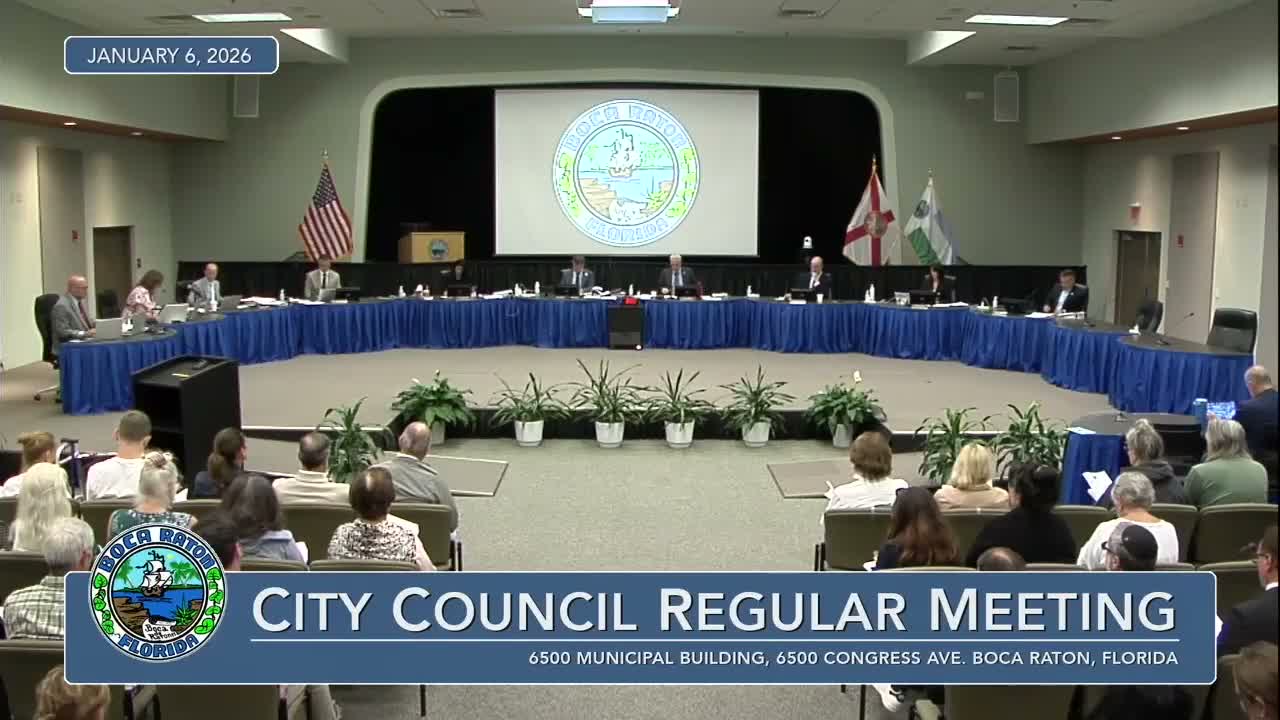
The Boca Raton City Council on Jan. 6 introduced an ordinance to advance a public–private redevelopment of the downtown government campus, prompting more than three hours of presentations, legal explanations and public testimony that sharply divided residents.
City staff and technical advisers described a revised master plan developed with Terra Frisbie (branded in materials as "1 Boca") that would reserve the west side of the campus for civic uses — including a city hall, community center and police substation — and allow mixed‑use private development east of Northwest 2nd Avenue anchored to the Brightline station. Deputy City Manager Andy Lukaszek told the council the project has been shaped by more than 40 public meetings and now reflects about a 27% reduction in development intensity from the original proposal.
The city’s financial advisers and consultants said the revenue model uses percentage rent — a share of gross rents generated on the private development — rather than a small guaranteed payment. CBRE, the city's technical adviser, defended a 4.4–4.5% discount rate for public‑side evaluations, while the city’s independent financial consultant (PFM) used a 5% rate. City staff also said the lease documents include protections: the city would retain fee simple ownership of the land, improvements revert to the city on termination, financing and zoning approvals must be in place before lease activation, and enforcement provisions give the city remedies if the partner fails to perform.
The legal framework drew particular attention because the council and the developer agreed in September to place a referendum on the ballot. City Attorney Mr. Kaylor read revised language intended to make clear that if voters reject the March 10 referendum the agreements “shall be null and void,” and to ensure that a postponement of the referendum for reasons outside city or partner control (for example, a declared state of emergency) would not be treated as a voter approval — instead, he said, the referendum would be rescheduled for the next available election. Councilmember Thompson and others asked staff to further clarify language to ensure postponement would neither count as approval nor rejection.
Public comment filled the meeting. Opponents organized under the Save Boca banner pressed hard on several themes: preserve Memorial Park and the existing mature trees; skepticism about long‑term fiscal assumptions (notably the discount rate, rent escalator and projected net present value); and distrust of draft contract language they said could permit the agreement to proceed even if the referendum did not occur as scheduled. John Perlman of Save Boca said the group had spent more than $100,000 to gather signatures and would “make sure that democracy is upheld” on March 10. Several speakers urged councilmembers to postpone any final approval until after the referendum and until the city had concrete, funded plans for the west side civic improvements.
Supporters and several planning speakers urged that the transit‑oriented, mixed‑use plan would activate underused land near the rail station, increase green space and create recurring jobs and economic activity. Urban planner Jason Haber told the council the proposal resembled the kind of people‑centered development cities should embrace.
Councilmembers were divided. Some described the proposed ordinance and contract changes as improvements that keep public safeguards and preserve the voters’ referendum; others said the protections did not go far enough and signaled they would withhold support. Mayor Singer and other councilmembers emphasized the public engagement and staff’s work to revise terms after resident feedback.
Procedurally, the council introduced Ordinance 57‑69 on Jan. 6 and scheduled further action: the council will consider approval at its Jan. 20 meeting, staff expects comprehensive plan amendments in February, and the voter referendum remains set for March 10. Several follow‑up steps — rezoning and site plan review — are contingent on the referendum outcome and will be subject to public hearings and design review.
What happens next: the council’s Jan. 20 meeting will include additional discussion and a possible vote on the ordinance and related agreements. The March 10 ballot will allow citywide voters to approve or reject the proposal; if voters reject it, city staff and the city attorney say the agreements as drafted would be void.