Lifetime Citizen Portal Access — AI Briefings, Alerts & Unlimited Follows
Boca Raton council adopts downtown redevelopment agreement, sends package to March 10 referendum
Loading...
Summary
The Boca Raton City Council voted 4–1 to adopt ordinance 57‑69, approving a master partnership agreement, construction management framework and a 99‑year ground lease with developer Terra Frisbee. The agreements are contingent on voter approval on March 10; the decision followed a daylong public hearing marked by sharp debate over Memorial Park, traffic and finances.
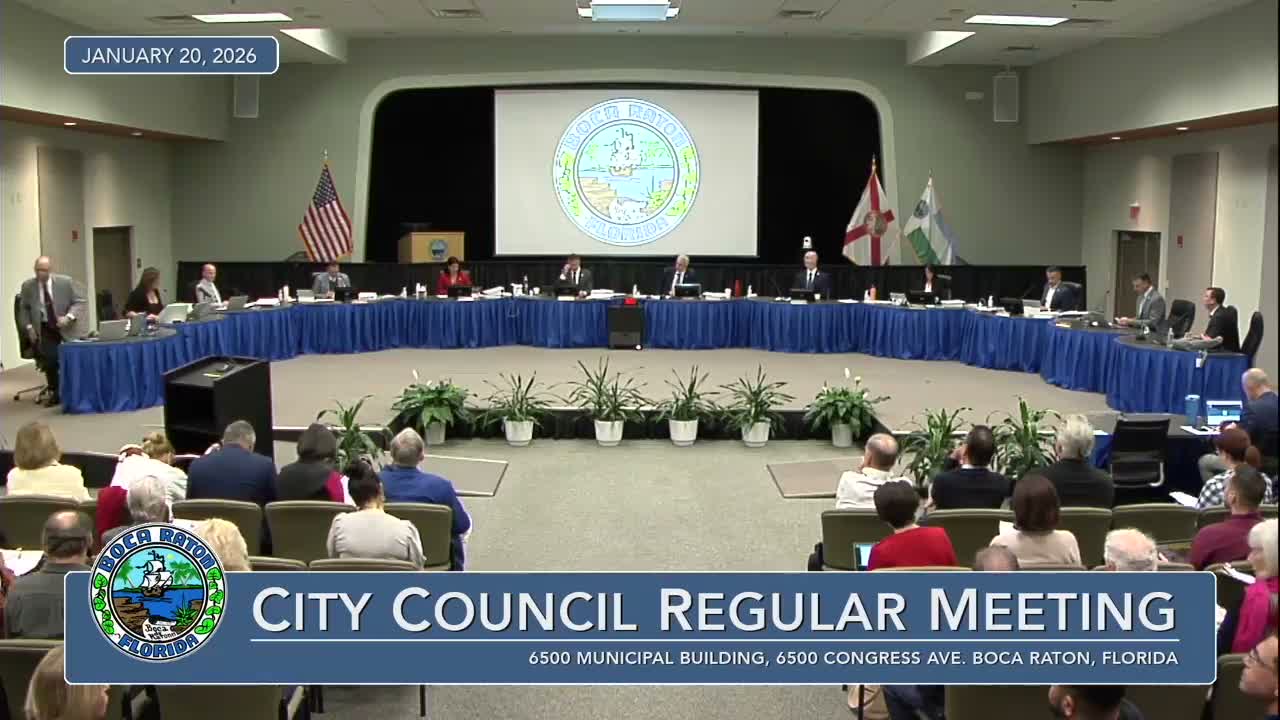
Boca Raton’s City Council voted 4–1 on Jan. 20 to adopt ordinance 57‑69, approving a master partnership agreement (MPA), a development management and construction agreement, and a 99‑year ground lease with the private partner Terra Frisbee for a mixed‑use downtown government campus. Council members Nattlis, Drucker, Victor and Mayor Singer voted yes; Councilmember Thompson voted no. The package now goes to voters in a referendum on March 10, 2026.
The agreements define a two‑phase redevelopment centered east of NW 2nd Avenue and establish how the private partner would design, build and operate a mixed‑use project while the city and the Community Redevelopment Agency (CRA) retain fee ownership of the land. City staff and the city attorney repeatedly told the council that no lease commencement, construction or possession can occur until the referendum is approved and all required regulatory and financing conditions are met. “It is not a green light by itself,” City Attorney Koehler said of the MPA, underscoring that financing, vertical permits and council approvals are prerequisites.
City presentations highlighted the financial structure: consultant PFM and CBRE provided updated analyses that factor construction rent, percentage rent (a share of gross project revenue), transfer fees and operating revenue streams. PFM’s presentation cited a total operating‑revenue net present value of about $382 million over the 99‑year term and a net fiscal impact figure of roughly $227.85 million; staff noted an independent appraisal of the fee‑simple land at about $99 million. The city will receive the greater of a minimum (floor) ground rent or percentage rent, plus profit participation and transfer fees on sales. PFM estimated near‑term bonding capacity tied to 30‑year monetization scenarios at about $107–$127 million.
The agreements include protections the city emphasized during deliberations: enhanced rent escalation during construction, a one‑time recalibration limit on the gross‑revenue hurdle (with a high standard for “extraordinary financial impairment”), a payment‑in‑lieu clause to protect ad valorem–based assumptions, remedies and termination rights if the partner fails to meet milestones, and contract language embedding traffic analysis and mitigation requirements, including mitigation fees up to $4 million in addition to other contributions.
Deputy City Manager Andy Lukasic described project design goals—protected bike lanes, narrower pedestrian‑friendly streets and a reimagined Memorial Park developed with veterans’ input—and said the conceptual renderings will be refined through the regular site‑plan and land‑development‑regulation processes. Lukasic and CFO Jim Zervis told the council that the developer is responsible for infrastructure on the east side and a pro‑rated share of off‑site improvements, and that the city expects roughly 2,100 parking spaces across the project (about 600 in structured parking adjacent to the office/grocery building). The developer’s construction management fee if the city uses its services is written at 3.25% of project cost but the agreement is permissive—the city may select other providers.
Public comment stretched for hours. About 40 speakers addressed the council. Supporters — including veterans, urban designers and residents who called for downtown revitalization — said the plan increases publicly accessible green space, preserves Memorial Park, adds recreation and civic facilities and produces workforce housing and jobs. Opponents raised concerns about the 99‑year lease of public land, shifting financial projections, long‑term traffic impacts, the scale and height of buildings, and perceived deficiencies in transparency or engagement. “We’re giving up this land for 99 years,” said Joe Majes, urging a no vote; veteran speakers and veterans’ organizations, by contrast, said the memorial concepts honor service and valued veteran engagement in the planning.
Council supporters framed the deal as a partial way to fund overdue civic improvements without drawing down reserves or placing a new tax burden on residents. Proponents noted the package preserves public ownership of the land at lease end, requires full financing and regulatory approvals before lease commencement, and embeds multiple revenue streams—ground rent, percentage rent, CRA tax‑increment increases, transfer fees and operating revenues—as hedges against inflation and taxation changes.
With adoption, the ordinance authorizes the city to enter the negotiated documents and place the referendum language on the March 10 ballot. If voters reject the measure, the agreements cannot take effect and the city will need to pursue alternatives to fund and site civic improvements. The council followed the vote by adopting its consent agenda and introducing related zoning and comprehensive‑plan amendments that will proceed through the separate regulatory process.
The council’s vote was the latest milestone in a multi‑year process that city staff described as involving public outreach, multiple consultant reviews and negotiations. Council members and staff noted more regulatory steps lie ahead — land development regulation changes, site‑plan reviews and community engagement on the civic (west‑side) designs — should voters ratify the agreement.