Get Full Government Meeting Transcripts, Videos, & Alerts Forever!
Get email alerts on the Parks Funding topic
No spam. Unsubscribe anytime.
Parks director, consultants outline menu of funding options; $1 monthly utility fee estimated to raise $5.4M
Summary
Austin Parks and Recreation and consultants presented short‑ and long‑term options to close a growing parks funding gap, including a proposed $1 monthly parks fee on utility bills (estimated $5.4M/year), bonds, enhanced fees, partnerships and consideration of a parks district; the study estimated the department needs on the order of $30M annually to match peer cities.
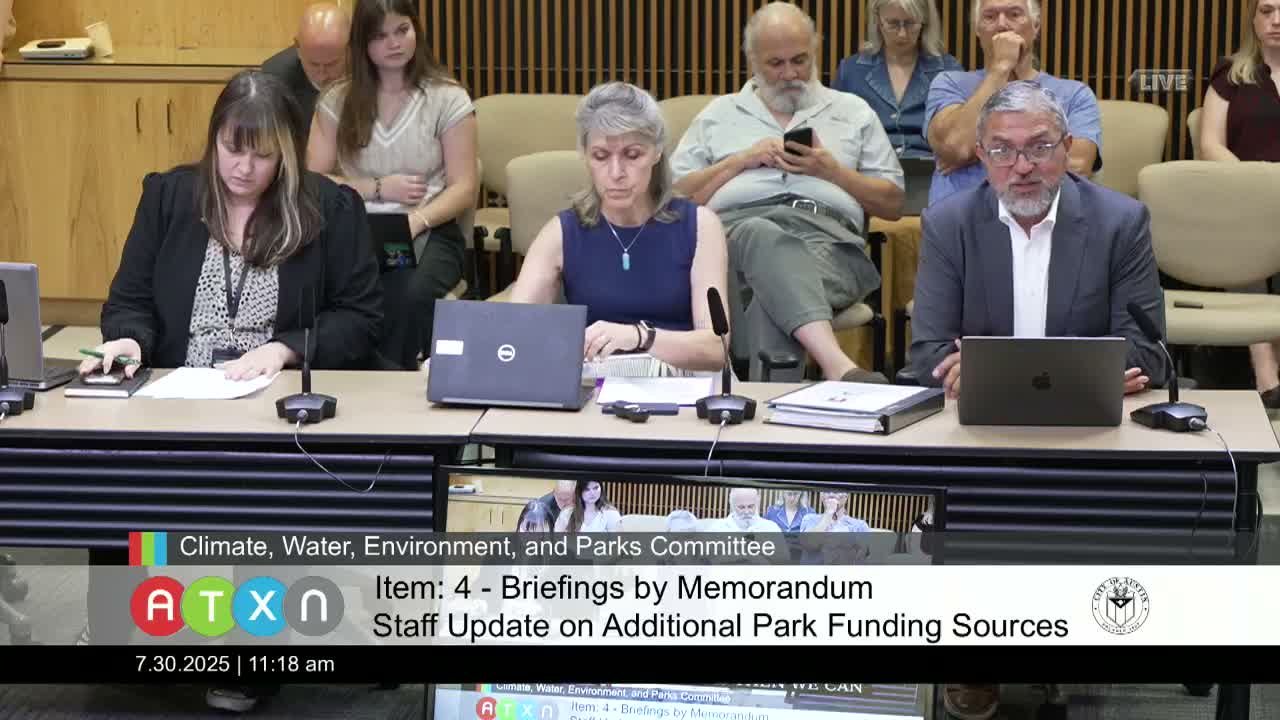
Austin Parks and Recreation and outside consultants briefed the Climate, Water, Environment, and Parks Committee on July 30 about a menu of options to address a growing parks funding shortfall, emphasizing short‑term fee options and longer‑term structural changes such as a parks district.
The lede: Director Jesus Aguirre summarized a multi‑phase analysis conducted with Trust for Public Land and PFM Group that found the department generates roughly $15.9 million in revenue (FY24) while operating costs far exceed that amount; the study proposed short‑term and long‑term strategies to close the gap.
The nut graf: Short‑term options include a monthly parks and recreation fee collected on utility bills (consultants estimated $1/month would yield roughly $5.4 million annually), adjustments to user fees and rental charges, targeted event‑fee capture, and pursuing additional partnerships. Long‑term proposals include exploring a regional parks district (with Travis County) or a local government corporation and potential property‑tax strategies, but staff noted such paths would likely require state legislative work and multi‑session timelines.
Aguirre and consultants emphasized the tradeoffs and complexities: forming a parks district would create a dedicated and sustainable revenue stream but is politically and legally complex and may require state enabling legislation and coordination with county partners. The consultants estimated that achieving a funding level comparable with peer cities could require roughly $30 million annually, a level the presenters said could not be delivered immediately and would likely require a blend of tools over time.
Committee members raised equity and access concerns, asking how fees would be structured to avoid limiting access for lower‑income families and how to ensure fees captured for events (for example, ACL) could be directed to Parks rather than lost to the general fund. Staff said they are exploring mechanisms to reserve event fees for parks and would return with further analysis.
Public commenters earlier in the meeting had urged exploration of multiple revenue sources and careful attention to equity; Kayla Reese of the Austin Parks Foundation supported a mix of short‑ and long‑term solutions while noting the staff memo provided a useful starting point but no funding was attached to the analysis.
No formal action was taken; staff said further analysis will follow and that conversations with Travis County about a regional approach have been initiated.