Get Full Government Meeting Transcripts, Videos, & Alerts Forever!
Get email alerts on the Public Safety topic
No spam. Unsubscribe anytime.
Austin Fire Chief seeks authority to run engines with three firefighters during staffing shortages
Summary
Fire Chief Joel G. Baker asked city council to give him limited authority to staff engines with three personnel when absences force overtime, arguing the change would avoid station blackouts while still meeting NFPA scene staffing recommendations; council pressed for data on frequency and operational impacts.
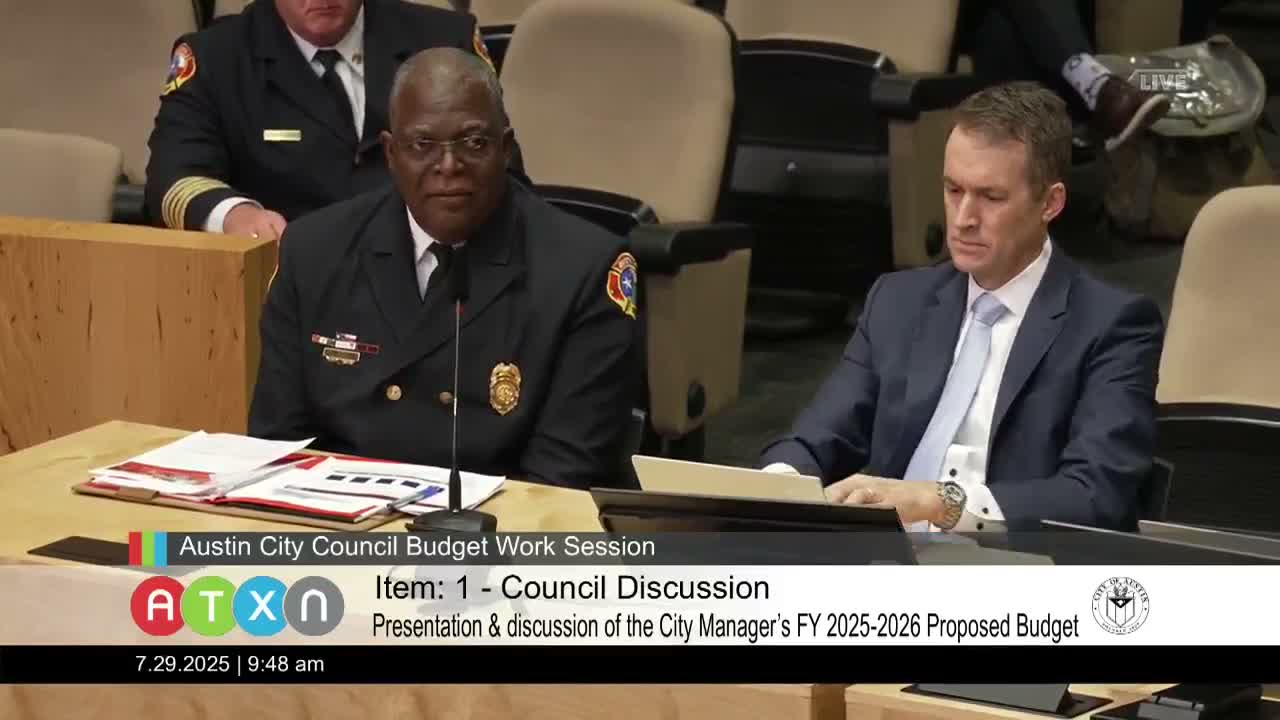
Fire Chief Joel G. Baker told the Austin City Council during its July 29 budget work session that he needs managerial flexibility to staff engines with three firefighters when staffing shortages make four-person engine staffing infeasible.
Baker said the department currently staffs apparatus to send about 32 personnel to a typical house fire, well above the National Fire Protection Association recommendation of 17. Under the proposed 4-on-trucks/3-on-engine model he described, the department would still be able to meet NFPA scene staffing guidance by sending roughly 24 personnel when some engines operate with three staff. "I'm not advocating to totally change the 4-person staffing," Baker said. "I'm requesting authority to manage my staffing level when shortages present themselves so I can keep stations open and staffed."
The city's budget presentation by Carrie Lang noted the change is intended to reduce overtime costs tied to high absenteeism (staffing models were built with a 25% absenteeism assumption, while actual leave has averaged nearer to 36% and spiked to about 39% in FY23). Baker told council he has hired recruit classes and reduced vacancies but still faces days where dozens of personnel are on leave and the department must hire overtime.
Several council members pressed for operational detail and frequency data. Council members asked how often engines would be staffed at three, whether response times would change in outlying districts and how the change would align with collective bargaining processes. Chief Baker said response times would not change because the nearest unit still responds, and that the department has automatic mutual-aid agreements with surrounding emergency service districts. He also said he would provide data showing how often overtime has been required and which apparatus might operate with three personnel under the proposed authority.
Council members emphasized safety concerns raised by firefighters about four-person staffing and urged that any policy change be informed by data. Several members suggested the collective bargaining table is an appropriate venue to address workplace conditions that affect absenteeism and overtime.
Council will receive follow-up data on overtime frequency, weekend vs. weekday call patterns, and which apparatus would have been affected in recent months under the proposed model. The council did not take a formal vote on the staffing authority during the work session; the issue was framed as a policy decision linked to the FY2026 budget and potential overtime restorations.