Demographer tells Crowley ISD board enrollment is at a record high of about 17,100; housing pipeline could bring thousands more students

Crowley ISD Board of Trustees · March 12, 2026

Get AI-powered insights, summaries, and transcripts

Subscribe
AI-Generated Content: All content on this page was generated by AI to highlight key points from the meeting. For complete details and context, we recommend watching the full video. so we can fix them.

Summary

The district's demographer presented a detailed forecast showing a 17,100 enrollment snapshot, multi-scenario projections for future growth, and a large development pipeline. Trustees discussed yields, capacity, and how growth may affect boundary and facility planning.

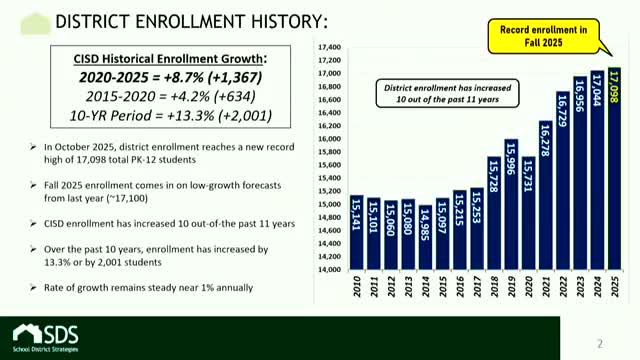
Crowley ISD's demographer told trustees the district recorded approximately 17,100 students in the snapshot for the 2025-26 school year and presented conservative, moderate and high enrollment scenarios tied to new-home production and student-yield estimates.

Mr. Alexander said the district has grown 10 out of the last 11 years and has net growth of about 1,400 students over the last five years (an 8.7% increase). He said the district's low/moderate/high scenarios reflect different yields (an average single-family yield of roughly 0.35—.4 students per house in many neighborhoods and lower yields for newer built-to-rent and multifamily developments) and varying kindergarten enrollment assumptions. "The official number for the 25-26 school-year enrollment is just right at 17,100," he told the board.

The presentation noted a substantial housing pipeline across the district: thousands of planned lots and several thousand apartments, with near-term closings and move-ins in areas such as Davis and Walker attendance zones. Mr. Alexander said the next five years could add roughly 8,400 single-family homes in the district pipeline and that over 10 years those figures could reach 15,000—,000 depending on build-out timelines. He also described how yields differ by housing type: he estimated built-to-rent neighborhoods yielding about 0.1 students per unit and many apartment projects yielding 0.15—.2.

Trustees and staff discussed capacity planning and thresholds Mr. Alexander and district staff use in forecasting: an elementary ideal range of 400'600 students, middle-school targets (ideal about 800, minimum ~700, maximum ~1,200), and functional-capacity planning that informed decisions about new construction and the design of Middle School 5 (built to be flexible as a K-8 if needed). The moderate projection puts district utilization in an "ideal" planning range (around 75'8% for combined campuses) with higher scenarios creating near-term pressure on seats and later-year overcrowding risks without new facilities or boundary adjustments.

Mr. Alexander flagged external factors that affect forecasts, including statewide voucher proposals and housing-market dynamics such as interest rates and turnover of existing homes. He said district staff are using conservative enrollment assumptions for budgeting and noted that the district's bond program has set aside funds for land acquisition to respond to growth.

Board members asked clarifying questions about how geocoding is used to map student residences, how transfers and employees' children are counted, and how yields vary among new subdivisions, multifamily, and apartments; Mr. Alexander noted that geocoding shows 97% of enrollment comes from resident students and roughly 3% are transfers. The demographer also provided visual maps showing growth corridors and areas of aging-in-place where yields have declined.

The presentation was extensive and framed by a multi-year planning outlook; trustees were asked to use the presented scenarios, yields, and pipeline data when considering boundary changes, capacity needs and timing for future facilities.