Get Full Government Meeting Transcripts, Videos, & Alerts Forever!
Get email alerts on the K 12 Education Academics topic
No spam. Unsubscribe anytime.
Crowley ISD reports strong math gains but flags reading gaps in midyear update
Summary
At a combined winter graduation and board meeting, Crowley ISD officials told trustees that district math performance is up substantially year over year while English language arts shows mixed results; the district outlined targeted campus-level interventions and testing milestones ahead of spring STAAR windows.
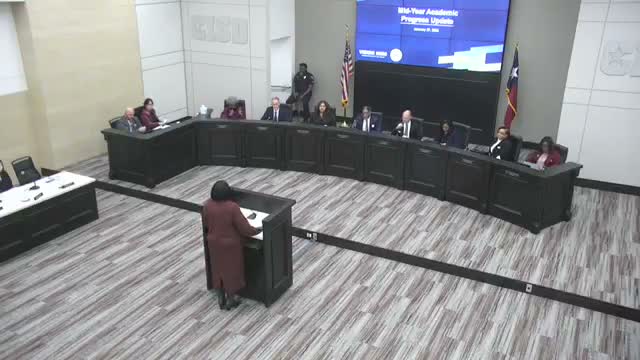
Crowley ISD trustees received a midyear academic progress report Feb. — district leaders said math outcomes are up across most grade levels while reading (ELAR) is uneven and requires more targeted intervention.
Dr. Milner, who led the presentation, told the board the district’s fall benchmark comparisons show mathematics up roughly 10 percentage points at the “approaches” level compared with last November, with middle-school double‑blocking cited as a primary driver of gains. “That group of seventh graders that you see with the 46 percentage point gain over last school year’s seventh graders is a group that benefited from increased instructional time,” Milner said.
The report said district reading results are a mixed picture: some grade levels (notably seventh grade) improved, while others — particularly fifth grade and certain third‑ and eighth‑grade cohorts — are off track. Milner and trustees noted teacher turnover and instructional gaps as contributors to declines in some grades and described action steps including gap‑map meetings, campus‑level targeted intervention plans, expanded tutoring (after‑school and Saturday school), and use of software such as IXL to personalize practice.
Superintendent Michael McFarland emphasized monitoring and execution: campuses have produced specific action plans and the district is deploying central‑office instructional staff to support implementation. Milner said the district will use spring district benchmarks in late February/early March and the upcoming TELPAS and STAAR testing windows to track progress and adjust pacing.
Trustees asked about Algebra I retesters, the success of accelerated cohorts, and whether the double‑block model might be extended to other subjects to build stamina and mastery. Milner said the district is considering where to strategically apply double‑blocking next year, acknowledging it carries staffing and budget implications.
The district framed its midyear goals around reaching a stronger overall accountability rating by year end; campuses have individualized targets that contribute to the district goal. The board heard that administrators will continue progress monitoring, revisit campus gap maps after each benchmark, and report back on outcomes at the next checkpoints.