Get Full Government Meeting Transcripts, Videos, & Alerts Forever!
Get email alerts on the Special Populations topic
No spam. Unsubscribe anytime.
Cedar Hill ISD reports bilingual/ESL counts and special education performance; 55 waivers submitted to TEA
Summary
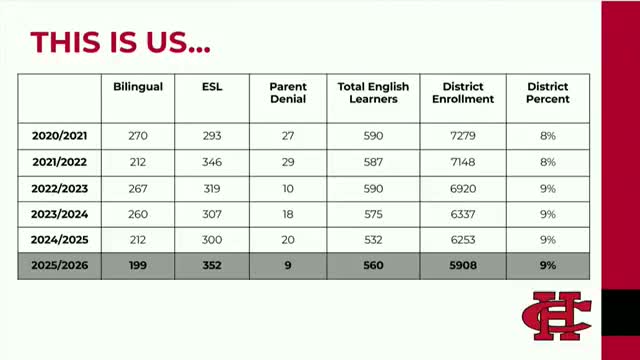
Administration reported 199 bilingual and 352 ESL scholars (9 parent denials), explained that 78 teachers deliver ESL instruction and the district submitted 55 teacher waivers to TEA (52 ESL, 3 bilingual); special education performance is below some MAP targets.
District staff presented detailed information about special populations and special education, citing program counts, assessment outcomes and action steps.
On bilingual and ESL programming, the presentation reported 199 bilingual scholars, 352 identified ESL scholars and nine parent denials (a total of 560 scholars in the bilingual/ESL categories). The presenter said 78 teachers are assigned to work with English Learners and that the district submitted 55 waivers to the state (52 ESL waivers and three bilingual waivers), noting each waiver includes a plan of action. "When you submit a waiver, you also submit a plan of action," the presenter told trustees.
On special education, the staff summary described placements (inclusion, resource, skill, TLC), noting that the special education population is steady at roughly 12–13% of district enrollment. Presenters said subgroups are small enough that some raw data cannot be published to avoid identifying students, and they showed that special-education students were below district targets on some NWEA MAP measures.
Trustees asked for clearer, actionable intervention plans and numerical targets to address achievement gaps; presenters said they will return with specific plans, certification supports for teachers and the waiver action steps already submitted to TEA.
What happens next: Administration said it will continue waiver plans and training for teachers, prepare intervention targets for special education students, and come back with numerical, campus-level plans for board review.