Get Full Government Meeting Transcripts, Videos, & Alerts Forever!
Get email alerts on the Parks Open Space topic
No spam. Unsubscribe anytime.
Somerville unveils 10-year Open Space plan and a first-of-its-kind Pollinator Action Plan
Summary
The city's director of Public Space and Urban Forestry presented a comprehensive Open Space and Recreation Plan and a Pollinator Action Plan that documents nearly 300 pollinator species, highlights park accomplishments, and outlines tree and park-maintenance programs; staff flagged soil-contamination and liability limits for community-garden expansion.
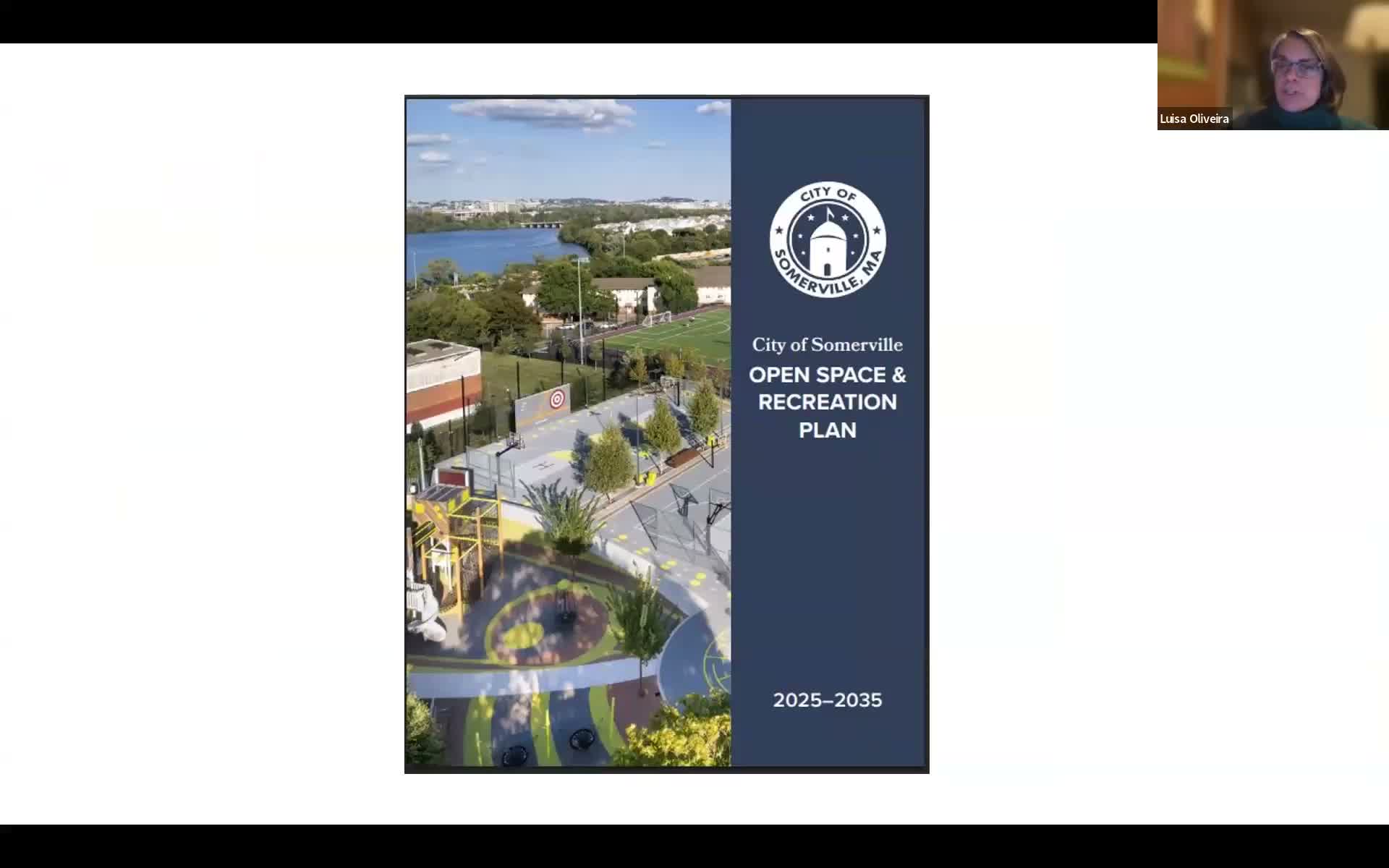
Luisa Oliveira, director of Public Space and Urban Forestry, presented the city's Open Space and Recreation Plan and the Somerville Pollinator Action Plan to the committee on Dec. 3. Oliveira said the Open Space plan is required for certain state grants (PARC) and goes beyond grant compliance to set policy priorities and an action plan for the next decade.
The Open Space plan: Oliveira highlighted accomplishments since the prior plan, including renovated athletic fields, three new synthetic turf fields, rehabilitation of natural-grass fields and about 6.37 acres added as privately owned public space. She described a proactive tree-maintenance program (young-tree training and a parks tree-health cycle) and said the city currently coordinates planting roughly 350 street trees per year. Oliveira identified Brickbottom as the neighborhood with the largest open-space deficit and noted walk-shed analysis is included in the plan.
Pollinator Action Plan: Oliveira described the Pollinator Action Plan as science-driven and highly local. She said an 11-person advisory committee and partnerships with scientists (including Tufts Pollinator Initiative contributions and iNaturalist data) produced a plant-pollinator mapping and recipe cards for plantings. "This is the first of its kind in The United States," she said, and the presentation cited roughly 300 insect species documented in Somerville. The plan includes a resident's guide, searchable plant lists and implementation recommendations (leave leaves, limit pesticides, choose neonic-free plants).
Community gardens and public-land constraints: Councilors raised a resident memo proposing new community-garden sites. Oliveira said community gardens are governed by the Conservation Commission and warned of practical constraints: urban parcels may be contaminated and require testing and remediation; untested city land can create liability if people are allowed to garden on contaminated soil. Oliveira said some city sites are gardenable now and that the administration has participatory-budget funds to create pollinator gardens as part of plan implementation.
Trees and maintenance: The presentation included a parks-tree health program and data on canopy goals; Oliveira said planting and maintenance decisions are guided by an urban-forestry master plan that identifies priority neighborhoods for tree canopy (East Somerville and Winter Hill).
Awards and next steps: Oliveira said the pollinator plan has won regional and national awards from landscape-architecture societies and that the full plan and supporting materials are on the city's SummerVoice page. The committee marked the items as work complete and requested continued coordination with the Conservation Commission and other departments.
Speakers quoted or paraphrased in this article are identified in the article's speaker list.