
Olympia fire chiefs present data-driven 'Standards of Cover'; council hears station gaps and options
Get AI-powered insights, summaries, and transcripts
Sign Up Free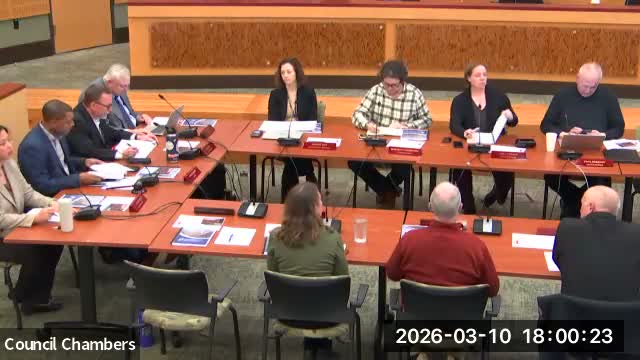
Summary
At a March 10 study session, the Olympia Fire Department presented a final draft Standards of Cover and community risk assessment, citing response-time gaps (notably Station 2 and Station 3), reviewing a January apartment fire with $800,000 loss, and urging options including digital alerting, added staffing or station siting; Chief Matt Morris said this is his final week with the city.
Fire Chief Matt Morris presented the Olympia Fire Department’s final draft Standards of Cover at a City Council study session on March 10, saying the data-driven plan lays out current performance, equity gaps and pathways to improve response across the city.
The Standards of Cover, developed over roughly 18 months, compiles a comprehensive risk analysis and performance metrics by the department’s four station-planning districts and ties those findings to national benchmarks such as NFPA 1710, Morris said. “This is my last meeting. Next week is my final week with the city,” Morris told the council as he closed his remarks.
Why it matters: The Standards of Cover translates response-time goals and staffing requirements into concrete investment choices: digital station alerting, added medic or BLS units, extra firefighters on engines or new station siting. City officials said these choices have both safety and budget implications, including potential impacts on the city’s WSRB insurance rating.
Deputy Chief Hillary Flowers walked the council through station inventories and district performance, noting the city’s four stations have different footprints and demands. “Our first arriving unit was on scene in 5 minutes and 55 seconds,” Flowers said when describing the January Landis Pointe Apartments fire; she added the department assembled its full effective response force in about 15 minutes, a response that department staff credited with limiting wider loss. Flowers reported total fire loss for that incident at about $800,000.
The presentation highlighted several gaps: Station 2’s large district (about 7.7 square miles) and an analog alerting system that the department estimates adds roughly 20 seconds to notification time; Station 3 is the slowest to meet targets because units are frequently used to cover downtown training and calls. Overall reliability and meeting the 7-minute, 6-second NFPA first-arrival target varied by district (Station 4 met targets much more consistently than Station 2).
Department leaders emphasized practical, staged options to improve performance rather than a single fix. They said digital alerting (reducing turnout delays), targeted placement of a BLS aid unit in high-volume medical areas, targeted additional staffing (a fourth firefighter on engines in some districts) and, in the long term, reconsideration of station siting could each improve first-due reliability and reduce costly second-out responses.
Council members asked about mutual aid and regionalization after noting a neighboring regional station sits near Olympia’s west boundary. Morris and Flowers said the department can import partners’ data into its modeling but cautioned that mutual aid should not become the routine substitute for a consistent first-due response; mutual aid remains important for large incidents but does not replace locally available resources for routine first-arrival reliability.
The department demonstrated the Dark Horse analytics platform used to aggregate historical calls, run predictive models and produce the annual performance dashboard. Presenters said they review data at least monthly, use the platform for long-range deployment planning and can model future land-use scenarios to show where new development would affect response times.
City Manager Bernie praised the work as the most comprehensive performance dataset he has seen for Olympia and said council finance and capital-planning conversations are underway to consider the multi-year investments this analysis implies.
No formal decisions or motions were made at the study session; the council recessed into an executive session on litigation afterward. Presenters and council members indicated next steps will include capital-facilities planning, budget committee discussion and further analysis of lower-cost measures (for example, upgrading alerting) before considering new stations or large capital expenditures.
A note on sources and attribution: Direct quotes and figures in this article come from remarks by Matt Morris (Fire Chief) and Hillary Flowers (Deputy Chief) during the March 10, 2026 Olympia City Council study session on the Fire Department’s Standards of Cover.