Get Full Government Meeting Transcripts, Videos, & Alerts Forever!
Get email alerts on the Automated Traffic Enforcement topic
No spam. Unsubscribe anytime.
Richland staff outline automated traffic‑camera proposal; council presses on privacy, equity and limits
Summary
City staff presented an introductory plan for automated traffic enforcement, focusing on speed cameras in school/park/work zones and problem corridors. Council members asked about vendor access to data, limits on camera use, equitable siting and how revenue and fines would be handled.
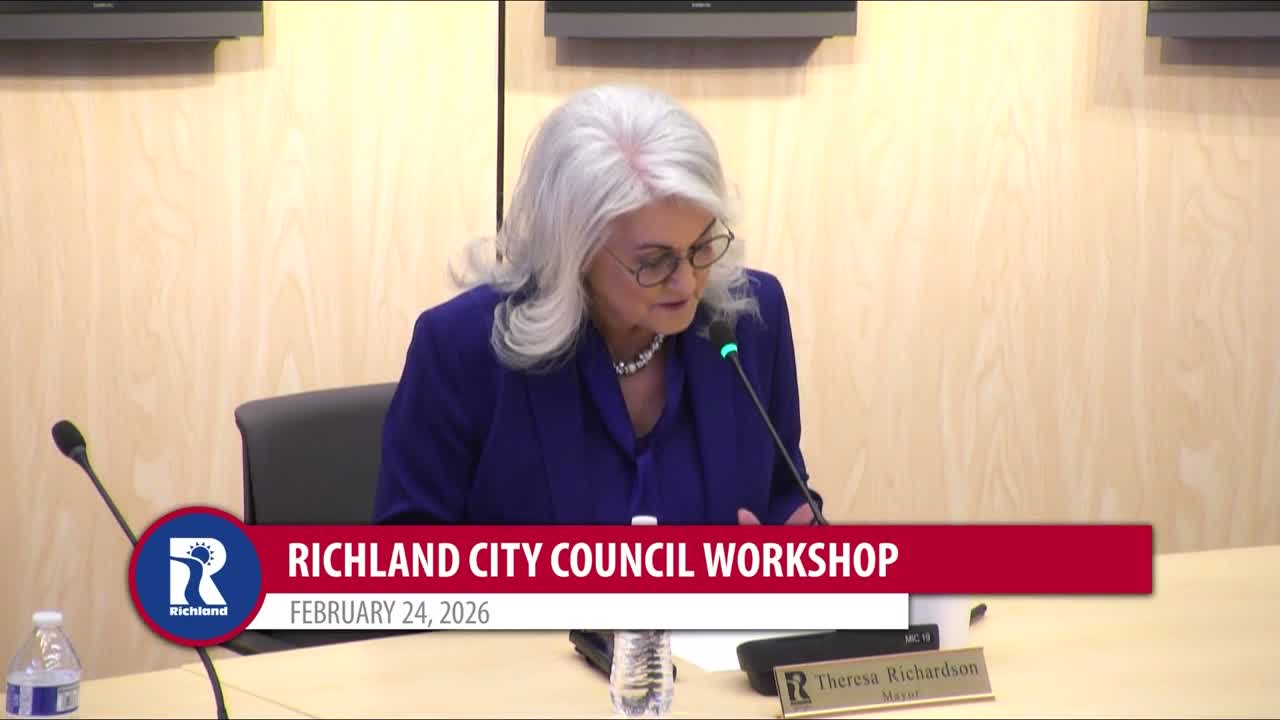
Mayor introduced a presentation by Drew Florence on automated traffic enforcement at the Feb. 24 Richland City Council workshop. Florence described recent 2024 changes in state law that broaden municipal authority to use speed and red‑light cameras and framed the proposal as an initial, transparent review to gauge council interest.
Florence said the program’s goal would be to reduce speeding and crashes through the ‘‘three Es’’—enforcement, education and engineering—and cited results from other Washington cities to illustrate expected effects. He said Kirkland saw roughly a 47% reduction in speeding at school camera locations and that Seattle’s violations fell from about 45,000 to 20,000 after camera deployment. Florence added that many drivers who receive a single automated citation do not repeat the behavior.
The presenter reviewed where the state allows cameras—school speed zones, school walk zones (defined as roughly a one‑mile radius from schools), park and hospital zones, roadway work zones and some state highways—and said there is no cap on cameras placed in those authorized areas. He noted that outside those categories a city may place one camera plus one additional camera per 10,000 residents, after conducting site analysis.
Florence described how the systems work: an initial image of the vehicle, a close‑up of the plate and a short video clip (about 12 seconds) are created; each event is reviewed by a trained city staff member; the registered owner is mailed a notice of infraction within 14 days and may either pay or contest. He said infractions are treated like civil parking citations (not reported to a driver’s record) and, to his knowledge, are not reported to insurers.
On revenue and equity, Florence said state law limits how cities may use program funds: revenue may cover installation, operation and administration of the camera program and traffic‑safety projects, with an emphasis on projects benefiting low‑income census tracts or areas with above‑average injury crashes. He noted that current law requires 25% of net noninterest revenue to be forwarded to the Cooper Jones active transportation safety account after four years; a bill under consideration in the legislature would change that to 10% of gross receipts, which would alter how much a city can retain.
Council members asked detailed operational questions. They were told thresholds for citations (for example, how many miles per hour over the limit triggers a ticket) would be set in each camera’s configuration in advance, and that the maximum fine under current law cannot exceed $145 (which can be doubled in a school zone if the city elects to do so). Florence also pointed to statutory privacy limits: cameras may capture only the vehicle and license plate during the infraction, not the driver; images and identifying data are exempt from general public disclosure and are retained only as necessary for enforcement. He said data would be owned by the city and hosted in U.S. data centers with geographic redundancy and that vendors told staff they do not use images for other purposes, but he said he would verify that commitment and seek contract language to lock it down.
Privacy and vendor access were recurring council concerns. One council member urged ‘‘zero‑knowledge’’ hosting so vendors could host data without access, and another warned against expanding cameras broadly without strict contractual controls. Florence acknowledged those concerns, said staff do not intend live streaming for law‑enforcement centers at this time, and committed to confirming technical and contractual restrictions with prospective vendors.
On next steps, Florence said staff would conduct the required equity analysis, refine maps and crash/speed data for potential camera sites, and draft an ordinance containing the state‑required elements (signage and a 30‑day warning period, an annual public report of infractions and crashes at camera sites, and the equity analysis). Council members signaled support for a cautious, phased approach—prioritizing school and high‑crash locations and using mobile cameras where appropriate—while asking staff to return with specific site analyses, draft contract terms and clarified revenue projections.
The presentation closed with staff noting that vendor compensation cannot be tied to the amount of revenue or fines generated; compensation must be limited to equipment and services. The council did not take a formal vote during the workshop; staff will prepare ordinance language and analysis for future consideration.