Get Full Government Meeting Transcripts, Videos, & Alerts Forever!
Get email alerts on the Land Use topic
No spam. Unsubscribe anytime.
Richland council adopts six-month moratorium on siting secure community transition facilities while region studies rules
Summary
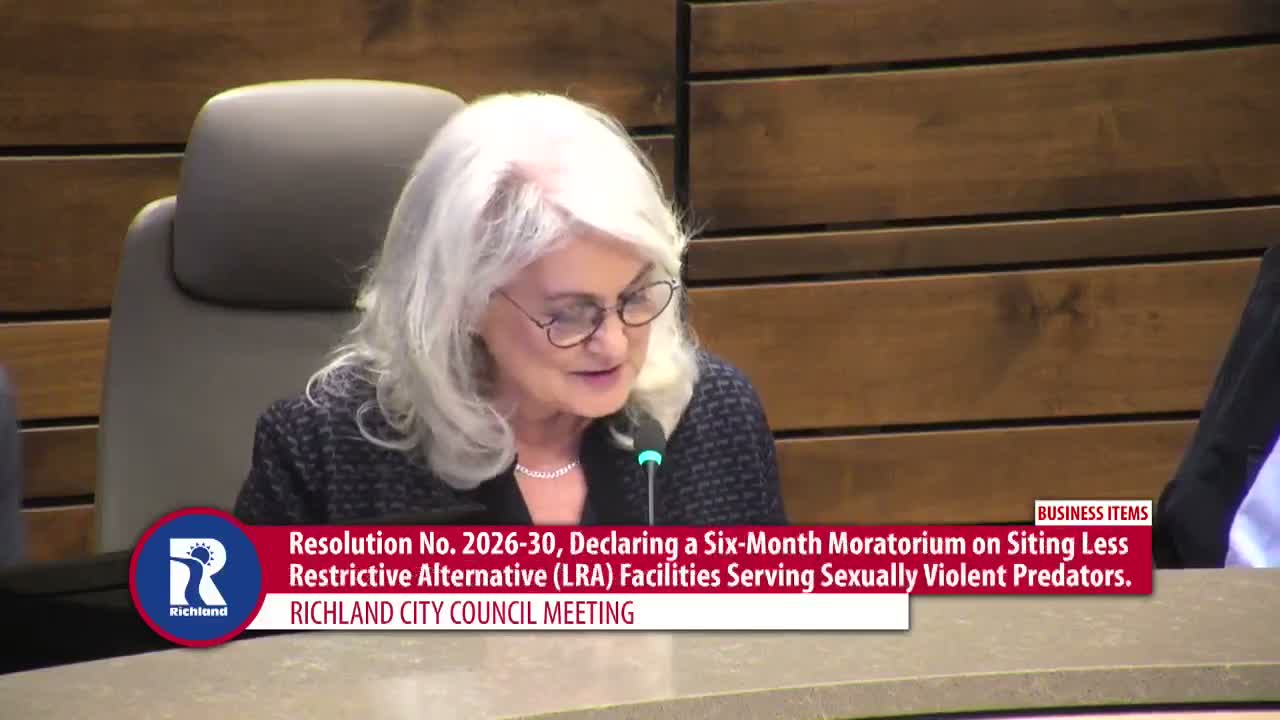
By a unanimous voice vote, the Richland City Council adopted Resolution 2026-30 declaring a six-month moratorium on siting secure community transition facilities (a type of less restrictive alternative for individuals in civil commitment) to allow regional coordination and local code review; a public hearing is set for April 7.
The Richland City Council on March 3 adopted a six-month moratorium, Resolution 2026-30, halting new local approvals for secure community transition facilities—residential, supervised placements for people conditionally released from secure confinement—so the city and region can study siting standards and engagement procedures.
Deputy city manager Shishel described the state legal framework under the Growth Management Act and the Washington Administrative Code, noting that essential public facilities (including secure community transition facilities) must be accommodated but that cities may adopt reasonable siting standards that do not amount to preclusion. He said the moratorium would allow time for a regional conversation about whether additional local regulation is warranted.
"This is a proactive conversation," Shishel told the council, explaining there are no pending applications in Richland and the pause would create time for public engagement and regional coordination. He defined secure community transition facilities as residential settings with supervision and security that serve people civilly committed and conditionally released to a less restrictive alternative.
Council member Meyer said she supported the moratorium while acknowledging the need for transitional housing and treatment pathways, calling the Kennewick rollout "utterly mishandled, in my opinion," and urging more engagement with state agencies. City manager Amundson said Kennewick and other local governments have begun exploring coordination but that no formal regional dialogue with state agencies had concluded.
Mayor Richardson moved to adopt the resolution; Council approved it by voice vote with no recorded opposition. The resolution schedules a public hearing in council chambers on April 7 at 7 p.m. and directs staff to study potential local code changes and regional approaches.
Next steps: staff will return with options and public hearing input after the moratorium period to determine whether amendments to the municipal code or other measures are needed.