Get Full Government Meeting Transcripts, Videos, & Alerts Forever!
Get email alerts on the Homekey Reconsideration topic
No spam. Unsubscribe anytime.
Residents, service providers urge Riverside council to reconsider rejection of $20M Homekey award
Summary
Scores of residents, social-service providers and faith leaders urged Riverside City Council on Feb. 3 to reverse its January decision and accept a state Homekey award to convert the Quality Inn into 114 permanent supportive units, arguing Housing First is evidence-based, protects vulnerable residents and avoids loss of state funding.
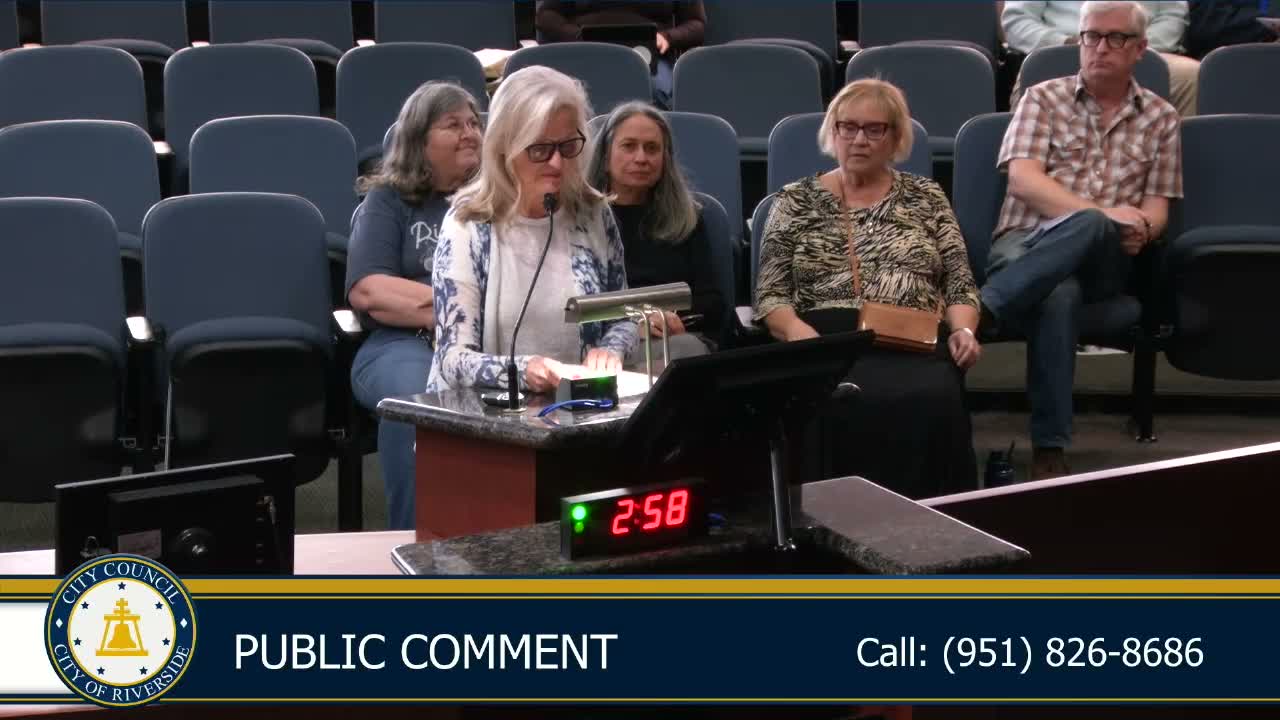
Dozens of Riverside residents, providers and faith leaders urged the City Council on Feb. 3 to reconsider the council’s recent rejection of a state Homekey award for a 114-unit permanent supportive housing conversion at the Quality Inn (referred to in public comments as University Terrace).
Speakers repeatedly told the council that the state awarded about $20 million for the conversion and that the proposal prioritizes seniors, veterans and people with mobility disabilities. Christine Martin, a member of the public, told the council that Housing First is supported by research and argued the project would house “114 people currently unhoused in our city” and save the city an estimated “between $6 and $11,000,000 each year” in emergency and social-service costs, as presented to the council.
Service providers and housing operators described the program model and on-site supports. Jasmine Sajady, a licensed clinical social-worker at Path of Life, said the project would require legally binding leases, case management and on-site staff to de-escalate incidents and that “accountability and structure are built into this project.” Jennifer Gonzalez, senior housing manager at Path of Life Ministries, said case management is required and that supportive housing is “housing first, but it is not housing only.” Representatives from US Vets Inland Empire described veteran-focused programs that would operate with the housing.
Other speakers raised legal and procedural concerns about the council’s prior vote. Bruce Culpa argued the city’s earlier predevelopment funding and prior approvals created reliance and that rejecting a compliant, state-approved project raises fair-housing and discrimination risks. Councilmember Clarissa Cervantes (speaking during council communications) said the city and the Riverside Housing Development Corporation were the grantee organizations and noted the ACLU of Southern California had urged reconsideration and said its partner organizations were investigating the council vote’s impacts on the city’s housing-element commitments.
Not all public speakers used identical figures; multiple commenters repeated that the award was roughly $20 million ($20,000,000 or $20,100,000 appears in the public record and in callers’ remarks). No final reconsideration vote took place during the Feb. 3 meeting. Councilmember Cervantes noted a Feb. 10 meeting had been scheduled and said council members have another week in which a motion for reconsideration could be made under current council rules.
The public comment period included extensive first-hand testimony from people who have experienced homelessness and from local nonprofit providers, who framed refusal to accept the state funding as a missed opportunity to house vulnerable residents and to preserve state trust and future funding. Several speakers asked the council to prioritize residents over private interests and to use the state extension to reopen the project.
The council took no formal action on reconsideration during this session; the meeting record shows councilmembers recorded communications and provided scheduling information about when a motion could be made. The record of public comment and the ACLU’s letter were made part of the meeting record and may inform any subsequent motion or staff report.