Get Full Government Meeting Transcripts, Videos, & Alerts Forever!
Get email alerts on the Housing Mobile Home Rent topic
No spam. Unsubscribe anytime.
Santa Paula council directs city attorney to draft urgency ordinance limiting mobile‑home rent petitions
Summary
After residents described repeated, large rent‑increase petitions, the council asked the city attorney to draft an urgency ordinance limiting mobile‑home park rent‑adjustment applications to once per 12 months (with exceptions for unusual circumstances); the proposal will require a four‑fifths vote to adopt.
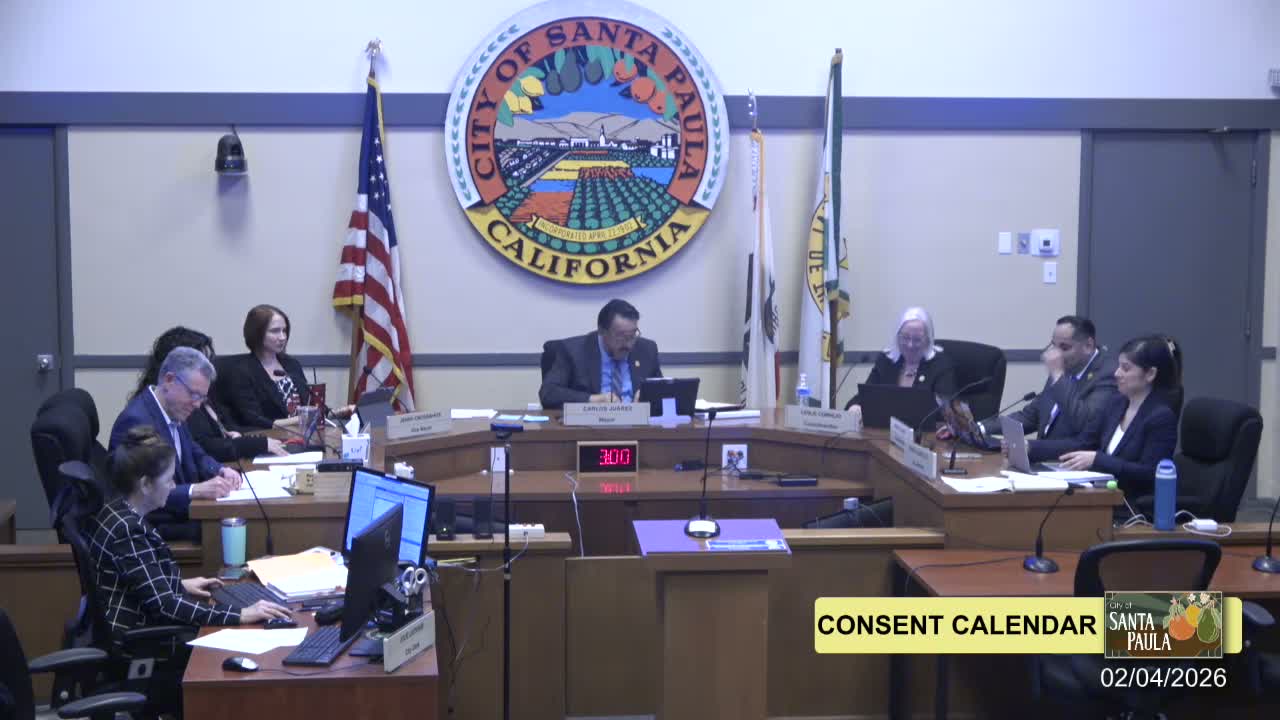
The Santa Paula City Council on Feb. 4 directed the city attorney to prepare an urgency ordinance that would limit the frequency of mobile‑home park rent‑adjustment applications and return the draft to council for consideration.
City Attorney Monica Castillo told council the ordinance under discussion would prohibit a park owner from filing for another rent increase within 12 months after a decision on the merits of a prior application "absent unusual circumstances," while preserving a property owner's right to obtain a constitutionally required “fair return.” Castillo said an urgency ordinance would take effect immediately but requires a four‑fifths vote to adopt.
The item drew lengthy public comment from mobile‑home residents and tenant advocates who said owners were exploiting a gap in the existing ordinance by submitting successive petitions after a denial. "I am not against the park owners, but against greedy landlords who will keep filing and filing," Tiffany Orr, vice president of the 400 Craig Drive Mobile Home Owners Association, told the council, describing two increase attempts earlier this year.
Advocates said the repeated filings impose financial and administrative burdens on residents and on city staff. "Families with children live there, as well as seniors who rely solely on social security," said Miley/Amalia Ochoa. Jennifer Hernandez, associate policy director at CAUSE, described past filings that sought increases of 45 percent and 47 percent and urged the council to act to avoid prolonged uncertainty for roughly 100 families in the community.
Gladys Valdovinos, president of the 400 Mobile Estates resident association, said the city spent significant staff hours processing multiple petitions: "Not only does that beat down the residents, but it diverts city time, staff, and resources that could otherwise be spent on…everyday residents."
Council members on both sides of the dais said they supported directing the city attorney to draft language for an urgency ordinance while recognizing legal limits. Council Member Pedro Chavez, who sponsored the referral through the housing and homelessness standing committee, told colleagues the committee made a unanimous recommendation to move forward. Vice Mayor Jenny Crosswhite and others said they wanted the city attorney to bring back a narrowly scoped, legally defensible ordinance.
The council did not adopt the ordinance at the meeting; instead members provided consensus direction for the city attorney to prepare the urgency ordinance and return it for formal consideration. If proposed as an urgency ordinance, Castillo said it would require four of five votes to pass.
Next steps: the city attorney will draft ordinance language and return it to council for formal action; council members indicated they expect that draft to reflect the 12‑month limit on subsequent applications after a merits decision, with explicit language for limited exceptions and staff‑cost provisions as appropriate.