
Residents and advocates urge council to fix open‑space and MMLOS gaps in growth‑management report
Get AI-powered insights, summaries, and transcripts
Sign Up Free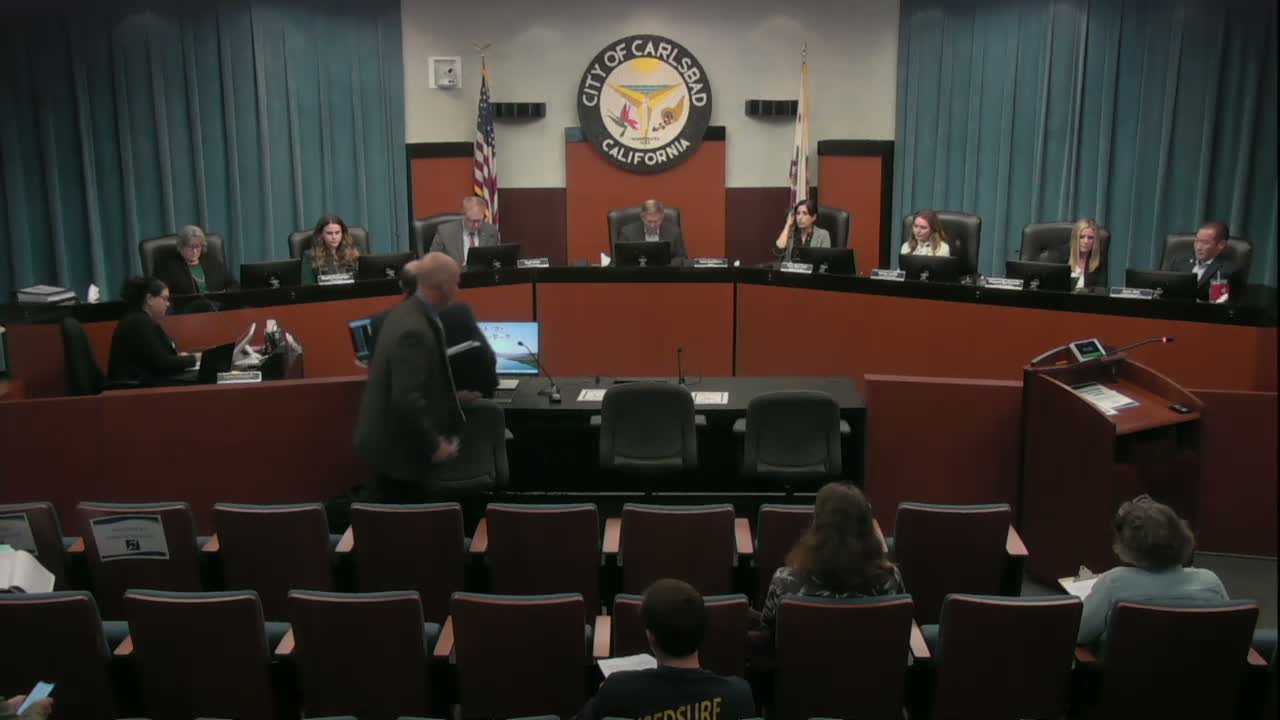
Summary
Public commenters and environmental groups told the Carlsbad City Council the annual growth‑management monitoring report omits open‑space calculations and fails to implement multimodal level‑of‑service (MMLOS) monitoring; staff said it will return by September with options after a recent favorable appellate decision. The council received and filed the report.
The Carlsbad City Council received and filed the city’s annual growth management program monitoring report after residents and land‑use advocates pressed elected officials to correct missing open‑space calculations and to resume vehicle‑level monitoring on critical streets.
City staff said the report — prepared under the municipal code to show whether public facilities are keeping pace with growth — shows current population numbers are at or below prior dwelling‑unit caps and that the city remains in compliance with the report’s public‑facility standards. Eric Lardy, an assistant director in community development, told the council the city intends to return by September with policy options related to multimodal level‑of‑service monitoring, assuming no new appellate developments affect available options.
But public speakers called attention to what they described as substantive gaps in the circulation and open‑space components of the report. Paige Desino, representing Preserve Calavera, said the monitoring report fails to show the criteria used to exempt 11 of 25 local facilities management zones from open‑space requirements and does not list the percent of open space in each zone. Desino asked the council to schedule workshops and include environmental commissioners in discussions about the Ponto area and other open‑space concerns.
Steve Linke of the Equitable Land Use Alliance assailed the report’s circulation component and the city’s MMLOS approach, saying the city’s system has not delivered enforceable mitigation and that a lack of quantitative, street‑segment vehicle‑level monitoring undermines safety and evacuation planning. Linke urged the council to reject the circulation component and set a date certain within six months to review MMLOS and related monitoring.
Lance Schulte, who has collected documentation on the Ponto area, asked council members to acknowledge prior directions from the council and more than 8,000 citizen emails arguing that usable open space promised for Ponto was converted to other uses; he asked the council to direct staff to work with residents to address the deficit.
In discussion, council members repeatedly noted the constraints imposed by recent state housing legislation. Lardy and Tom Frank, the city’s transportation director, said the MMLOS concept was an emerging idea when incorporated in the general plan and that staff and consultants have struggled to develop a workable methodology; staff said it will seek council guidance on whether to pursue MMLOS methodology work or potential amendments to the circulation element and growth management performance standards.
Councilmember comments acknowledged both the community concerns and the limits of local authority. Several council members encouraged state‑level advocacy to preserve local tools and impact fees used to fund parks, roads and public safety. The council then moved to receive and file the report as presented.
The council’s next step is for staff to return with policy options by September and, where appropriate, to coordinate additional workshops to engage residents and advisory commissions on open‑space and circulation monitoring changes.