Get Full Government Meeting Transcripts, Videos, & Alerts Forever!
Get email alerts on the Zoning Corridors topic
No spam. Unsubscribe anytime.
Ordinance committee advances Mass. Ave. zoning with amendments; Cambridge Street sent to council with no recommendation
Summary
After a staff presentation and two hours of public comment, the Cambridge Ordinance Committee voted to send the Massachusetts Avenue zoning petition to the full City Council with a favorable recommendation as amended and to move the Cambridge Street petition to council with no recommendation; staff were directed to draft clarifying ordinance edits and to revert hotel treatment to current zoning.
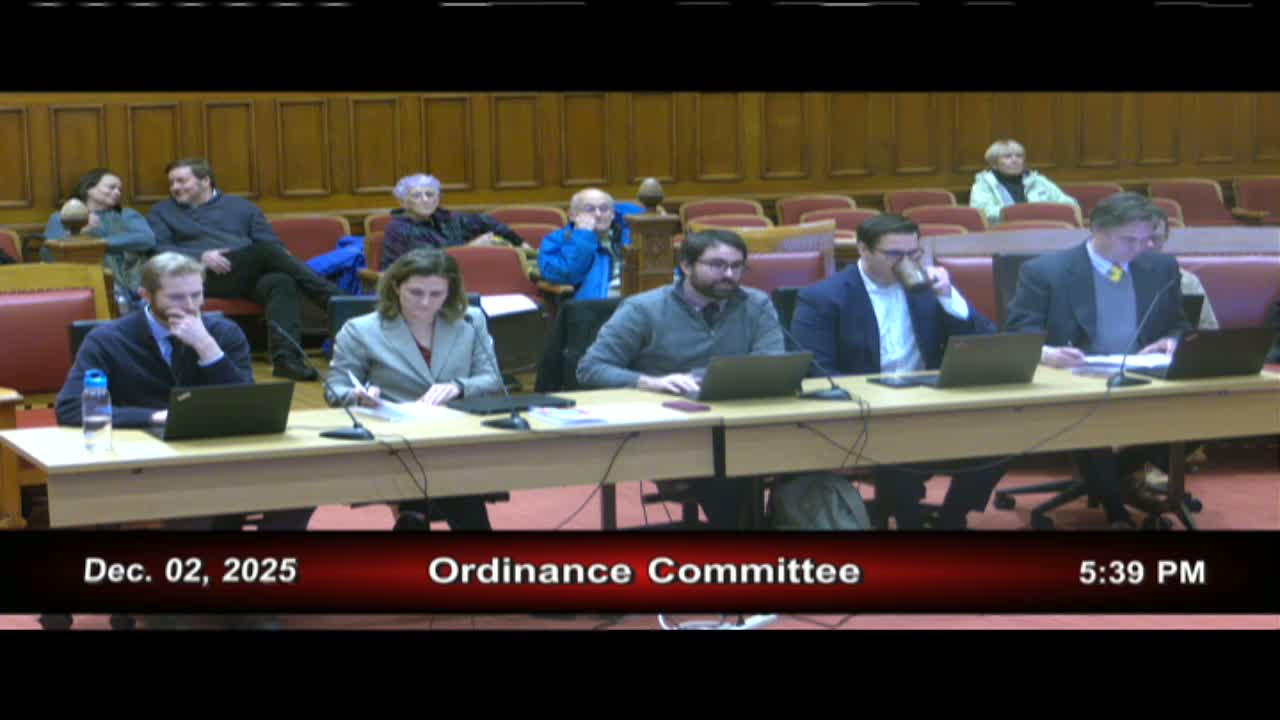
The Cambridge Ordinance Committee on a continuation meeting reviewed two corridor zoning petitions for Massachusetts Avenue and Cambridge Street and voted to move both to the full City Council while directing staff to draft clarifying amendments.
Vice Mayor McGovern, chairing the meeting, opened by reviewing the schedule: the council will consider the petitions on Dec. 8 with potential subsequent readings on Dec. 15 and Dec. 22, and the petitions expire on Jan. 28, 2026. Assistant City Manager Melissa Peters then introduced city staff leading the proposals, including Jeff Roberts (director of zoning and development), Evan Spetrini (senior zoning manager) and Daniel Mesplay (director of community planning and design). Peters said staff would present possible revisions based on prior hearings and public feedback.
Evan Spetrini summarized the two petitions. On Mass Ave the zoning as drafted would "allow up to 12 stories of housing throughout the corridor, 18 stories in Porter if the project includes public open space and preserves the square as a retail destination," he said. For Cambridge Street, Spetrini said the petition would "allow up to 8 stories of housing throughout the corridor" with targeted additional height in places such as Inman Square, Webster/Windsor and Lechmere, each subject to active ground-floor uses and open-space requirements.
Staff emphasized constraints on what could be changed without refiling: amendments that are more restrictive than existing zoning generally would require starting the petition process over. Nonetheless, Spetrini identified clarifications the council could adopt now, including requiring stronger active ground-floor uses south of Porter Square, adding clarifying text to require that "publicly beneficial" open space be physically accessible to the public, deleting obsolete BA5 district references, clarifying which office uses qualify as "active," excluding active-use gross floor area from the special-permit floor-area threshold when that exclusion would discourage active uses, and restoring unintended reductions in FAR and height for certain nonresidential and institutional uses.
The committee opened a lengthy public-comment period (the clerk managed a large speaker list and limited comments to two minutes each). Speakers voiced a broad range of views. Opponents of the proposed heights warned of threats to neighborhood character, trees and small businesses; Alan Spate told the committee he was "very surprised to see the amount of height that's being suggested for Inman Square" and called the proposal "a developer's agenda, not a people's agenda." Several speakers asked the council to let the petitions expire and return next year for more public engagement.
Supporters said the corridor approach would create more housing and customers for local retail. Itamar Turner, who lives near the corridor, said more residents would "make the shopping areas and ground retail just that much more vibrant." Business and nonprofit speakers urged protections for ground-floor retail and flagged possible losses to community-benefit funding if special-permit negotiations decline.
Councilors then questioned staff about PUDs (planned-unit developments), trade-offs in requiring active retail, infrastructure capacity and how the petitions interact with other housing programs such as the city’s Affordable Housing Overlay. Staff told the committee that a PUD for Inman would likely require consolidated ownership or parcel aggregation and a separate petition; they also said converting ground-floor retail to residential later is generally infeasible because of differing layouts and building systems.
On a series of procedural votes, the committee directed the city manager and Community Development Department to draft a package of clarifying amendments capturing the items staff described (vote recorded as 8 in favor, 1 absent). The committee also voted to revert how hotels are treated to their current, more mixed status in existing zoning rather than uniformly making hotels as-of-right across the corridors (motion passed, 7 yes, 1 no, 1 absent). Finally, the committee voted to send the Massachusetts Avenue petition to the full City Council with a favorable recommendation as amended (recorded as 6 yes, 2 no, 1 absent) and to move the Cambridge Street petition to the full council with no recommendation (7 yes, 1 no, 1 absent). The items will appear on the Dec. 8 council agenda; the petitions may be further amended at council hearings and do not expire until Jan. 28, 2026.
What happens next: staff will draft the clarifying ordinance language for the committee's consideration and the full City Council will take up both petitions on Dec. 8, allowing more opportunity for public comment and further amendments. The committee’s decisions preserve the option to refine either petition before final adoption.