Get Full Government Meeting Transcripts, Videos, & Alerts Forever!
Get email alerts on the Personnel Process topic
No spam. Unsubscribe anytime.
Public speakers and council demand answers after abrupt layoffs of commission staff
Summary
Public commenters and councilors criticized sudden layoffs of seven commission staff — including the Women's Commission — and the council adopted a late policy order asking the city manager for a written explanation of the process, timing and transition plans.
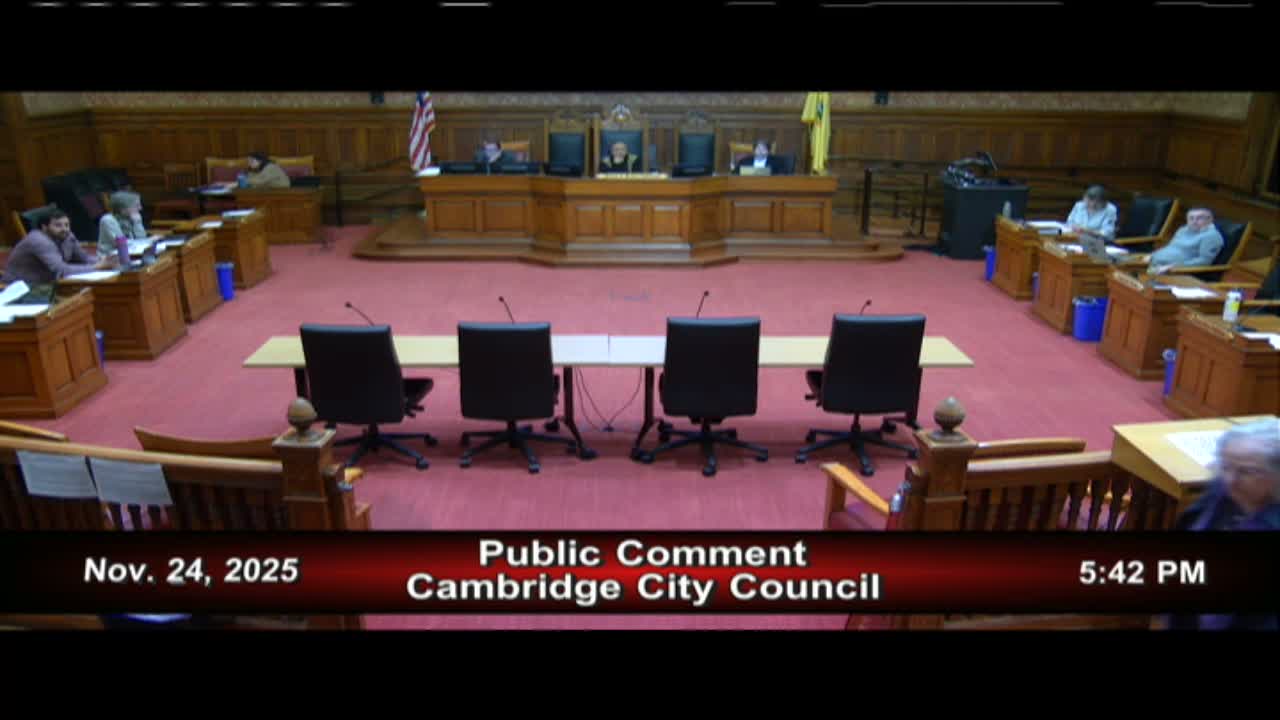
Public comment at the Nov. 20 Cambridge City Council meeting centered on sudden layoffs affecting multiple volunteer commissions, prompting councilors to press the city manager for written answers and to adopt a late policy order. Residents, former commission directors and commissioners described the dismissals as abrupt, harmful and inconsistent with the city’s ordinances.
The most immediate criticism came from Nancy Ryan, a long-serving former director of the Women’s Commission, who said the city manager “decided to, quote unquote, restructure several of the commissions” on Nov. 20 and that staff were told with no warning. Ryan said the city’s ordinance requires the manager to consult the commission before changing an executive-director position and asserted that the manager did not follow that process.
Why it matters: speakers said the layoffs remove staff who maintain institutional knowledge and daily services for survivors and other residents; commissioners and volunteers depend on that continuity to run programs and maintain public trust. Speakers warned the rapid, unexplained change has chilled staff and volunteer participation.
Several other commenters echoed Ryan. Caitlin Dubie, a commissioner on the Women’s Commission, cited Cambridge municipal code 2.88 0.05 and said eliminating the commission’s staff without the commission’s required advice contradicts both the “letter and the intent” of the ordinance. Mara Marie Horwitz, also a commission member, called the move a destruction of decades of institutional knowledge. Several speakers urged reinstatement at least long enough to complete transitions and avoid program disruption.
Council reaction was mixed but probing. Councilor Wilson and others supported putting a policy order on the table asking staff to produce a written explanation of the decision-making process, the timing and what steps will be taken to preserve program continuity. Councilors repeatedly noted that the city charter vests personnel authority in the city manager, but said that did not absolve the administration from explaining how the action was carried out and whether ordinances or commission roles were respected.
City staff response: City Manager Ian Wong and department leaders said the restructuring followed a multiyear review of overlap and administrative redundancies and was intended to create efficiencies and a clearer organizational structure. Chief people officers said many affected employees will receive pay and benefits through January, with health benefits extending into February, and described an attempt to provide a “soft landing” even as separations were executed promptly.
What the council did: the council adopted a late policy order (as amended) requesting written answers and additional information. The roll call on the amended motion was recorded as five in favor, three opposed and one absent; the council later moved related policy action and other agenda items as shown in the official record.
Details to watch: petitioners asked for (1) a clear timeline of who decided the reorganization, (2) confirmation whether the Women’s Commission and other ordinances were followed in appointing or consulting on executive-director roles, (3) whether affected employees were offered alternate roles, and (4) how key programs and upcoming events will be staffed during the transition. City staff agreed to return with written responses.