
Cook County finance committee approves nearly $20 million for food, rental assistance and homelessness programs
Get AI-powered insights, summaries, and transcripts
Sign Up Free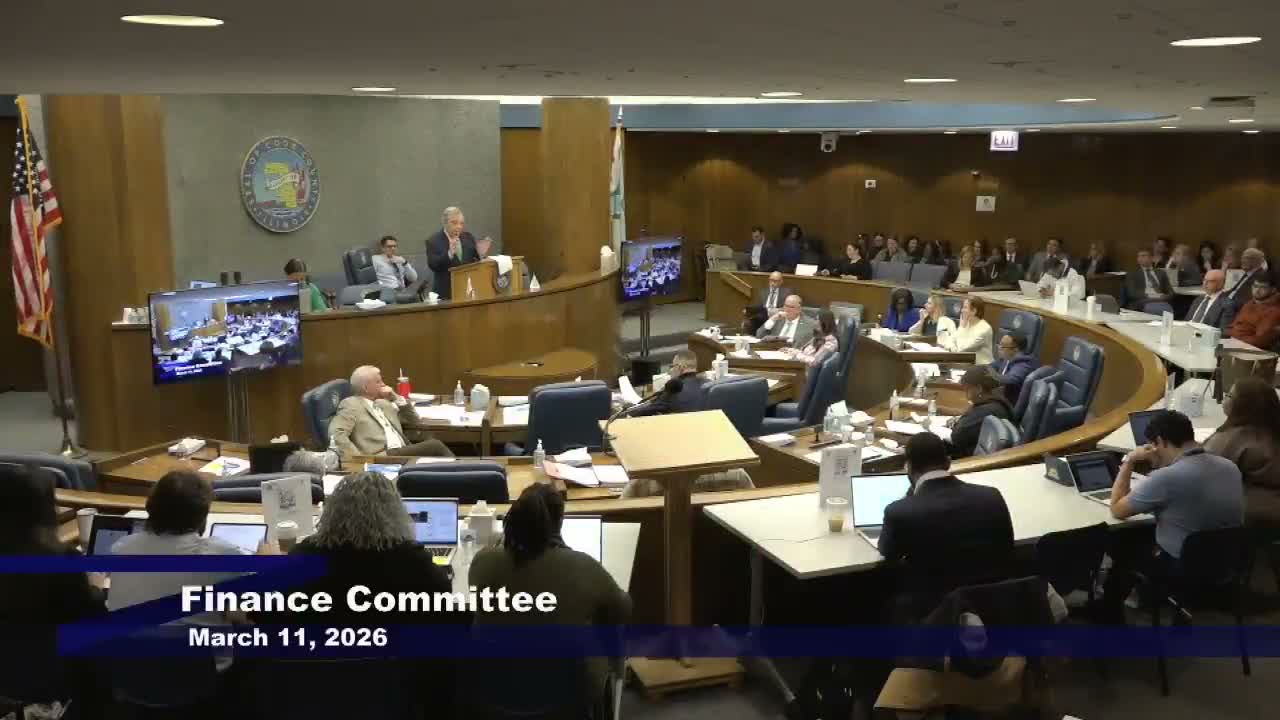
Summary
The Finance Committee approved a package of TIF and ARPA allocations totaling about $19.9 million to expand food distribution, extend court-based rental assistance, fund a homelessness problem-solving pool and sustain hotel-based sheltering. Commissioners cited looming SNAP rule changes as a primary driver.
The Finance Committee of the Cook County Board voted to approve a package of tax increment financing (TIF) and ARPA-funded allocations on March 11 that together direct nearly $20 million to food access, rental assistance and homelessness prevention programs.
The bundle included: a $10,000,000 allocation to the Greater Chicago Food Depository to expand emergency food and capacity-building grants; a $5,800,000 intergovernmental agreement with the Illinois Housing Development Authority to extend the court-based rental assistance program; a $3,400,000 problem-solving fund for homelessness prevention, shelter diversion and rapid resolution; and $688,700 to continue the county's hotel-based sheltering program. Commissioner Lowery moved the package and the clerk recorded the roll-call approval (15 ayes, 2 absent).
Why it matters: presenters and commissioners said federal changes to SNAP eligibility will reduce benefits for many residents this spring and summer, increasing reliance on food pantries and local safety-net programs. "We service about 268,000 households," said Jill Rockman, chief operating officer of the Greater Chicago Food Depository, describing the request as roughly $8 million for immediate food assistance and $2 million for capital and capacity building. Danielle Perry, vice president of policy at the food depository, warned that SNAP rule changes could remove benefits for people who do not meet new work-verification rules, producing a sharp near-term increase in need.
What supporters said: Rosie Sopka, deputy director at the Illinois Housing Development Authority, said the court-based rental assistance program has helped tens of thousands statewide and would exhaust current funding by early April without an infusion. "Payments are made to landlords in as few as 30 days from the date of application," she said, characterizing the program as an effective eviction-prevention intervention. Jennifer Hill of the Alliance to End Homelessness in suburban Cook County described the problem-solving fund as a flexible pool for prevention, diversion and rapid resolution to keep people stably housed.
Questions and clarifications: commissioners pressed staff and partners for details about how funds would be distributed across Chicago and suburban pantries, the breakdown of the $3.4 million problem-solving fund, and administrative overhead. Susan Campbell, director of the Cook County Department of Planning and Development, said the problem-solving fund includes about $700,000 for hotel shelter support and that the Alliance may subaward portions for shelter expenses; the Alliance indicated a target of roughly 10% for administration.
Funding source and legality: county staff and the chief financial officer said the money comes from declared TIF surplus and was allocated within the county budget process; Tony Anthony, chief financial officer, said the county identified approximately $19.9 million in TIF surplus that could be directed to these programs.
Votes at a glance: the bundle of items (26-0727, 26-0761, 26-0762 as amended in errata, and 26-0763) was approved by roll call 15–0 with 2 absent. An earlier motion to allow remote participation for some commissioners passed 14–0 with 3 absent.
Context and next steps: presenters said some program details (subaward budgets, exact subrecipient lists) remain to be finalized and that staff will return with implementing documents. Commissioners asked partners to share digital toolkits and volunteer portals to help residents meet new SNAP work-verification requirements. The Finance Committee adjourned after the vote.
Sources: statements and slide presentations by Jill Rockman and Danielle Perry (Greater Chicago Food Depository), Rosie Sopka (Illinois Housing Development Authority), Jennifer Hill (Alliance to End Homelessness in suburban Cook County), Susan Campbell (Cook County Department of Planning and Development), and county staff. The board approved the items by roll call vote.