Get Full Government Meeting Transcripts, Videos, & Alerts Forever!
Get email alerts on the Capital Improvement Plan topic
No spam. Unsubscribe anytime.
Visalia council reviews $237 million six-year capital plan, flags wastewater shortfalls and grant contingencies
Summary
City staff presented a proposed six-year Capital Improvement Plan totaling about $237 million and asked the council for feedback; staff warned several wastewater and sewer-related funds will not cover projected capital needs without advances and some airport and transit projects are contingent on grant awards.
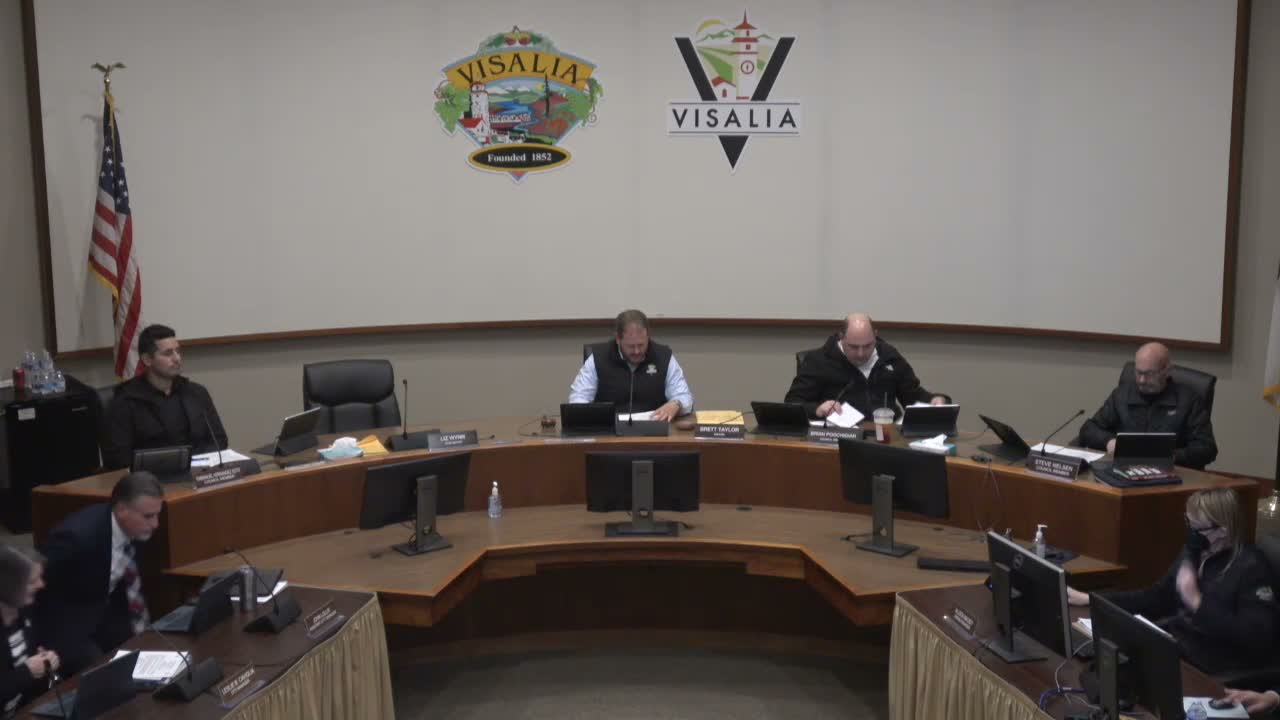
Visalia City Council met in a combined work session and regular meeting to review a proposed six-year Capital Improvement Plan (CIP) and receive public comment.
Nicole Richie, the city’s finance manager, told the council the full six-year plan totals about $237,000,000 and that staff are seeking council input now with adoption and appropriations scheduled in June. Richie said the presentation focused on the first two years (fiscal years 2026–27 and 2027–28) for which staff proposed appropriations while the remaining four years are for planning only.
The review highlighted several funds with near-term shortfalls. Staff reported the wastewater trunk line construction fund is restricted to new sanitary sewer trunk-line projects and is not projected to generate enough revenue to cover $21.7 million in six-year capital needs; the two-year capital request for that fund is $4.5 million and will require an advance from the wastewater facility fund. Staff also said the sewer connection fund — financed by treatment-plant connection fees and limited to treatment plant expansion — is projected to run a shortfall over six years and will also require an advance from wastewater reserves.
“We’ve updated the sewer master plan and we’re conducting a nexus study to review the fee structure,” a staff presenter said. Council members asked whether staff could estimate the customer impact of fee changes; staff replied they could not provide a number at this time and projected the study would take roughly 12 months to complete.
On the wastewater fund as a whole, staff outlined 49 proposed projects over six years totaling approximately $76 million, saying the majority of that total is directed to treatment-plant capacity expansion. Staff noted the city’s facility-replacement need across the wastewater system is about $315 million and emphasized that future fees and grant decisions will shape how much of the proposed work is funded.
Other enterprise funds drew council questions. The airport fund lists $9.2 million in projects over six years, with staff saying about $7.3 million of that would come from federal and state grants and that several near-term projects are contingent on grant awards and will not proceed absent funding. City Engineer Chris Crawford summarized the Cross Valley Express cost breakdown, describing a PA/ED (planning, environmental, design) phase and larger construction costs to follow.
Council members pressed staff on replacement-timing decisions for asset maintenance (for example, animal-services camera replacement and kennel-floor refinishing), with staff describing replacement schedules intended to avoid last-minute crises while acknowledging some items could be accelerated if failures occur.
Staff stressed that no formal action was required at the meeting and that the presentation was intended to gather council feedback; detailed funding and individual project appropriations will be returned to the council at future meetings in March and April before adoption in June.