Residents and groups push back as supervisors consider Mead Valley foundation change
Loading...
Summary
At a long public hearing, developer and staff urged initiation of a Mead Valley foundation general-plan amendment to allow mixed-use and light-industrial development; dozens of residents and environmental-justice advocates urged delay or denial, citing nearby schools, traffic, air pollution and lack of detail about a large industrial parcel.
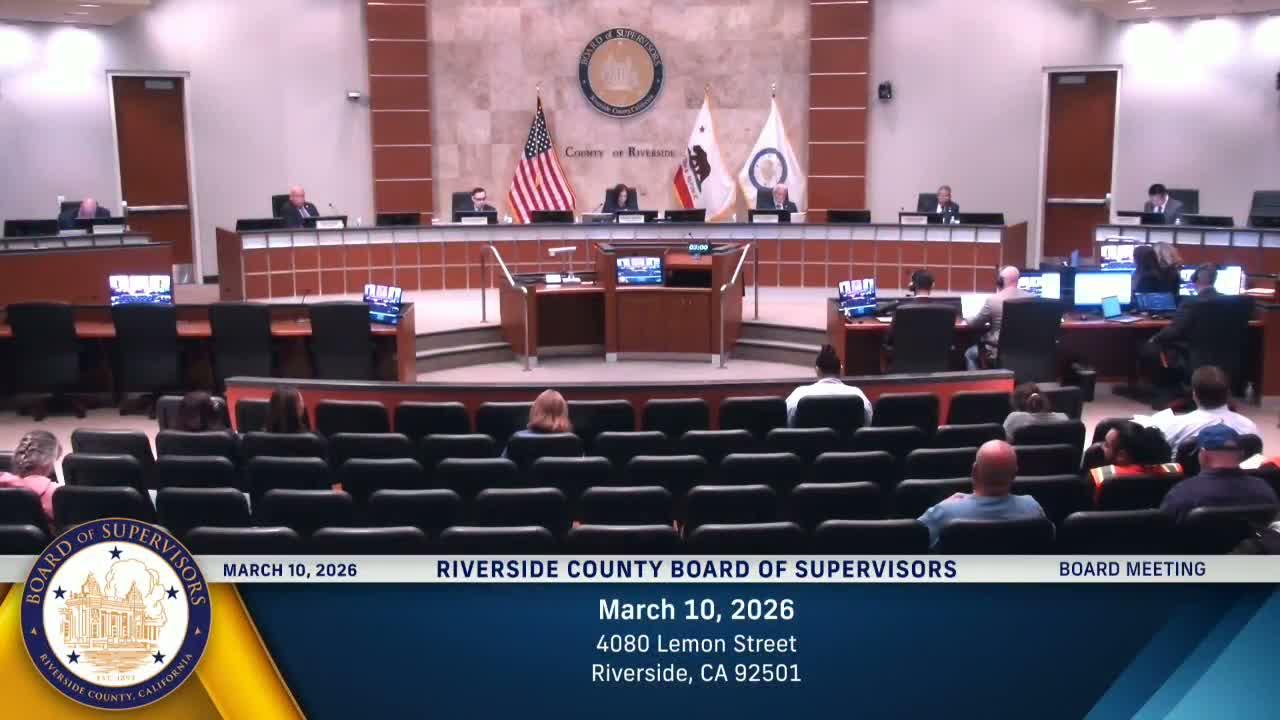
The Riverside County Board of Supervisors heard more than three hours of testimony on March 10 over a proposed foundation-component general-plan amendment covering roughly 668 acres in the Mead Valley area, a staff presentation and developer pitch followed by intensive public comment that split residents, labor and community groups.
Staff presenter Pye Van Nantungdansi told the board the request would change land-use designations from rural-residential and very-low-density residential to community development, mixed use, light industrial/business park and open-space conservation to allow a private sponsor to prepare an implementing project within a county-established timeline. Travis Duncan, who identified himself as lead developer at DECA, said the initiative would fund infrastructure, create retail and construction jobs and preserve about 200 acres as conservation land. "This is an opportunity to do two more years of outreach, environmental and technical studies," Duncan said, adding the sponsor expects commercial anchors such as a grocery store and intends to pursue community benefits and infrastructure contributions.
But the hearing drew sustained opposition. Multiple residents said a large western parcel that the developer has described as industrial would sit adjacent to homes and Columbia Elementary School. "We are an environmental-justice community," said Carla Cervantes of Inland Valley Alliance, adding that Mead Valley already carries a high concentration of warehouses and that residents had not been given sufficient detail about what would be built on the 350-plus–acre industrial parcel. Speakers with the Sierra Club, CCAG and other groups echoed concerns about air quality, truck traffic and the long-term decline of warehouse jobs as automation grows.
Local labor leaders and other speakers urged caution about categorically opposing development. David Cordero, representing the Western States Regional Council of Carpenters, said construction and tax revenue could help the area: "The creation of job opportunities for our members is very important," he said. Several residents said they supported new stores, medical services and road repairs but asked that industrial uses be located closer to existing logistics corridors and that any change come with a clear community-benefits agreement and infrastructure commitments.
Several speakers asked the board to continue the item to allow additional engagement with environmental-justice organizations and to demand specific commitments on truck routes, conservation boundaries, community investments and affordable housing. Opponents argued that treating the initiative as a 'foundation change' that must be followed by an implementing application in months would effectively pre-clear land for industrial development without adequate detail. "It is unacceptable to ask this board to approve a major amendment without clear details about what will ultimately be built on hundreds of acres," said Joaquin Castillejos of the Center for Community Action and Environmental Justice.
Board members acknowledged the breadth of community input. Supervisor Medina, whose district includes portions of Mead Valley, said he has been meeting more with residents and the MAC; he moved approval to initiate the foundation change while emphasizing the need for continued community engagement and oversight as the project advances. Several supervisors urged the developer and staff to work directly with residents to address infrastructure, truck routing and environmental-health concerns before an implementing project is submitted.
The transcript records the initiation motion and extensive debate and public comment; a formal project-level application and environmental review would follow. The board gave the item consideration and the record shows the motion to initiate was moved; the transcript does not contain a roll-call vote tally for the initiation within the provided excerpt. Next steps identified by staff included follow-up outreach, technical studies and a requirement that the applicant submit an implementing project within the time window the board sets for foundation changes.
What to watch next: whether the applicant submits a detailed implementing application, whether the board attaches specific public-benefit or truck-route conditions, and whether staff and community groups secure a negotiated community benefits agreement before project entitlements proceed.