Get Full Government Meeting Transcripts, Videos, & Alerts Forever!
Get email alerts on the Environment Water topic
No spam. Unsubscribe anytime.
Riverside County planning commission continues SkyBridge solar, hydrogen hearing after water and wildlife concerns
Summary
The Riverside County Planning Commission on March 4 voted 4-0 to continue the public hearing on the SkyBridge solar and green hydrogen project to May 6 after planning staff said late technical comments required additional review; residents and environmental groups urged a full environmental impact report and raised groundwater, wildlife and cumulative-impact concerns.
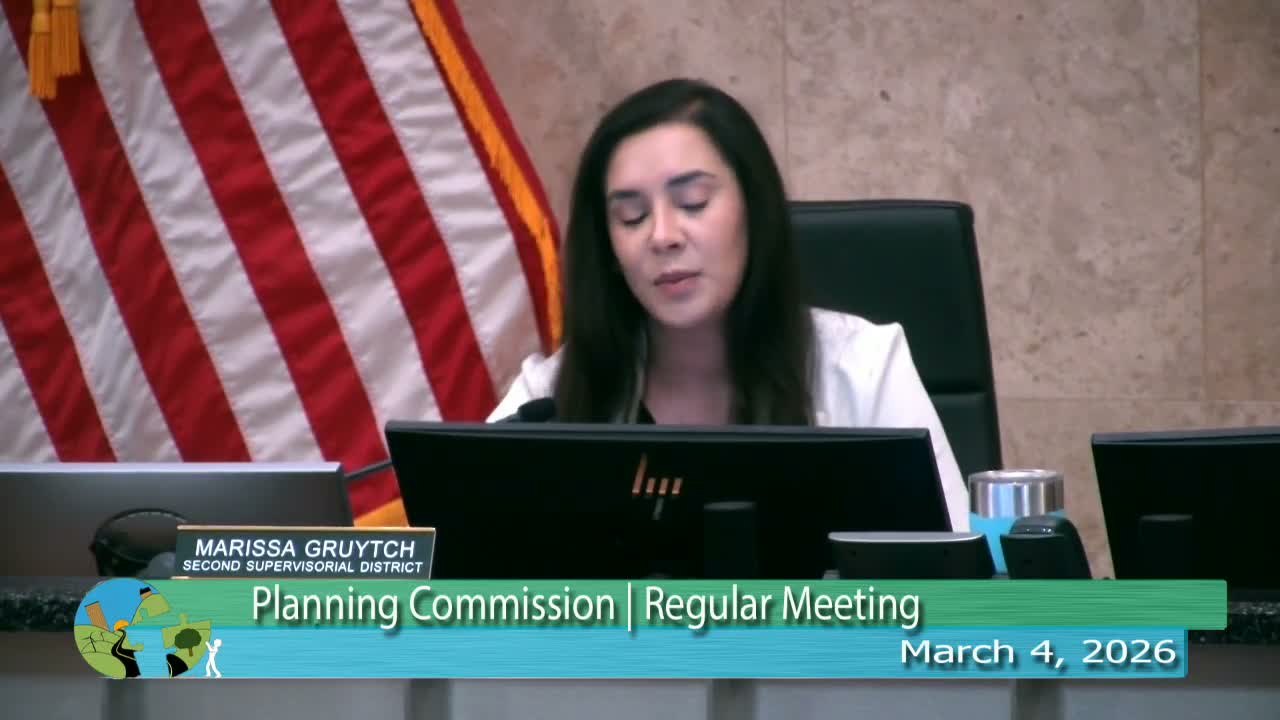
On March 4 the Riverside County Planning Commission voted to continue its public hearing on the SkyBridge solar project, which includes electrolyzing and green hydrogen production, to May 6 after county planning staff said late, technical public comments required additional review.
Sarah Moore, assistant planning director, asked the commission not to open the public hearing because the county and the applicant needed time to respond to new material and to coordinate further environmental review. A commissioner moved to continue the item to the May 6 hearing; the chair seconded and the continuance passed 4-0.
The continuance followed more than an hour of public comment in which residents, local farm operators and environmental groups urged further study and objected to approval on a mitigated negative declaration. "We don't think that a project of the size of the SkyBridge solar with the electrolyzing and green hydrogen can properly be approved based on a mitigated negative declaration," said Lisa Belenke, senior attorney with the Center for Biological Diversity, who highlighted the project's water use and potential cumulative impacts.
Representatives for community groups and local residents argued the project could significantly affect the Chuckwalla Valley groundwater basin. "An environmental impact report is absolutely necessary because we've already shown ... that there is a significant impact from groundwater extraction," said Mark Carrington of Active Communities of Desert Center, who said cumulative extraction from solar developments and the new project could dramatically lower the water table.
Other speakers raised related concerns. "This project is estimated to consume over 8,000,000 gallons of water per year," said Sandy Barrows of the Cactus to Cloud Institute, citing the project estimate listed in the agenda. Resident Michael Cook, manager at Chuckwalla Valley Raceway, told commissioners he had observed the local groundwater table fall by as much as one to two feet a year and said prior hydrology reports had not been filed.
Speakers also described ecological and community impacts they said were not adequately analyzed: changes to wildlife migration and bird collisions with panels, nighttime lighting and noise, possible microclimate effects on crops and plants, and psychological effects on nearby residents. "Before further expansion, there should be independent, long-term environmental and human health impact studies specific to the desert regions," Norma Ortiz said.
County staff and the commission did not make new findings on the merits of the project's environmental review at the March 4 meeting. Planning staff encouraged members of the public to submit written comments and to reserve oral comment for the reopened public hearing on May 6. The meeting concluded after a brief planning director's report and commissioner remarks.
The Planning Commission is scheduled to take up the continued hearing on May 6; planning staff will review the submitted comments and any supplemental materials filed by the applicant prior to that date.