Get AI Briefings, Transcripts & Alerts on Local & National Government Meetings — Forever.
City updates council on multiyear spaceport effort; staff says site control is critical path
Summary
City CIO Isaiah Kirk told the council the FAA 4-20 site-operator application is paused pending site control, the NEPA environmental assessment is underway, preferred Arizona State Trust land has been identified, and cross-border MOUs with Mexico are being drafted; staff reported roughly $500,000 spent to date.
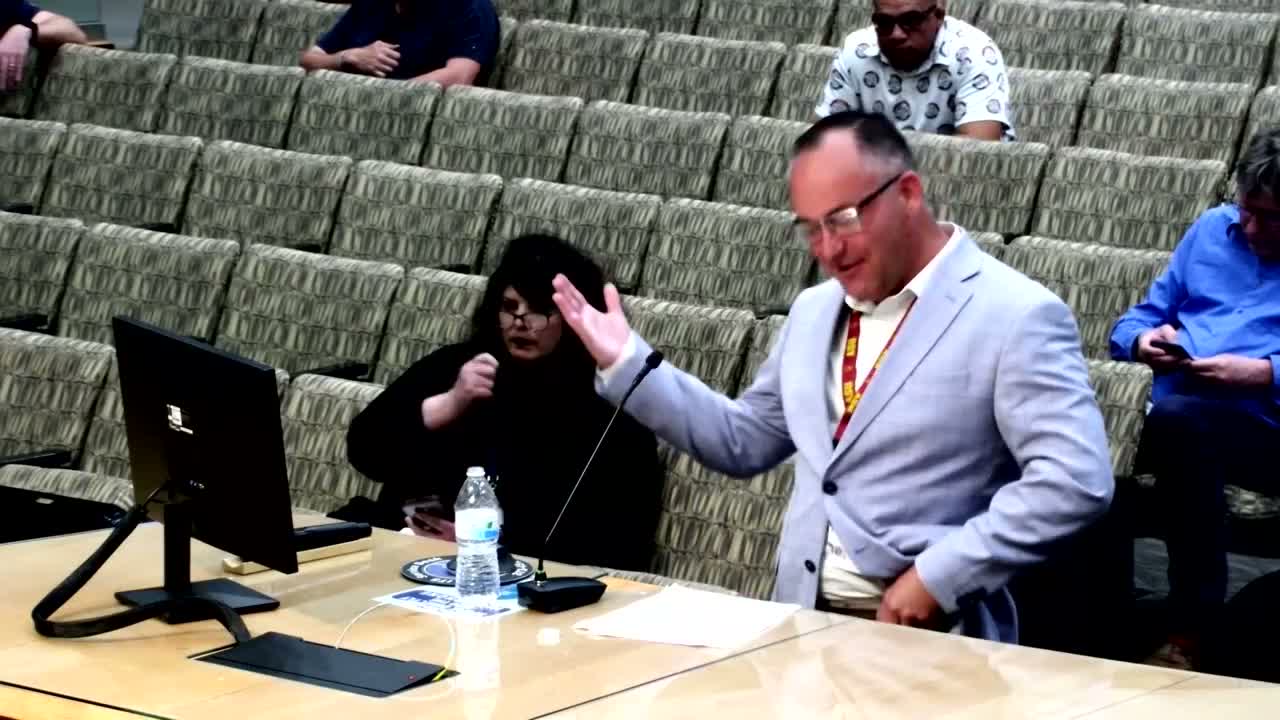
Isaiah Kirk, the city of Yuma’s chief information officer, told the City Council on March 4 that the city’s spaceport project remains a multiyear effort and that land control is now the program’s critical path. "The near term critical path is site control," Kirk said, urging the council that without site control the FAA licensing process cannot proceed.
Kirk summarized progress on the FAA application and parallel environmental work. The city's 4-20 site-operator application was returned by the Federal Aviation Administration because the initially proposed city parcels were judged "not ideal," he said. To avoid a licensing pause, the city has continued a NEPA environmental assessment (EA) for the site; chapters 1 and 2 of the EA are being finalized so the process can move quickly once site control is established.
Kirk said the team evaluated multiple site options — city parcels, Bureau of Reclamation lands (rejected because of wildlife and water constraints) and Arizona State Trust Land, the latter now the preferred target. He described a roughly one-square-mile preferred footprint that meets required standoff distances and can accommodate launch pads, fuel storage, payload processing and control areas.
Kirk outlined cross-border coordination steps for southerly trajectories and said the city has drafted memoranda of understanding with Mexican counterparts and is awaiting signatures. He also listed partners assisting outreach and industry engagement, including the Greater Yuma Area Development Corporation, Elevate Southwest and the Arizona Space Commission.
On cost and budget, Kirk said the city has spent "a little over $500,000 in the last 4 and a half years," mostly on consultants, filing fees and travel. He described a proposed near-term budget that mirrors current staffing and consulting needs: about $300,000 for FAA licensing, administration and public outreach, and roughly $500,000 in capital improvements program funds for engineering surveys, though he noted actual spending will depend on gating events such as land acquisition and EA requirements.
Council members sought more details on who would build and operate the site. Kirk said the city is pursuing public-private partnerships: the city would act as a land and license holder while private operators, holding FAA 4-50 launch licenses, would operate launch activities. He added that mission control does not necessarily need to be on-site, but launches do.
Council questions focused on timelines, economic-development roles, and community impacts. Staff emphasized that industry commitments are frequently verbal and companies typically will not finalize investments until a site-control and licensure path is secure. Kirk reiterated that the Arizona State Land acquisition process is lengthy (12 steps) and that the city is at an early step with a scope-of-work for cultural assessments under way.
What’s next: staff said they will continue parallel tracks — securing site control, advancing the EA with the FAA, negotiating cross-border protocols and pursuing tenant/outreach work with economic-development partners. The project remains contingent on federal approvals and the outcome of the state-land acquisition process.