Get Full Government Meeting Transcripts, Videos, & Alerts Forever!
Get email alerts on the Tourism Funding Accountability topic
No spam. Unsubscribe anytime.
Cambridge committee hears tourism office presentation as calls grow for funding changes and accountability
Summary
The Cambridge Office of Tourism presented data on campaigns, TDMD grants and visitor services while business leaders and councilors questioned transparency and urged Policy Order 1‑17 to change how municipal tourism funds are allocated. Councilors proposed advisory and follow‑up reviews rather than immediate budget reallocation.
Candace Bollier, executive director of the Cambridge Office of Tourism, told a City Council committee the office is a 30‑year public‑private destination marketing operation that uses a mix of municipal funds and Tourism Destination Marketing District (TDMD) assessments to promote Cambridge and support local events.
The presentation outlined COT’s mission, board governance and performance metrics and highlighted recent campaigns and grants. Bollier said a July–October Expedia campaign that cost $157,000 produced "9,742 room nights," yielding "over $3,000,000 in gross bookings," and told the committee the office has distributed about $670,000 in TDMD‑funded grants and sponsorships since the assessment started. "We are transparent in our reporting, data driven in our decisions," she said.
Why it matters: the hearing followed public comment from business leaders and association representatives who urged more accountability for how city and TDMD funds are used and pushed Policy Order 1‑17, which would change the city’s approach to funding destination and district marketing.
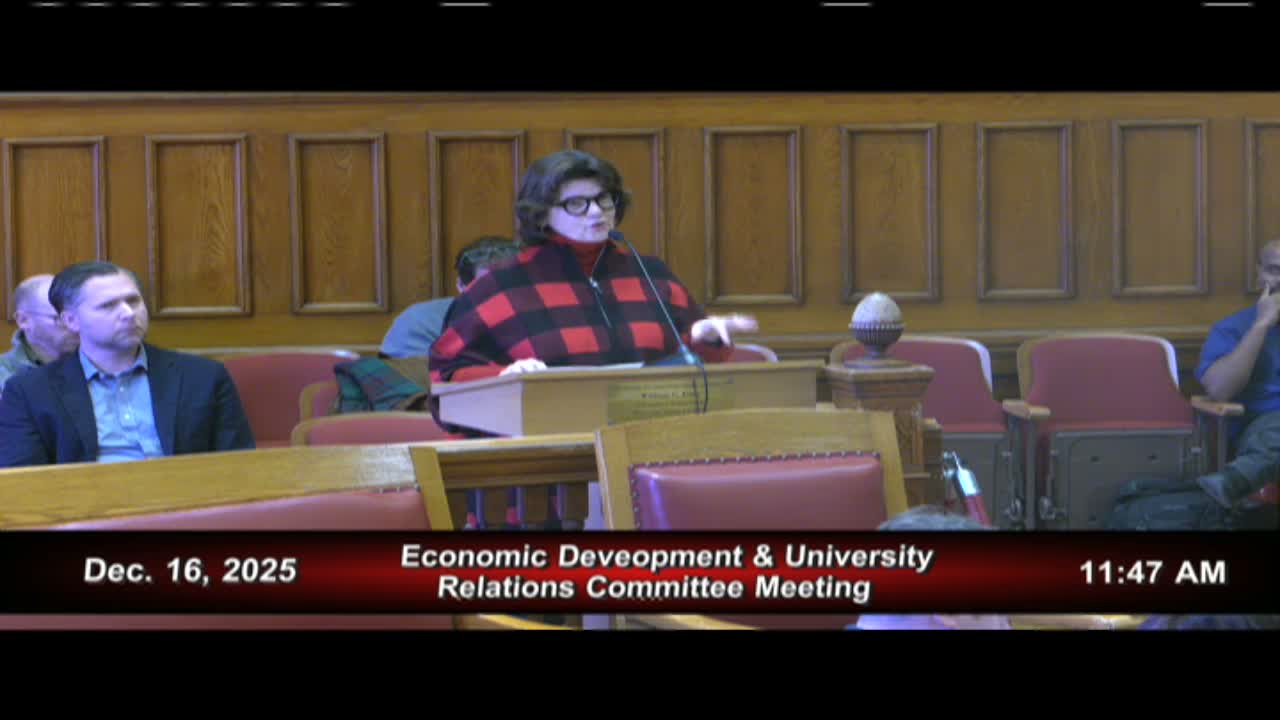
Denise Jillson, representing the Harvard Square Business Association, asked, "What exactly are we funding and why?" She argued COT operates structurally like a private 501(c)(6) and that, with TDMD providing a stable revenue stream targeted at destination marketing, municipal tax dollars should be redirected to neighborhood business associations that run street‑level events and activations. Jillson said the city has funded the office for nearly three decades with municipal appropriations totaling "exceeding 10,000,000 dollars" and voiced concern about kiosk programming that she said included artwork for sale and flyers promoting events outside Cambridge.
Business leaders echoed calls for clearer reporting and coordination. "If Cambridge office of tourism's work is scaled back, the Cambridge risks getting diluted just into being greater Boston instead of being seen as a distinct and compelling place to visit," said Adam Sperling, general manager of the Charles Hotel, who noted the hotel employs about 260 people who rely on visitor demand.
Legal and policy constraints: Councilors questioned whether city baseline funding could be reduced because TDMD funds now exist. Bollier and staff cited the TDMD legislation and the state review of relevant law, saying TDMD dollars are "supplemental" and that the legislature generally does not allow baseline municipal funding to be removed solely because a TDMD is in effect. A city staffer recommended further review by the law department to clarify options available to the council.
Kiosk operations and Culture House: Several councilors, including Mayor Simmons, raised concerns about programming in the renovated visitor kiosk, including items for sale and non‑Cambridge flyer postings. Assistant manager Peters (CDD) said Culture House was selected via an RFP as the operator, that the contract includes restrictions and that staff would follow up with Culture House and the project manager to address the raised concerns.
Council response and next steps: Rather than immediate budget reallocation, councilors and business leaders consistently called for strengthened collaboration. Multiple members suggested forming an advisory or working group to coordinate the Office of Tourism, business associations and city staff; Bollier said she plans to rebuild partnerships and provide further written data, including Placer.ai and other analytics, to business associations and council members. The committee received follow‑up requests for a written data package and a return visit from COT and Culture House.
Formal action: The committee approved a motion to suspend the rules to allow Jillson additional time to present her statement. The motion, "to suspend the rules to allow Miss Jillson time to read her statement to complete her statement," was moved by Councilor Toner and approved in roll call (five ayes). The meeting adjourned after a final roll call.
What’s next: Staff offered to have the law department clarify statutory constraints on reallocating baseline city funding; members requested continued briefings, a possible advisory group, and written follow‑up materials from COT and Culture House to resolve questions about kiosk operations and spending oversight.