Get Full Government Meeting Transcripts, Videos, & Alerts Forever!
Get email alerts on the Automated Traffic Enforcement topic
No spam. Unsubscribe anytime.
Meriden public safety committee adopts ordinance authorizing speed‑camera program
Summary
The Meriden Public Safety Committee voted Jan. 22 to adopt an ordinance enabling automated traffic enforcement safety devices (speed cameras). Officials said cameras aim to reduce speeding and pedestrian injuries, but emphasized vendor oversight, required supervisory staffing, data limits and equity safeguards.
The Meriden Public Safety Committee voted Jan. 22 to adopt an ordinance authorizing automated traffic enforcement safety devices (ATESDs), a program the police chief said is intended to curb speeding and reduce serious crashes, particularly involving pedestrians.
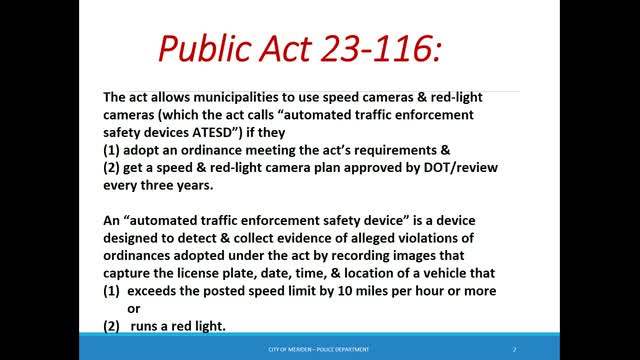
Chief of Police Rob Rosato said the program would follow Public Act 23116 and require a data‑driven plan submitted to the Connecticut Department of Transportation for approval. "The goal is basically it's not to issue out tickets. That's not the goal. It's not to collect revenue, but it's to improve driver behavior and reduce serious crashes, injuries, and fatalities," Rosato said during the committee meeting.
The ordinance, as discussed, requires the city to maintain a fully funded supervisory position to oversee the program and related reporting. City Attorney Emily Holland told the committee that state law limits how long personally identifiable information may be retained and restricts uses of any fine revenue. "No personally identifiable information shall be stored or retained by the municipality or a vendor unless such information is necessary for the charging, collection, and enforcement of the fines," Holland said.
Committee members asked how the system would operate in practice. Rosato said vendors typically perform site studies and handle installation and maintenance; vendors also often issue the infractions after city review. "The vendors basically come out. They set it all up for you at no cost. They manage the cameras. If it breaks, they come out and fix it," Rosato said. The chief noted some vendor reports show large declines in violations — he cited roughly an "80% decrease" observed in other communities, and said that effect should be interpreted in light of motorists avoiding camera locations.
City Manager Brian Daniels and the city attorney emphasized that adopting the ordinance is only the first step: the city must prepare a three‑year plan for DOT review, and the plan may be revised. The ordinance includes a 30‑day warning period before fines are issued and sets the first fine at up to $50 and the second at $75, subject to vendor administrative fees. Rosato said the city would review each alleged violation before an infraction is issued; the vendor typically mails the citation once the municipality signs off.
Several committee members raised budget and staffing questions. Councilor Zachary said the ordinance closely tracks the state statute and that the committee is beginning with the ordinance only. "If we funded a six‑man traffic unit, the chief would be happy as could be, but we don't have that funding," Zachary said, adding that the supervisory role could be staffed by a sworn officer or a civilian depending on operational needs. Rosato said he plans to budget for a dedicated position in the next fiscal year but could phase hiring depending on study results.
Public input at the hearing reflected both support and concerns. Several residents told the committee that cameras have slowed traffic in nearby towns and urged adoption; some local businesses warned that camera locations can depress patronage and asked how tickets issued to registered owners would be handled when loaner or rental vehicles are involved.
The committee adopted the ordinance by voice vote; the chair called for ayes and the motion carried with no recorded opposition during the committee meeting. The ordinance and any subsequent plan will require follow‑up steps, including a vendor study, a DOT review of proposed camera locations and periodic reporting to the city. Officials said they expect vendor studies and procurement to take months and estimated a 9–12 month timeframe to have devices operational if the program moves forward.
Officials emphasized the life‑safety purpose of the effort. "The ultimate goal is life safety," the city manager said during discussion. The committee also directed staff to proceed with the required planning and public outreach steps before final implementation.