Lifetime Citizen Portal Access — AI Briefings, Alerts & Unlimited Follows
Planning Commission backs interim SB 79 exclusions, narrows scope and ties sunset to local alternative plan
Loading...
Summary
The Oakland Planning Commission voted unanimously to recommend council adopt interim zoning-map exclusions from Senate Bill 79 standards, but amended staff proposals to remove three higher-resource station areas from one exclusion and to sunset exclusions upon adoption of a city alternative plan or the housing-element deadline.
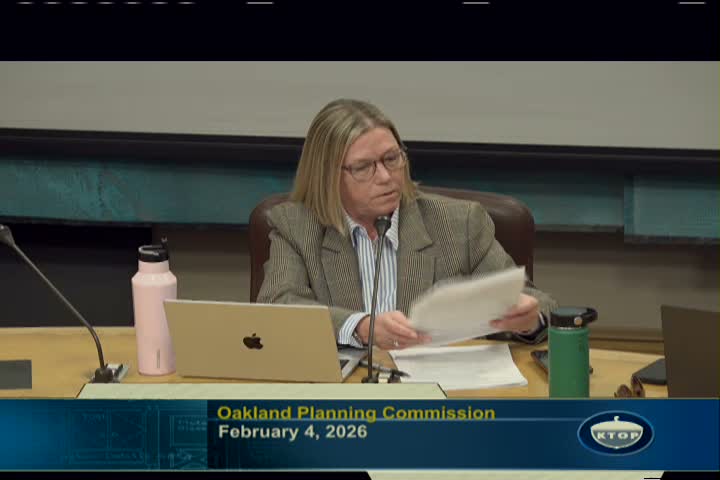
The Oakland Planning Commission on Feb. 4 recommended that the City Council adopt planning code and map amendments that would temporarily exclude many parcels from the new Senate Bill 79 transit-oriented development (TOD) heights and density standards — but the commission narrowed the proposed exclusions and added a clear sunset tied to a local alternative plan.
Laura Kaminski, the city's strategic planning manager, told commissioners the state law (SB 79) takes effect July 1 and would allow higher heights and densities near transit; the staff proposal would create an S-8 combining zone to map which parcels are eligible, ineligible, or excluded and to give staff time to craft a locally tailored alternative plan as part of the general plan update. "My name is Laura Kaminski, strategic planning manager for the City of Oakland, and I'm going to be presenting on ... Senate Bill 79," she said during the presentation.
Why it matters: SB 79 grants cities options to adopt targeted exclusions or an alternative plan that meets the law's aggregate capacity requirement. Oakland staff argued exclusions are a short-term, practical step so the city can complete a more fine-grained alternative plan during its general plan update, allowing community input on where upzoning should occur. Opponents warned broad exclusions could undermine the law's goal of producing housing near transit.
Public comment illustrated the split. Raul Maldonado of East Bay YIMBY urged the commission to "lean into supporting SB 79," while Ally Sacerman of the Housing Action Coalition warned that broad exclusions and long delays "risk turning the housing law into something that exists mostly on paper." Naomi Schiff of the Oakland Heritage Alliance urged creative reuse of existing buildings. Aaron Eckhouse of California YIMBY asked the commission not to adopt the 50% exclusion for certain corridors.
Deliberations focused on three statutorily authorized exclusions staff recommended: (1) parcels whose existing zoning already allows at least 50% of SB 79 density/FAR thresholds; (2) TOD zones in "low resource" areas that meet a 40% aggregate density threshold; and (3) locally registered historic resources. Multiple commissioners, including Vice Chair Natalie Sandoval and Commissioner Alex Randolph, expressed concern about applying exclusion 1 to higher-resource corridors such as Rockridge, MacArthur and Ashby.
After extended discussion and legal clarification by City Attorney Mike Ransom and deputy director Ed Manasseh about review timelines and state review (HCD path), the commission voted to forward staff's recommendation to council with three targeted edits: remove maps 1–3 from Attachment D (i.e., exclude Ashby, MacArthur and Rockridge BART half-mile areas from exclusion 1), amend the planning-code language so the exclusions expire upon adoption of a qualifying local transit-oriented development alternative plan (or upon the housing-element trigger / 01/31/2032, whichever occurs first), and request that the City Administrator present an alternative plan within a year of adoption of the land-use and transportation element.
The vote: The motion to forward the recommendation with the changes carried unanimously on a roll-call vote.
What happens next: The Planning Commission's amended recommendation will go to the City Council for consideration; staff said they plan to develop the alternative plan as part of the general plan update (phase 2), with outreach and refinements to the zoning and map designations.
Context and limits: Staff noted SB 79 itself contains affordability, demolition-replacement and labor-related provisions that would apply only to projects using SB 79 standards; staff also pointed out that Oakland's existing impact-fee and inclusion tools apply for non-SB79 projects. The commission's recommendation does not itself adopt new zoning; it forwards a proposal to council that includes CEQA findings and the mapping and code language to implement the interim exclusions and the S-8 combining zone.