Lifetime Citizen Portal Access — AI Briefings, Alerts & Unlimited Follows
Del Valle ISD presents special-education review, highlights rising enrollment, grants and cleared corrective actions
Loading...
Summary
Del Valle ISD officials told the board their special-education program has grown and received new grants, reported that the district was cleared of corrective actions in November 2025, and outlined steps to improve inclusion and reduce disciplinary removals for students with disabilities.
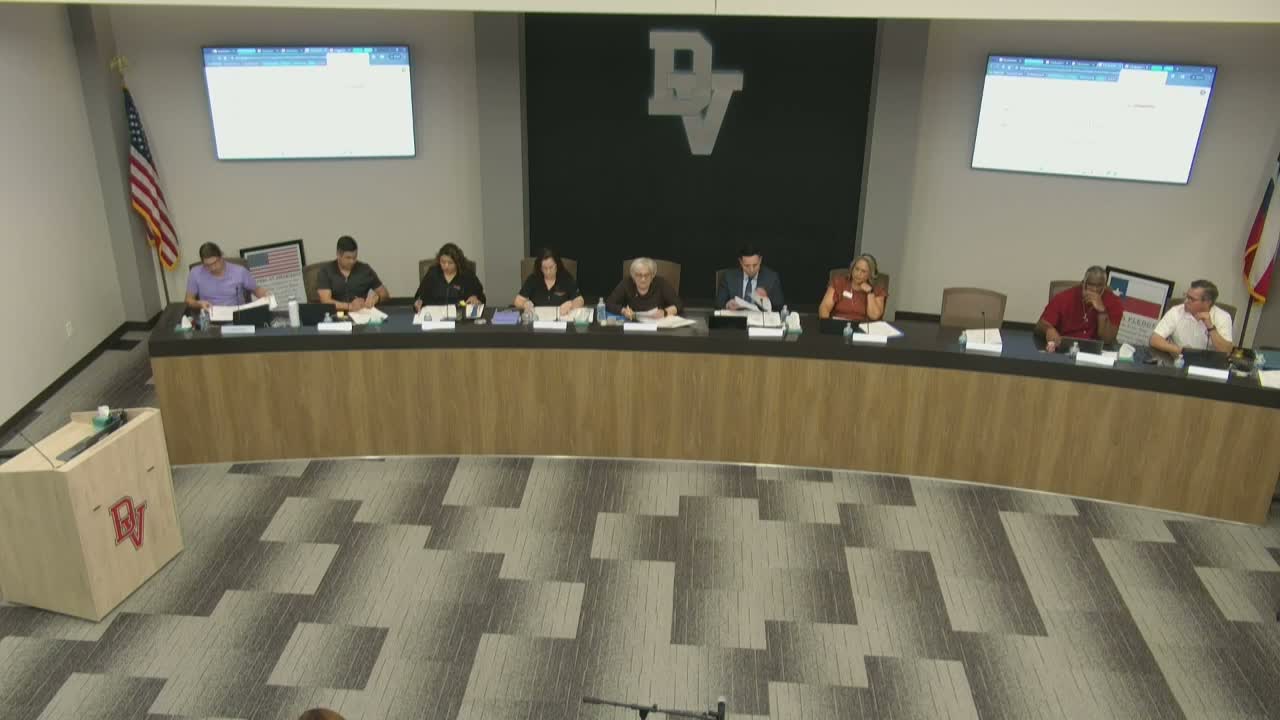
Del Valle ISD officials on Jan. 6 presented the district’s annual special-education evaluation, telling trustees that enrollment in special education has grown and that the district has been cleared of corrective actions while pursuing grants and program improvements.
Dr. Bailey opened the public performance review required by Senate Bill 568 and said the district’s special-education population has increased by about 600 students. "We’re still following the same trend that we’ve seen in the past several years," Dr. Bailey said, noting the district expects to exceed last year’s initial-evaluation total.
Nicole Roberts, the district’s executive director of special education, walked trustees through disability categories and instructional arrangements. Roberts said about 47 percent of students receiving special education services are identified with a specific learning disability, 17 percent with autism, and 14 percent receive speech-related services. She said roughly 26 percent of special-education students spend the majority of their time in general-education (mainstream) classrooms, with larger shares in more restrictive settings according to the state’s instructional-arrangement calculations.
On accountability, Roberts said the district’s Results Driven Accountability (RDA) overall determination slipped from a level 2 to a level 3 this year by a narrow margin. "We were a determination level 2 last school year; we did slip this year back to a 3 by 0.02 percentage," she said, adding that the district will continue monitoring and coordinated support with TEA to address the indicators that drove the change.
Staff highlighted both strengths and areas requiring attention. Roberts said Del Valle showed growth in several STAR 3–8 measures (math, reading, science) and some exit-year indicators, but that the district saw declines in Algebra I, Biology, U.S. History and English I–II. She also pointed to discipline measures as an area of concern for RDA: "Total discipline looks at removals across in-school suspension, out-of-school suspension and placements," Roberts said, and noted that the formula counts repeated removals for the same student.
Trustees pressed staff on the discipline counts and how they are calculated. Trustee Franco illustrated the effect of counting multiple removals for one student and said that the method can overstate the share of students affected. Roberts explained the state formula and said the district is standardizing practices across campuses so similar incidents receive more consistent consequences.
Roberts described a set of programmatic priorities coming from a TKES review: establishing an inclusive-practices roadmap, improving specially designed instruction, strengthening collaborative teaching between general and special education, expanding professional learning, and developing systematic staffing guidelines. She said the district has done classroom "STI walks" for in-the-moment coaching, is preparing master scheduling and campus rosters, and intends to form a special-education parent advisory committee (CPAC) in the spring to improve parent outreach and training.
On resourcing, Roberts said the district has contracted for some hard-to-fill therapy roles and reported approximately 12 vacancies in special-education staffing; evaluation staff, school psychologists and diagnosticians are reported as fully staffed. "We are working with contract agencies right now with certified teachers in order to ensure that the services are provided," she said.
Roberts also told the board the district had been awarded two grants that will support special-education work: an empowering early-childhood grant of $12,000 for pre-K inclusive practice professional learning and an announced federal mental-health services professional demonstration grant in partnership with the University of Texas school psychology program. Roberts reported that the mental-health award totaled $6,531,913 and said Del Valle was the only district in the country selected to receive that award directly; other awards went to state or regional service centers.
On compliance, Roberts said the district had been cleared of four corrective actions as of November 2025 and has submitted a strategic support plan that will be monitored by TEA staff. "We want to stay that way," she said, describing monitoring meetings planned with TEA.
The board’s discussion concluded with questions about communication with parents, universal screening (MAP), and whether long-term substitutes affect compliance. Staff said long-term substitutes do not change the district’s compliance stance regarding hiring and that the application and supports are focused on certified hires and retention.
The district agreed to return with the materials needed for any required follow-up and to bring the TKES updates and CPAC plans forward in coming months.
Ending: Trustees did not take a final vote on special-education program changes at the meeting; staff framed the presentation as the required annual evaluation and said specific action items will return to the board as needed.