
Largo City police review highlights e‑bike enforcement, cybercrime rise and staffing needs
Get AI-powered insights, summaries, and transcripts
Sign Up Free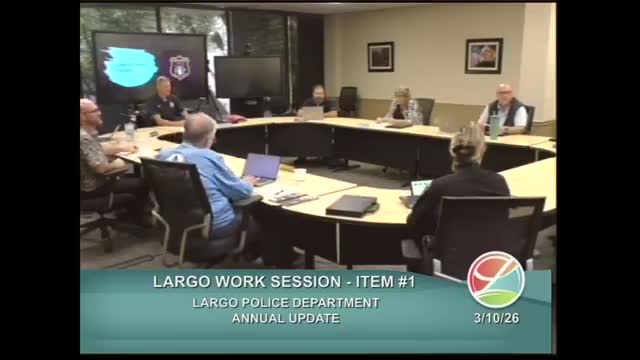
Summary
Deputy Chief Scott Gore and department leaders told the city commission March 10 that Largo remains broadly safe but faces new challenges: e‑bike and e‑scooter enforcement, rising fraud and cybercrime targeting seniors and children, and continued recruitment needs; an operational analysis RFP is planned.
Deputy Chief Scott Gore told the Largo City Commission at a March 10 work session that “Largo is a safe community,” then led an annual review in which department leaders outlined crime‑pattern changes driven by technology, targeted traffic enforcement, homelessness outreach outcomes and recruitment challenges.
The presentation, delivered by Deputy Chief Scott Gore and Major Rochelle Bradshaw and supported by unit leaders, front‑loaded the most immediate operational concerns: a calls‑for‑service heat map showing weekday early‑afternoon peaks that guided recent schedule adjustments; a traffic safety unit emphasizing targeted enforcement and grant‑funded overtime; and an expanded accounting of cyber and economic crimes.
Major Rochelle Bradshaw said the patrol heat table showed higher call volumes between about 1 p.m. and 4 p.m. on Tuesdays and Wednesdays and that the department used the data “when we built out our new schedule” to align officer patrols with demand. Sergeant Chris Keeler, the traffic safety supervisor, described a six‑officer unit (one vacancy) that runs targeted enforcement, DUI work and traffic‑safety equipment; he credited FDOT‑funded programs and lowered speeds on East Bay Drive with contributing to fewer crashes on major corridors.
Keeler also flagged electric bikes and e‑scooters as a growing enforcement issue and noted legislative change: “House Bill 382 was just passed, and it’s on the governor’s desk for signature right now, to greatly change the enforcement aspects of ebikes and identify them,” he said. Keeler described local work to start tracking e‑bike crashes separately and said enforcement and education efforts are under way but that the devices’ speed and quick departure from scene make enforcement difficult.
On homelessness, Community Service Sergeant Andrew Lynch described a coordinated approach that pairs a civilian specialist and a homeless liaison with police enforcement when necessary. Lynch cited a one‑stop program he identified as “HUP” and said, “of those people that get into HUP, there’s like an 80 percent chance that you’re going to be on your own and successful again if you’re motivated to do that,” highlighting the department’s emphasis on referral plus enforcement when contacts are noncompliant.
Investigations leaders described trends that are changing workload and investigative complexity. Detective Lance Wagner said the Investigations Services Division cleared about 71% of cases in 2025 and warned that courier‑style in‑person scams and cryptocurrency laundering are complicating recovery and cross‑jurisdictional prosecution. Wagner said fraud trends often involve elderly victims who are social‑engineered to withdraw cash or buy precious metals, then hand funds to couriers.
Cybercrime investigators reported sharp increases in child‑exploitation and cyber tips. Detective Lance Moore said the department received 107 NCMEC cyber tips in 2024 and 157 in 2025, and that as of the March 10 presentation the unit had logged about 50 tips for 2026 and forecasted the year could exceed 200 at the current pace. He said stronger device encryption and rapid app turnover are making investigations more time‑consuming and resource‑intensive.
Staffing and recruitment were raised repeatedly. Sergeant Matt Williams said the department had about 148 sworn officers able to perform full duty at the end of February, with three (possibly four) vacancies and several conditional offers in process; he outlined recruiting outreach, over‑hire practice and a military skill‑bridge intern the department hopes to convert into a hire.
Deputy Chief Gore said the commission funded resources last year to support a top‑to‑bottom operational analysis; an RFP for a consultant to advise on staffing, civilianization and a strategic approach to future policing will be issued soon. The department also described routine and tactical use of drones for protest monitoring and SWAT callouts and said the expiring Axon contract creates an opportunity to evaluate first‑responder drone capability.
The presentation closed without formal action; commissioners thanked staff and the commission moved on to committee reports and adjourned. The department said it will return with results from the operational analysis when that consultant work is complete.