Get Full Government Meeting Transcripts, Videos, & Alerts Forever!
Get email alerts on the Housing topic
No spam. Unsubscribe anytime.
Largo advances rewrite of mobile-home-park relocation rules in first reading
Summary
The commission approved first reading of Ordinance 2026-01 to repeal and replace Chapter 19 of Largo's development code, standardizing application steps, relocation-fund calculations, a neighborhood meeting requirement, and a $500 application fee; second reading is scheduled for Jan. 6, 2026.
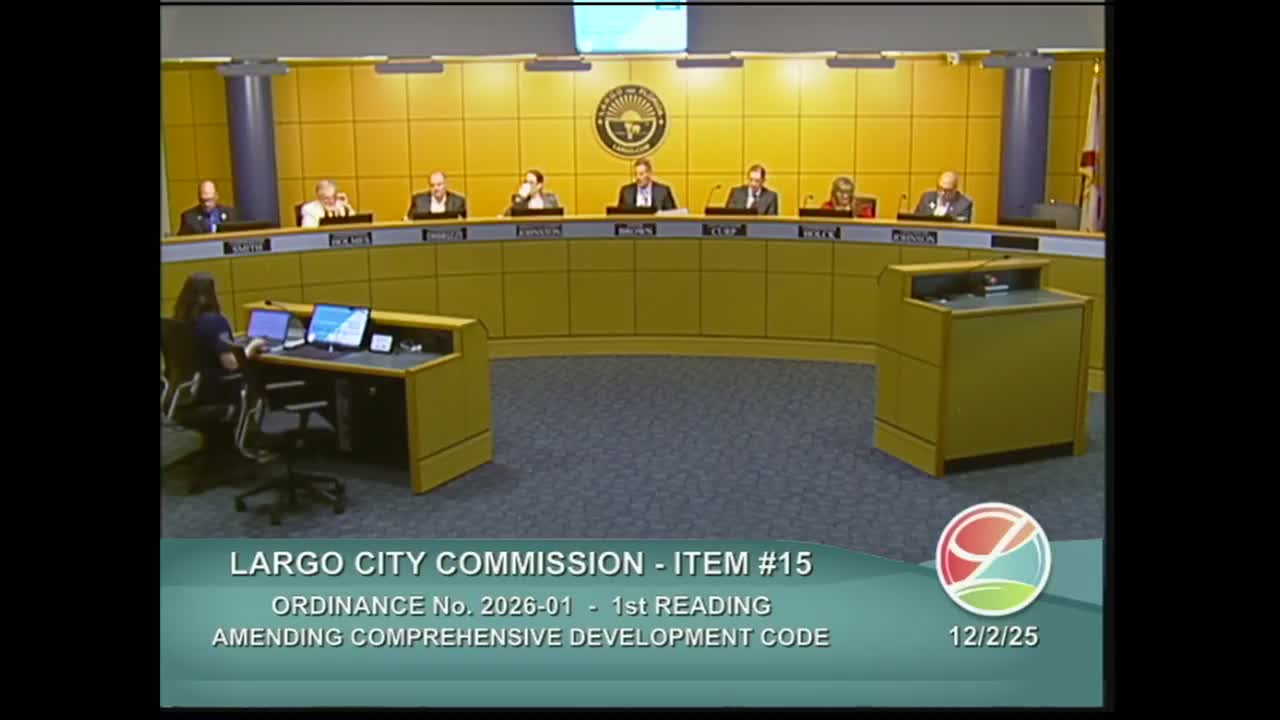
The Largo City Commission voted unanimously on Dec. 2 to advance Ordinance 2026-01, a repeal and replacement of Chapter 19 of the city's Comprehensive Development Code that governs when a mobile-home-park owner seeks a change of use.
Staff said the updated code formalizes an application and review process, requires a neighborhood meeting open to all residents, defines criteria for "adequate replacement housing" (affordability, suitability and availability), and standardizes the method to calculate deposits to a relocation and supplemental rent assistance fund. The changes also add language to connect affected renters and non-owner residents to city housing resources and clarify that the state statute (Chapter 723, Florida Statutes) requires adequate relocation options and a minimum six-month relocation notice.
Staff noted the code will preserve a 10-mile maximum radius for locating replacement housing when appropriate and added that the proposed application fee paid by the park owner will be $500 to cover staff review and neighborhood-meeting facilitation; a 15% administrative fee for managing a 24-month supplemental rent-assistance option will continue to apply. As an example, staff showed a two-bedroom household at 50% of median income with a monthly gap of $637, producing a maximum 24-month supplemental assistance total of $15,288 and an administrative fee in that example of about $2,300.
Staff emphasized additional resident protections: the draft clarifies the definition of "late on rent" so that residents are disqualified from assistance only if an eviction proceeding for nonpayment has been filed; it also expands outreach and referrals to available programs and services for displaced residents.
Greg Gardner, who addressed the commission during public comment, praised the ordinance and urged extending eviction notice periods as a policy preference, though the code remains aligned to the state's six-month minimum. Commissioners asked staff for clarification on how the 15% fee is calculated and on eligibility criteria; staff said the deposit and assistance calculations use HUD and state published rent standards and that the code includes options for either monthly supplemental payments or a lump-sum relocation payment.
Action: Ordinance 2026-01 passed on first reading; second reading and public hearing scheduled for Jan. 6, 2026.