Get Full Government Meeting Transcripts, Videos, & Alerts Forever!
Get email alerts on the Historic Preservation topic
No spam. Unsubscribe anytime.
Fort Myers council backs homeowner in appeal over altered historic windows
Summary
The Fort Myers City Council voted to support homeowner Raymond Schweitzer and effectively overturn a Historic Preservation Commission denial after hearing testimony about safety, insurance urgency and preservation concerns over enlarged second‑story windows at 3927 McKinley Avenue in the Seminole Park Historic District.
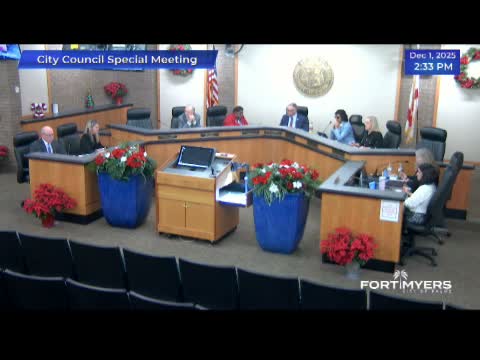
Fort Myers City Council voted to support homeowner and appellant Raymond Schweitzer on Dec. 1, approving his already‑installed second‑story windows after hearing a de novo appeal of the Historic Preservation Commission’s (HPC) unanimous denial.
The council’s decision follows testimony that the windows were replaced under emergency conditions tied to a roof failure and an imminent insurance nonrenewal. “I was within five hours of losing my house,” appellant Ray Schweitzer said, explaining he needed larger windows without interior grids for both code and personal‑health reasons. Building official Brent Brewster and Planning Manager Nicole Devaughn told the council staff had issued a permit to allow the work to proceed for insurance purposes, but the HPC later determined the changes harmed the house’s historic character under Secretary of the Interior standards.
Why it matters: the case pits preservation standards for contributing buildings in the Seminole Park Historic District against homeowner safety, building‑code egress requirements and a claim of disability accommodation. The HPC concluded the change from narrow arched windows to larger rectangular openings removed defining facade rhythm; neighbors and preservation advocates said restoring openings protects the district’s integrity. Gina Saviston, speaking during public comment, urged the council to uphold the preservation rules that buyers rely on when they purchase in a historic district.
Evidence and arguments: the assistant city attorney opened the hearing, citing Fort Myers City Code section 1‑14‑85 and explaining the de novo appellate process. Staff witnesses explained that, while the existing building code allows like‑for‑like window replacement, enlarging openings can trigger historic review; the HPC, voting 7–0 on Aug. 28, found the alteration inconsistent with Standards 2, 5 and 9 of the Secretary of the Interior’s standards for rehabilitation because the recessed arches and the multi‑light rhythm were removed. Brent Brewster told council members that new windows must meet modern emergency‑egress requirements if they serve sleeping areas, and that window sizes can be custom‑ordered to match openings but that in this case the owner purchased windows that enlarged the openings.
The applicant’s case focused on immediacy and safety. “I am disabled and I have optic migraines that are triggered by artificial lights and grids in the windows,” Schweitzer said, arguing that removing the grids was a reasonable accommodation and that contractors’ failures and an urgent insurance deadline forced the timing of the work. He also described alleged lapses by the contractor (identified in testimony as Reese Windows) and roofing problems tied to a separate contractor (GSD roofing) that contributed to the emergency.
Council response and outcome: after extended questions about whether staff had warned the owner and whether lower‑cost mitigation options (such as decorative panels or stucco panels recreating the arch look) could restore the facade’s visual rhythm, the council moved to support the appellant. The motion carried by recorded vote; the clerk announced five votes in favor and one opposed (Councilmember Bochette). The council did not unanimously endorse one remedy; several members expressed interest in staff’s proposed aesthetic mitigation as a compromise in similar future cases.
What happens next: the council’s vote supports the windows as installed and thus relieves the homeowner of the HPC’s restoration order for this property. No further council action on this item was noted at the meeting; the council adjourned at 3:32 p.m.
Authorities referenced in the hearing included Fort Myers City Code section 1‑14‑85 and the Secretary of the Interior’s Standards for Rehabilitation. The record includes testimony from the applicant, the applicant’s representative, planning and building staff, and one public commenter.