Get Full Government Meeting Transcripts, Videos, & Alerts Forever!
Get email alerts on the Public Safety Funding topic
No spam. Unsubscribe anytime.
Consultant outlines possible police impact fee schedule, projects $9M over 10 years
Summary
City consultant presented a police impact fee proposal that calculates an $838 per-equivalent-dwelling-unit basis and a $8.38 single-family fee; councilmembers pressed on growth assumptions, fee application only to new construction, and how revenue could be applied to a planned police headquarters.
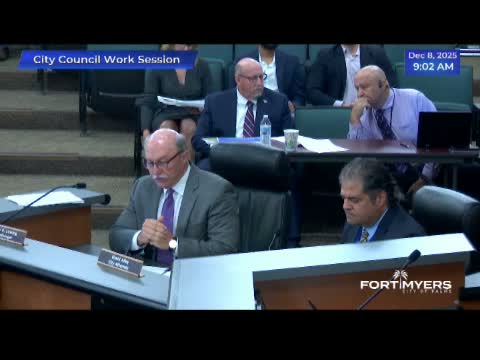
A consultant hired by the city presented a police impact fee study recommending a fee schedule based on a $64.8 million existing public-safety asset base and a calculated cost-recovery rate of $838 per equivalent dwelling unit (EDU). Chris Tenney, director of financial services, introduced Peter Napoli of Santech Consulting, who said the study used replacement-cost assumptions tied to a planned police headquarters and inventory of vehicles to set the fee basis.
“The city has plans to build the new police headquarters around the time of fiscal year 2027,” Peter Napoli said, and the study used an $850 per-square-foot replacement cost to compute facility replacement and a resulting total existing cost basis of roughly $64.8 million. Napoli said that, at 100% cost recovery, the calculated single-family fee works out to $8.38 per EDU and the model produces a 10‑year revenue projection of about $9 million under a median-growth scenario.
Why it matters: impact fees are charged as a one-time payment on new construction to help pay for growth-driven expansion of facilities. Napoli emphasized impact fees apply only to new construction and are tied to service-demand equivalencies: residential fees are per dwelling unit while nonresidential uses are charged per 1,000 square feet with equivalency factors for employees and visitors.
Council members questioned the underlying growth assumptions and the differences among nonresidential categories. Napoli replied the commercial/industrial gap reflects different occupant densities: “what we do for these nonresidential classes is we look at the average employees per thousand square feet, the average visitors, based on trip data,” he said, and those functional-population equivalencies drive the per‑use fee schedule.
Councilors also pressed how revenues could be applied to the new headquarters’ debt service and whether impact fees could fully pay those costs. Napoli said the fee revenues would be restricted to expansion projects (including debt service associated with growth components) and that a portion of debt servicing could not be borne solely by growth if the project also replaces existing facilities. He recommended jurisdictional steps including public hearings, an enabling ordinance or resolution, and 90 days’ notice before collecting newly adopted fees. Napoli also recommended recalculation of fees every four years to reflect cost and demographic changes.
What’s next: staff will consider the study’s maximum-calculation and options for lower cost‑recovery levels, return with public‑hearing dates, and provide additional debt-service detail if council requests.