Get Full Government Meeting Transcripts, Videos, & Alerts Forever!
Get email alerts on the Water Infrastructure topic
No spam. Unsubscribe anytime.
Fort Myers council backs plan to validate service‑line inventory, will sample 369 homes
Summary
The council approved staff to proceed with validating the city's service-line inventory under EPA's Lead and Copper Rule Improvements: field checks at 369 representative sites, predictive modeling to cover ~9,175 unknown lines, and resident notifications via mail and door hangers.
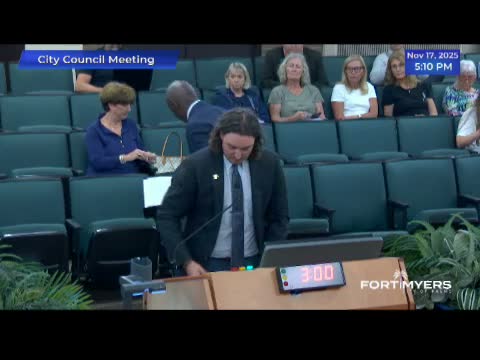
The Fort Myers City Council on Nov. 17 approved staff's plan to validate the city's drinking water service-line inventory under the EPA's Lead and Copper Rule Improvements (LCRI). Utilities staff said the city has identified zero confirmed lead service lines so far, but about 9,175 service lines remain unknown out of roughly 25,000 connections in the city.
Environmental compliance manager Justin Mahone told the council staff has published an interactive inventory (fortmyers.gov/lcrr) and has engaged Black & Veatch for predictive modeling. To validate the model to a 95% confidence level, the city contracted HST Utility to field‑verify 369 representative meter‑box sites; validations will be minimally invasive and largely limited to meter box inspections, not excavations. Staff presented a door‑hanger and a mailed notification letter to be used before crews access private meter boxes.
Mahone described the model and verification approach as intended to avoid physically digging thousands of sites. He said the model uses construction age, location (front vs. back easement), and other factors to extrapolate from representative samples. He told the council that, if lead is detected, the notification materials will provide contact information and next steps for residents.
Council members asked procedural questions and then moved to approve the staff recommendation to proceed with the representative sampling and resident notification plan. The motion passed on a council vote.
What the council approved: staff may proceed with the HST Utility field verification of 369 representative sites (sampling to validate predictive modeling), publish and maintain the service-line inventory online, and use the proposed door‑hanger and pre‑mail notifications to inform residents prior to entry into meter boxes. Staff said the program is part of a larger, ongoing federal and state compliance effort to identify service-line materials and address potential lead in drinking water.
Next steps: staff will deploy notifications, complete the representative site checks, plug results into the predictive model to achieve the 95% validation threshold, and publicly update the inventory dashboard as findings are confirmed.