Get Full Government Meeting Transcripts, Videos, & Alerts Forever!
Get email alerts on the Public Safety topic
No spam. Unsubscribe anytime.
Gainesville committee approves concept for police campus fencing, orders community design work
Summary
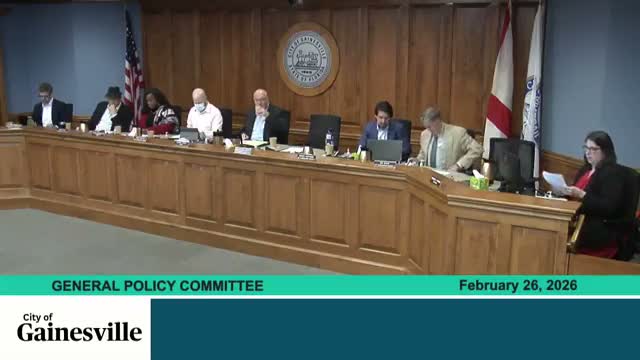
After testimony from Gainesville Police and a long public-comment period, the General Policy Committee approved a conceptual plan for a see-through fence around part of the Gainesville Police Department campus 4-3 while directing staff to pursue neighborhood design input and to reconsider placing public art on the fence.
The General Policy Committee of the Gainesville City Commission voted 4-3 on Feb. 26 to approve the concept of a fence around part of the Gainesville Police Department campus, but left final design, setback and art placement to staff after a lengthy public discussion.
City staff presented aerial plans and a preliminary budget for parking-lot security and a short section of fence tied to an ongoing property-and-evidence building project. Brian Singleton, interim chief operating officer, said the standalone capital allocation for the lot-security portion was roughly $150,000 and that installation would be timed to coincide with the property-and-evidence construction next summer or fall.
Major Jamie Kurnick of GPD described several safety incidents that drove the department's request: vehicles entering the department's lot during outdoor briefings, people who did not belong on the property and at least one detainee who escaped from the parking area into the surrounding neighborhood. "Anybody can still travel along rails to trails," Kurnick said, adding that the department intends to install a transparent, CPTED-compliant fence that would preserve trail access and sight lines.
Neighbors and planners offered split testimony at the public-comment period. Supporters who live next to the station and several former law-enforcement officials emphasized the risk to staff and evidence processing and said a transparent fence would add a layer of security; Betty Cook, a nearby resident, told the committee she had seen incidents that convinced her fencing would help. Opponents asked the city to prioritize trail lighting and community design input, warning that fencing close to the rails-to-trails corridor could make the corridor feel —3 walled in—3 and reduce the informal contact between officers and residents.
Commissioners debated trade-offs between staff safety and the trail's public character. Several recommended practical steps before construction: place fence mock-ups on site so neighbors can judge scale, ensure setbacks (staff said there was roughly a 7—0-foot grass buffer in parts of the alignment), and avoid an opaque barrier. Commissioner Eastman said he would "not be supporting the motion as it stands" without stronger assurances on setback and visibility, while Commissioner Book framed the measure as a risk-mitigation step and moved to approve the concept with two explicit conditions: no impact to trail access and incorporation of existing benches and transit stops into the fence design.
The motion to approve the fence concept passed 4-3. The committee then unanimously referred the arts component of the project back to the city manager and the Arts & Public Places Trust for reconsideration, citing safety and visibility concerns; staff had already issued an RFQ for "public art fencing," but officials said the RFQ does not obligate construction and artist selection will produce concepts to be reviewed before any art is installed. Finally the commission directed staff unanimously to engage the surrounding neighborhood and the Bicycle & Pedestrian Advisory Board on design, height, scale and placement with the express goal of maximizing sight lines and visibility for trail users.
Next steps: staff will return with design options and engagement results as the property-and-evidence building project proceeds. Installation is not expected before the building project finishes in about a year, and the commission asked for on-site samples and clearer design mock-ups before final approval.
Vote at a glance: Concept approval for 2026-156 (GPD campus fencing) passed 4-3; referral to reconsider art placement passed unanimously; direction to engage neighborhood and the Bike/Ped advisory board passed unanimously.