
Alachua County leaders hear plan to scale literacy supports; PEAK describes volunteer‑led tutoring gains
Get AI-powered insights, summaries, and transcripts
Subscribe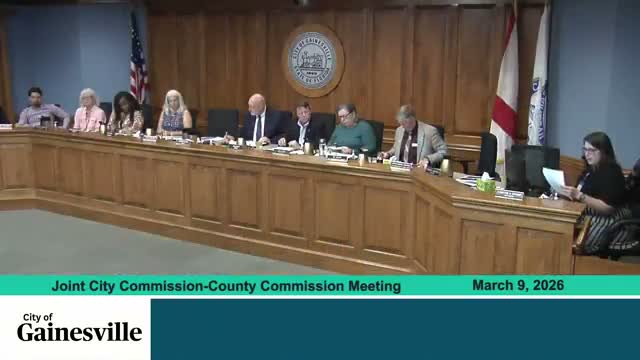
Summary
The county’s joint literacy update detailed a four‑team Alachua County Reads collaborative and a push to expand community hubs, while PEAK Literacy said brief, high‑dosage volunteer tutoring produced measurable early gains and sought more data‑sharing and funding to scale.
Leaders from the Center for Nonprofit Excellence and PEAK Literacy presented a coordinated plan to expand literacy supports across Alachua County, urging more interagency data sharing and sustained funding to move pilot gains into the school day.
The Center for Nonprofit Excellence (CNE) described Alachua County Reads as a four‑team collaborative that will combine curriculum design and training, implementation and provider partnerships, a community advisory council and a communications hub. CNE staff said the model will connect work already under way — including programs run by PEAK — to a virtual site, alachuacountyreads.org, and a set of physical hub locations so families and providers can easily find services.
"This initiative addresses the critical need for systemic literacy improvement," said the CNE presenter, who identified the collaborative structure and named the University of Florida Literacy Institute among the expert partners helping shape training and evaluation.
PEAK Literacy’s executive director, Leah Galione, told the joint meeting her volunteer‑driven model delivers brief, individualized lessons three to five times a week and is designed to fit into after‑school schedules. ‘‘Students get individual lessons 3 to 5 times a week at their just‑right level in just 15 minutes per day,’’ Galione said. She said PEAK now serves more than 300 students countywide and that a recent county investment of $200,000 allowed the organization to add new school and after‑school sites and expand at‑home tutoring.
Galione provided early outcome data from PEAK cohorts and said students in a tracked sample averaged roughly 1.27 grade‑level growth across the measured period. "We have DIBELS, Tower 2 and fluency metrics, and we’re working to align those with district FAST scores," she said, noting the district does not share all assessment data without formal agreements.
Elected officials and school staff pressed presenters on several operational pieces: volunteer training requirements, coordination with school‑day curricula such as UFLY and GreatLeaps, and the need for data‑sharing agreements so community providers can use school assessments to target students earlier. A county commissioner asked whether the Children’s Trust or county funds can be used to cover volunteer background check fees; presenters said trust funds are constrained by statute but that local partners are exploring ways to reduce barriers to volunteer placement.
Several commissioners and public speakers urged earlier identification of students at risk — including pre‑K screening for dyslexia — and stressed that household stability (housing, transportation, and family supports) shapes children’s ability to benefit from interventions. "We need to identify these kids before they start struggling," a public commenter said.
CNE and PEAK emphasized next steps: a two‑year coordinated action plan, an expanded training and evaluation contract with UFLI, recruitment of an advisory council to ensure community direction, and additional grant seeking to sustain the effort beyond initial local investments. Presenters repeatedly asked for clearer district data access to accelerate targeted interventions.
The board did not take formal votes during the presentation. Officials said they would continue cross‑jurisdictional conversations about funding and data sharing as the collaborative moves from planning into broader implementation.