Get Full Government Meeting Transcripts, Videos, & Alerts Forever!
Get email alerts on the Transfer Station Funding topic
No spam. Unsubscribe anytime.
North Port commission opts for density-based, one-time assessment to fund transfer station; vote 3–1
Summary
The City Commission gave consensus to charge vacant parcels on a density basis and to use a one-time special assessment in fiscal year 2027, approving the funding approach 3–1; staff estimated the transfer station capacity at about 118,000 tons and assessed costs used in the presentation totaled roughly $13.7M (planning estimate cited elsewhere at $15M).
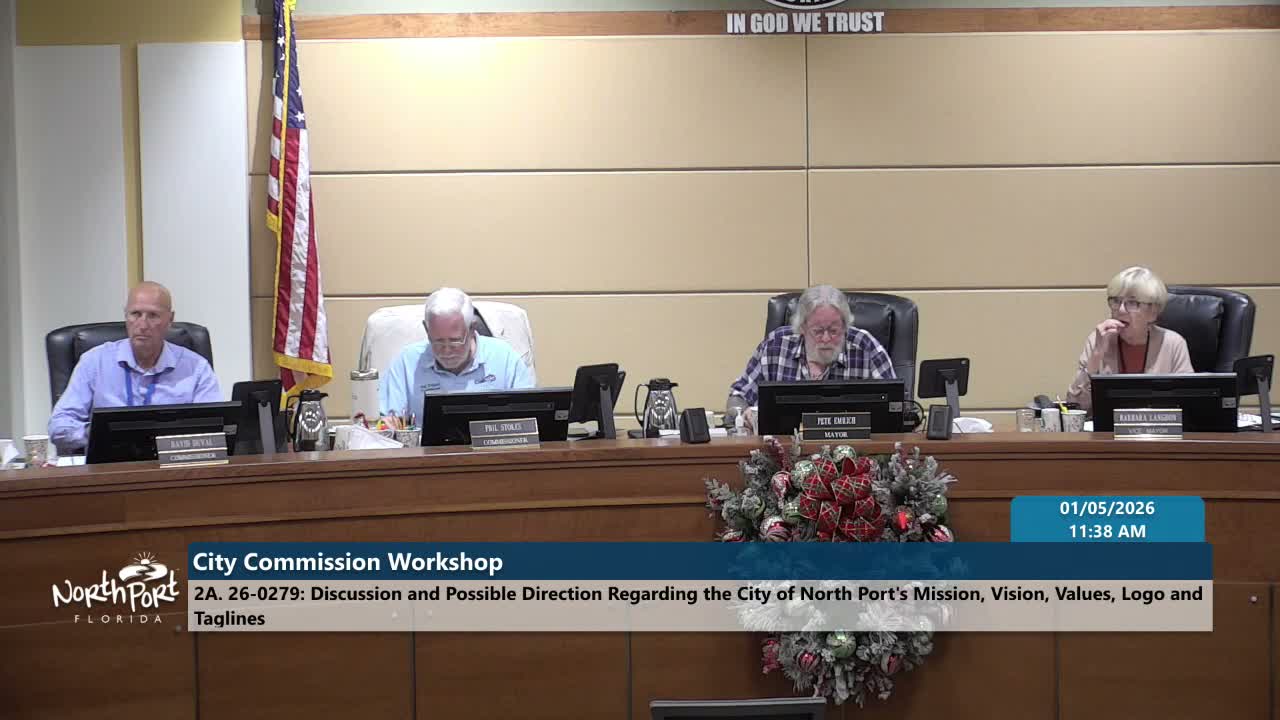
At a Jan. 5 workshop, the North Port City Commission reviewed financing options for a proposed solid-waste transfer station and reached consensus on a density-based assessment for vacant parcels and a one-time assessment in fiscal year 2027 to recover the city's share of construction costs.
Chuck Speake, public works director, introduced the staff's work with Stantec Consulting. Consultant Peter Napoli summarized the assessment approach, noting the special-assessment district that currently funds solid-waste operations would be used and must satisfy a two-prong legal test: (1) properties receiving a special benefit from the improvement and (2) assessments sized proportionally to that benefit.
Napoli said the transfer station is sized for about 118,000 tons of capacity while current customers use roughly 61,000 tons (about 52%); the analysis allocated 52% of assessed costs to existing customers and 48% to future capacity. The presentation cited an estimated project planning cost of about $15,000,000 and used a $13,700,000 grossed‑up figure in the assessment calculations. Under the presented scenarios, the existing residential base would pay a one-time assessment of $128 per household (or $64 spread over two years). Vacant parcels would be assessed either by acreage (about $111 per quarter acre) or by density (about $106 per potential residential unit). Commercial capacity (about 18% of the system) would be covered through commercial rate increases rather than a one-time assessment.
Commission discussion focused on fairness and timing. Commissioner Stokes argued that a one-time assessment places the cost on current taxpayers while the benefits will accrue to future residents; he urged financing via bonds (certificates of participation) to spread costs over the useful life. Napoli and Speake replied that reserving capacity for vacant parcels and charging them now is the most equitable way to capture future beneficiaries and that postponing construction an extra year could raise costs (staff estimated construction cost increases around 15% and noted potential lost operating savings of roughly $2 million per year).
Vice Mayor Langdon made a consensus recommendation to use the density-based approach for vacant parcels; the commission confirmed that consensus. The commission then took consensus on a one-time fiscal-year-2027 assessment to fund the transfer station. The roll-call result on the one-time assessment was Mayor Emerich: yes; Vice Mayor Langdon: yes; Commissioner Duvall: yes; Commissioner Stokes: no (Commissioner Petro absent), a 3–1 outcome. Staff said a one-time assessment approved for 2027 would appear on next year's tax bills if implemented, and that a two-year split would require postponing construction to 2028 to accumulate the funds.
Speake said staff expects operational savings once the transfer station is in service and estimated a payback on the investment in roughly 5–6 years under earlier presentations, though the conservative financial forecast did not program those savings into near-term numbers. Staff will proceed with implementation work consistent with the commission's direction.