Get Full Government Meeting Transcripts, Videos, & Alerts Forever!
Get email alerts on the It Migration topic
No spam. Unsubscribe anytime.
Gainesville outlines multi‑year plan to bring IT in‑house, flags network and lifecycle risks
Summary
The city presented a plan to migrate systems from GRU IT to a new city technology department, identified urgent network and cybersecurity needs, estimated a $4.2 million transition budget and asked commissioners to prioritize network infrastructure and lifecycle funding in the coming months.
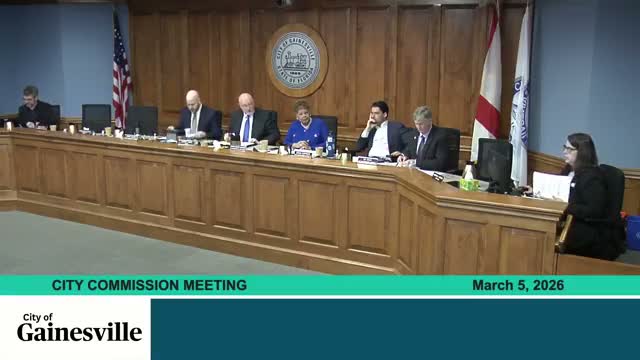
Gainesville’s newly formed technology department told the City Commission on March 5 that moving dozens of applications and hundreds of network devices out of GRU control and into a city IT environment will be a complex, multiyear effort that requires immediate work on the network and security layers.
Technology Director Ed Nagy told the commission the department completed an inventory of the city’s IT assets and “triaged 371 different applications,” and that an error on the slide should have noted “92 applications that are impacted by the transition from GRU.” He described a cloud‑first strategy, said the city lacks direct access to many current systems and called building a new secure network the near‑term “urgent” priority.
Why it matters: The migration touches systems that support public safety, finance and everyday city operations. Nagy said the city has inventoried nearly 1,500 desktop systems and about 230 network devices and that many firewalls and backup (UPS) systems are past their recommended service life, creating an elevated risk profile if replacements and a new network architecture aren’t put in place.
Nagy laid out costing and timing: a one‑time startup and transition package he described as $2,000,000 plus $2,200,000 associated with the service‑level arrangements previously negotiated with GRU (totaling roughly $4,200,000), ongoing life‑cycle replacement of desktops at an estimated 20 percent per year (about 300 systems annually ≈ $600,000 if fully funded), and current PC life‑cycle funding at $190,000 annually. He urged commissioners to prioritize core network and cloud infrastructure in the next three to five months so migration work can proceed.
Commissioners pressed on details such as whether “urgent” percentages tied to device counts (Nagy said they relate to age bands rather than absolute counts), the expected lifetime of UPS batteries as battery technologies evolve, and options for hosting services through outside providers when appropriate. Nagy said the city is evaluating both cloud and software‑as‑a‑service opportunities and has engaged vendors experienced in tenant divestiture for Microsoft‑based migrations.
Public comment highlighted risk. Armando Grundy Gomez asked for higher‑level review and independent audit oversight, warning: “Number one is … if this does not go right, who gets impacted? … we have some folks in the room to my right that are gonna be impacted in our first level responders.” City leaders said audits and careful transition planning have been part of the work and that the separate roles of GRU and city systems make the migration more complicated.
What’s next: Nagy said staff will continue design of a new network topology, accelerate early cloud and service desk implementations and return to the commission as budget and procurement steps advance. The commission discussed budget timing and the merits of ensuring audit involvement and clear service‑level reporting as the transition proceeds.