Get Full Government Meeting Transcripts, Videos, & Alerts Forever!
Get email alerts on the Sponsorship Policy topic
No spam. Unsubscribe anytime.
North Port to update citywide sponsorship policy, expand tiers and adjust presenting‑sponsor pricing
Summary
City staff proposed a revised sponsorship framework to scale with growing events, including new feature/amenity levels, a shortened renewal timeline, and raising presenting sponsor ranges; commissioners gave consensus to proceed and asked staff to return a resolution for review.
North Port commissioners on Feb. 2 gave staff consensus direction to move forward with updates to the citywide sponsorship policy that would add new sponsorship levels, cap sponsor numbers per tier, shorten the first‑right‑of‑renewal timeline and adjust pricing ranges for presenting sponsors.
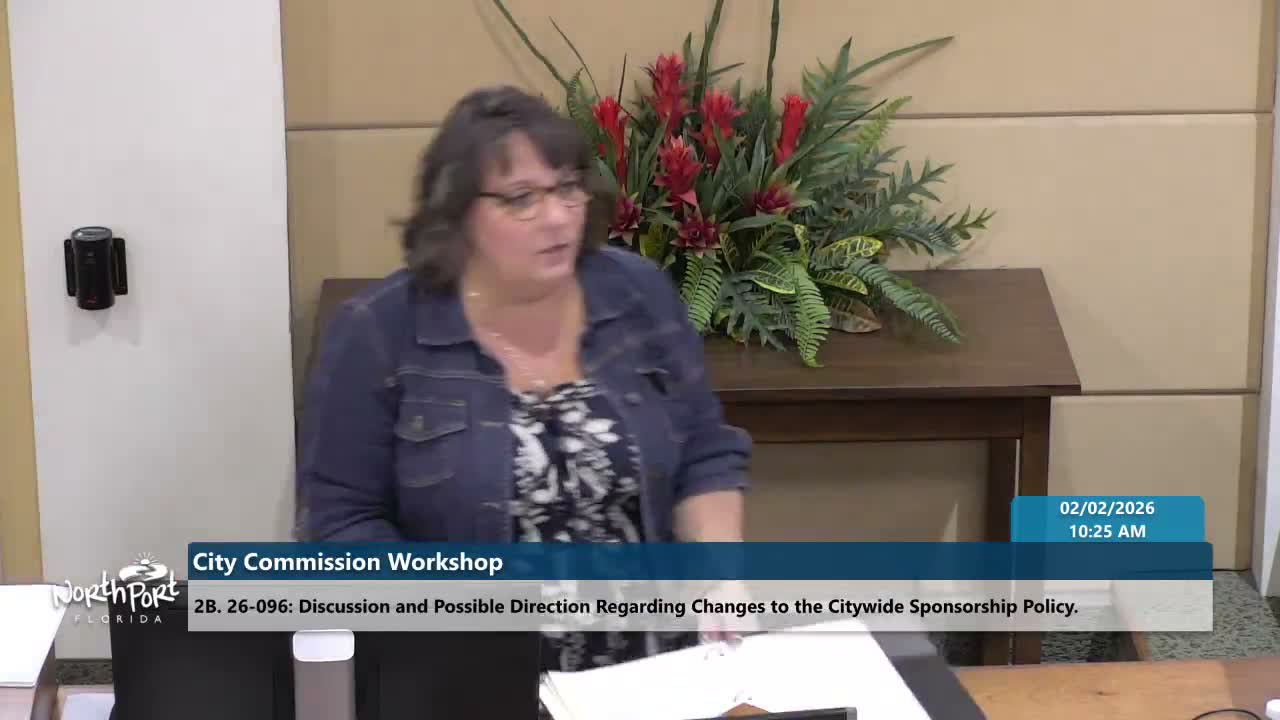
Kim Lunsky, the community partnership and engagement manager, told the commission the policy has not been updated since its 2019 adoption (Resolution 2019‑R5) and needs revision to match the city’s growth: North Port’s population figure in staff slides rose from about 73,652 in 2019 to about 96,301 today and signature event attendance has increased (for example, the Poinsettia Parade and Festival attendance grew from roughly 5,200 to more than 12,200). Lunsky presented a five‑level sponsorship framework (presenting, feature, tiered/event, amenity/public space or facility, and in‑kind) and proposed a feature sponsorship that ties a sponsor to a specific visible element (for example, a kids zone) with exclusive recognition.
For presenting sponsors, staff recommended replacing a flat $2,000 contribution with a scaled range of $4,000 to $10,000 based on event size and a percentage of direct event costs and marketing value delivered. The first‑right‑of‑renewal timeline was proposed to be shortened to 120 days (from roughly 274 days as currently written) to ease sponsor commitments. Staff proposed reducing amenity sponsorship from $5,000 to $2,500 to align price with seasonal visibility windows and increase affordability for prospective sponsors; in‑kind donations and volunteer hours would continue to be accepted and valued.
Commissioners asked how the city would measure event scale and whether higher presenting fees would reduce demand; staff said the formula would use attendee counts and direct event cost percentages, and that ranges were informed by industry comparables and estimated marketing deliverables. Staff said sponsorships currently offset roughly 10% of direct event cost and that reducing the number of sponsors per tier would protect value and visibility for contributors. Commissioners also discussed naming rights as a separate contractual policy to be addressed later.
Mike Morales, a longtime parade sponsor, used public comment to press for clearer fulfillment of promised sponsor benefits (branded giveaways and recognition), saying some benefits disappeared while sponsorship prices stayed the same. “When I was first asked to be the sponsor... I thought it kind of as a long term thing and a good representation,” Morales said, urging the city to consider donated materials or cost‑sharing to preserve parade traditions.
Vice Mayor Langdon asked for consensus to approve the updates and direct the city manager to bring a resolution back for commission review; the commission recorded consensus and asked city staff to return a resolution for formal consideration.