Get Full Government Meeting Transcripts, Videos, & Alerts Forever!
Get email alerts on the Infrastructure Funding topic
No spam. Unsubscribe anytime.
Commission backs two‑phase plan to create special district for Activity Centers 6 and 10
Summary
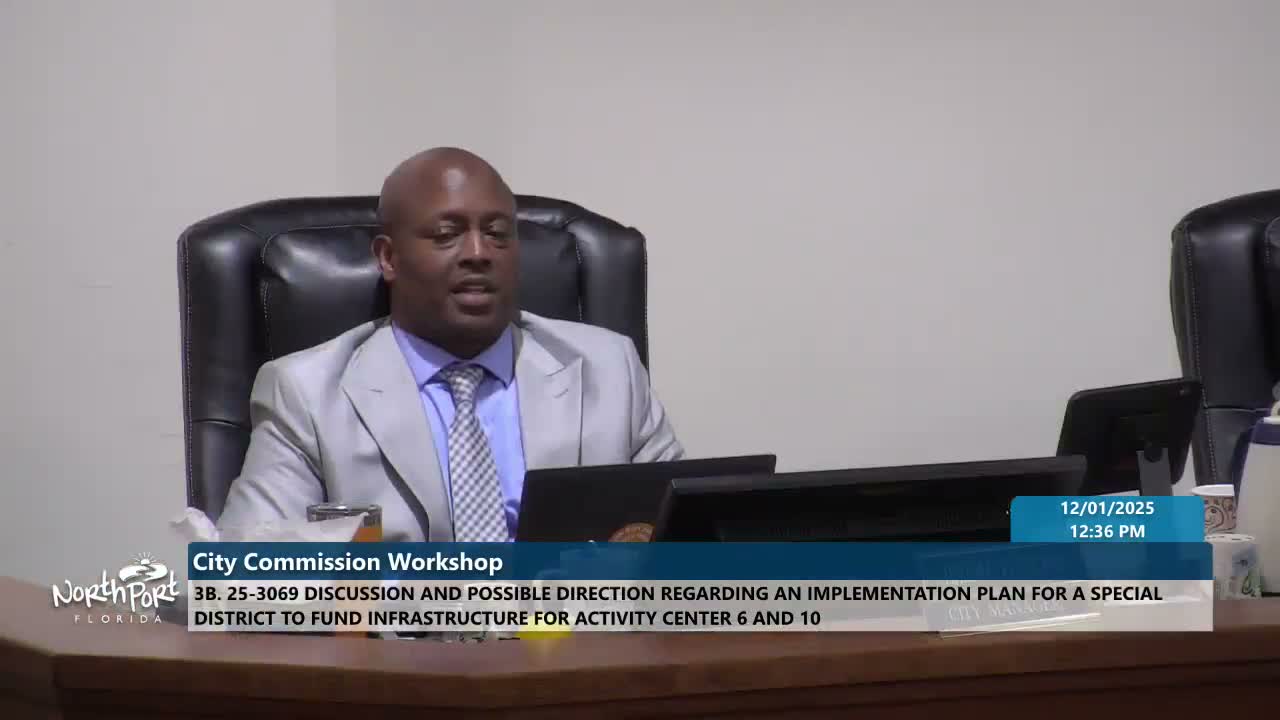
Deputy City Manager Jason Yarborough outlined a two‑phase approach (city‑created dependent district in 2026, then a state‑authorized independent special district via the 2027 legislative session) to finance water, sewer, roads and stormwater for Activity Centers 6 and 10; commissioners gave consensus direction to draft ordinances, an assessment methodology and pursue legislative support.
Deputy City Manager Jason Yarborough described staff’s recommended implementation plan to fund and deliver infrastructure in Activity Centers 6 and 10, a combined area of more than 3,600 acres that staff said is key to rebalancing the city’s tax base toward commercial and industrial uses.
Yarborough said the work would follow a two‑phase path: first, create a city‑created dependent special district to begin collecting assessments and fund planning and initial projects; second, pursue an independent special district through a state legislative special act that could give the district broader borrowing authority and an independent governance structure. He told commissioners the model is similar to other Florida improvements districts and said the plan focuses assessments on the properties that will benefit most.
Staff listed likely infrastructure needs (water and sewer extension, stormwater, road extensions and ultimately an interchange), the need to coordinate with DeSoto and Charlotte counties on road network improvements, and the importance of fiber and power capacity for prospective industrial or data‑center uses. Yarborough said assessment collection timing means the dependent district ordinance would need to be ready in 2026 if the commission wants revenue on the 2027 tax roll; an independent special act in Tallahassee would likely align with the 2027 legislative session and revenue flow in 2028.
Commissioners expressed broad support. One commissioner framed the work as vital to stabilizing property tax rates and enabling the city to attract higher‑paying jobs; another urged urgency to avoid losing development to neighboring counties. The commission recorded consensuses directing staff and legal counsel to: draft an ordinance establishing a dependent district for 2026 consideration; prepare a resolution of intent to use Florida’s uniform method of collection for fiscal year 2027; develop and advance a legislative concept for an independent special district to be considered in the 2027 session; draft an assessment methodology; and seek assistance and coordination with Sarasota, DeSoto and Charlotte counties on legislative support and interchange planning.
Staff said the approach intends to place the assessment burden on benefiting property owners rather than the citywide taxpayer base while enabling the city to work with property owners, developers and adjacent counties to deliver the long‑planned infrastructure improvements.
Next steps: staff will draft the dependent‑district ordinance, the uniform‑method resolution, an assessment methodology and legislative concept and return to the commission for consideration in early 2026.