Get Full Government Meeting Transcripts, Videos, & Alerts Forever!
Get email alerts on the Udo Overview topic
No spam. Unsubscribe anytime.
Rockdale County presents major UDO rewrite to encourage diverse housing, modern uses and clearer procedures
Summary
Consultants from CPL and county staff outlined a draft Unified Development Ordinance that consolidates zoning districts, adds a PUD tool and new housing types (live-work, cottage/tiny-home villages and ADUs), modernizes use tables for data centers and battery-storage, and tightens enforcement and multifamily inspection rules.
Consultants from CPL and county planning staff presented a draft Unified Development Ordinance (UDO) update at a Rockdale County town hall, describing a suite of changes intended to align zoning with the county's comprehensive plan and an Atlanta Regional Commission housing study.
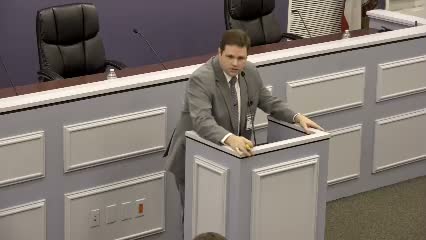
"A unified development ordinance also provides consistent standards," said Sarah McQuaid of CPL, who opened the presentation by describing how the UDO translates long-term policy into enforceable zoning regulations. She reviewed the project timeline and public hearings planned during the adoption phase.
Liz Mitchum, a lead presenter, summarized three policy directions driving the update: expand and diversify housing policy, reorganize the code for clarity, and modernize definitions and use standards to reflect current state law and new development types. Key structural changes include consolidation of overlapping residential and mixed-use districts (for example, folding several R- and MRU-type districts into clearer RM/R1 or mixed-use categories) and a new Planned Unit Development (PUD) district.
The PUD would allow master-planned or innovative developments that do not fit standard districts but must include at least two defined policy-supporting features such as affordable housing, public green space, adaptive reuse, targeted industries or senior-housing components. "You have to choose at least 2 unique features to support innovative requests for a PUD," Mitchum said.
The draft also reworks the use table by district type and modernizes supplemental standards. Presenters called out updated definitions and rules for emerging uses: clearer distinctions between mining and quarrying, new language for battery energy storage systems (explicitly not to be treated as electric-generating facilities), and stricter, use‑intensity–based regulation for data centers and high-intensity processing facilities to address noise, energy and emergency-access concerns.
Housing changes emphasized the "missing middle": new residential types such as live-work buildings and tiny-home or cottage-village patterns (CV and Monastery Village/MV districts) and provisions to allow development on deficient lots of record with limited setback adjustments to encourage infill. The presenters also introduced accessory dwelling unit (ADU) rules focused on small, cottage-scale units limited to 1,000 square feet or 50% of the primary dwelling size.
Several procedural and enforcement changes were highlighted: a 24-month sunset for concurrent applications and clarified vesting rules intended to prevent indefinite vesting of inactive projects; consolidation of environmental chapters into a single Article 14 for easier updates; revisions to zoning procedures and public-notice requirements to conform with state law; expanded enforcement authority including a clarified citation process and the power to revoke permits; and a new proactive multifamily inspection program tying recurring interior and exterior inspections to continued business license and certificate-of-occupancy eligibility.
Presenters repeatedly asked the public to review posted drafts and noted upcoming hearings (first read, Planning Commission public hearing, a Board of Commissioners zoning hearing and a second read/final decision) where residents can place comments on the record. Director Jennifer Rutledge said residents may submit comments via the project website portal, directly to staff or by testifying at the Planning Commission and Board of Commissioners hearings so their input becomes part of the official record.
The town hall closed with presenters promising to circulate specific proposal documents (for example, architectural standards and use‑table matrices) for public review and noting that staff will check the draft language on certain spacing or use limits that residents flagged as potentially overbroad.