Get Full Government Meeting Transcripts, Videos, & Alerts Forever!
Get email alerts on the Transportation topic
No spam. Unsubscribe anytime.
Gainesville commission declines to halt 10th/12th one‑way pair project after heated debate
Summary
After hours of public testimony and commissioner questioning, a motion to discontinue the Vision 0 conversion of NW 10th and 12th streets failed; commissioners and neighbors sharply disagreed over safety data, outreach and neighborhood impacts.
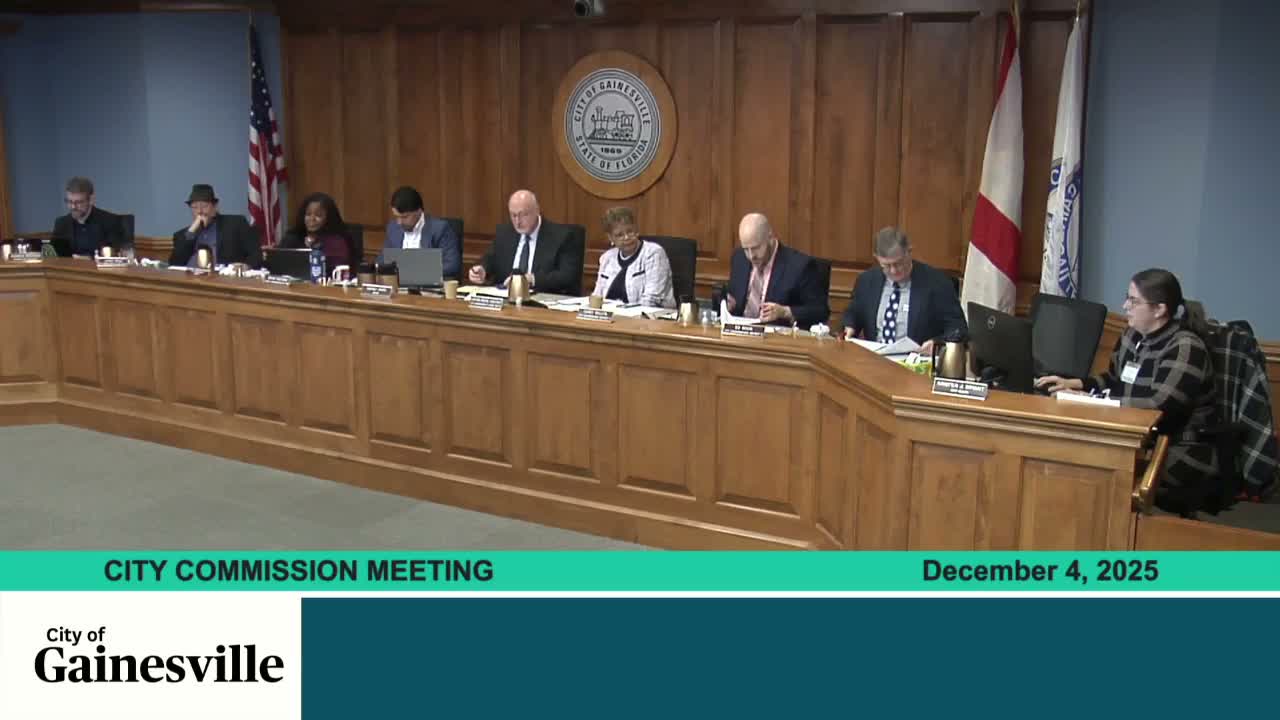
The Gainesville City Commission on Dec. 4 rejected a motion to discontinue a long‑planned Vision 0 project that would convert segments of NW 10th and 12th streets into a one‑way couplet. The public safety‑focused redesign, presented by transportation staff as a way to reduce conflict points and add separated bike lanes, drew both organized neighborhood opposition and supporters who said the changes would make the corridors safer for people walking and biking.
Supporters and opponents filled the public comment period. “Converting these corridors to one‑way streets will reduce those conflict points and reduce the likelihood of serious crashes,” said Joshua Ney, cofounder of Gainesville for People. Neighborhood speakers and civic groups pushed back, citing outreach failures, parking loss and fears the work would accelerate redevelopment that damages historic neighborhoods.
Transportation staff described the project as consistent with the city’s Vision 0 strategy and said modeling shows a 25–30% reduction in conflict points at major intersections. “This project would add buffered bike lanes, new crossings and parking where feasible,” Debbie Leistner of the Department of Transportation told the commission.
Commissioners split over data, context and community outreach. Some members said the longer history of the program and prior spending meant the city should proceed; others said recent research on one‑way pairs and strong neighborhood opposition counselled caution. Commissioner Duncan Walker moved to discontinue the project and redirect funds; that motion was seconded but did not carry after roll call.
The commission did not adopt a substitution motion and left the project active. Staff said they would continue outreach and return to the commission with follow‑up information.
Next steps: staff will incorporate community feedback and updated safety analyses and report back to the commission, which can reconsider design or funding allocations at a future meeting.