Lifetime Citizen Portal Access — AI Briefings, Alerts & Unlimited Follows
Mayor Ward outlines $40 million in infrastructure investments and cites drop in gun homicides
Loading...
Summary
At the Feb. 18 State of the City in Gainesville, Mayor Harvey L. Ward Jr. highlighted $40 million in surtax-funded projects, new public-safety facilities, transit and sustainability investments, and reported a notable decline in city gun homicides over three years.
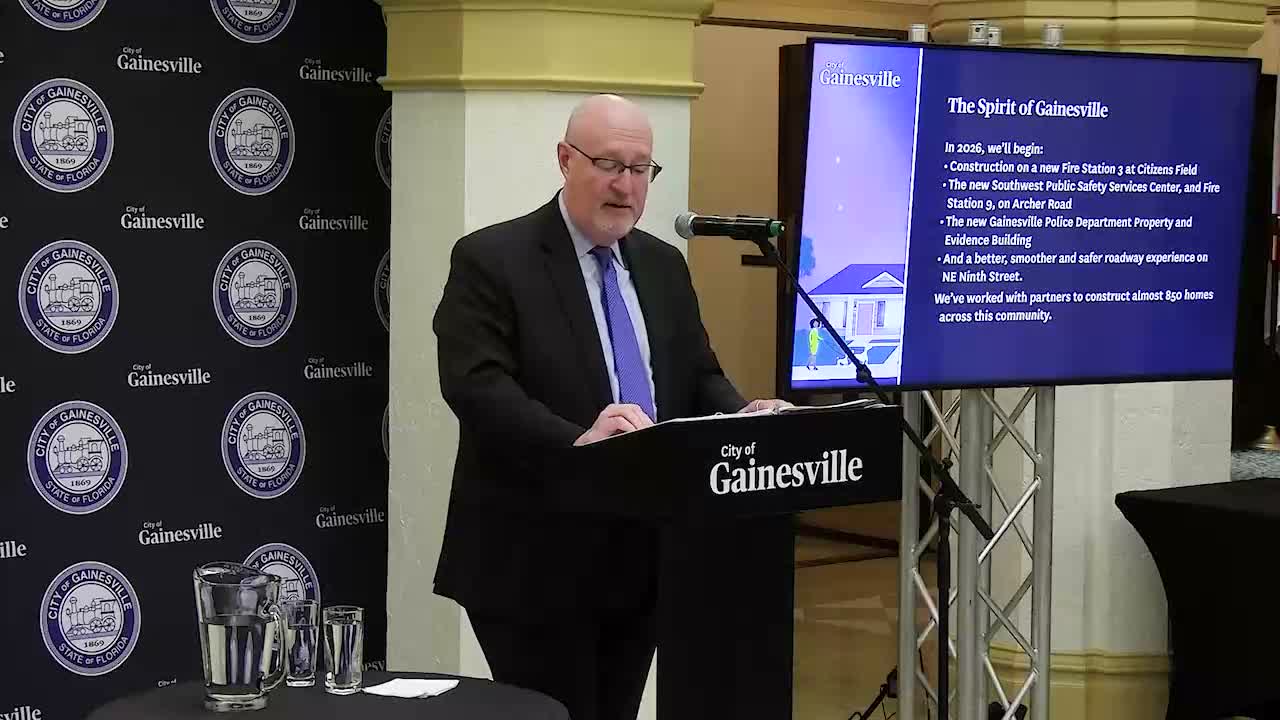
Mayor Harvey L. Ward Jr. delivered Gainesville's State of the City address at the Thomas Center on Feb. 18, 2026, announcing $40,000,000 in projects funded by a voter-approved half-cent surtax and citing declines in local gun homicides.
"Gainesville is investing $40,000,000 in projects ready to break ground this very year," Ward said, listing a rebuilt Fire Station 3, a new Southwest Public Safety Services Center and Fire Station 9, a new police property and evidence building, and complete-street work on Northeast Ninth Street.
The mayor framed those capital investments as part of a broader strategy that includes affordable housing and transit. Ward said the city and its partners have constructed "almost 850" affordable homes across the community in the past three years and announced federal low/no-emission grant funding of $22,000,000 to purchase 21 hybrid-electric buses for the regional transit system, plus $4,400,000 to support a solar array at the transit facility.
"We are seeing real measurable decreases in gun violence," Ward said, citing city gun-homicide counts of 16 in 2023, 7 in 2024 and 3 in the most recent year. He connected the declines to local policy direction — including declaring gun violence a public health crisis in February 2023 — and to the launch of ImpactGNV, the city's intervention and prevention framework.
Commissioners who spoke at the event expanded on Ward's priorities. District 1 Commissioner Desmond Duncan Walker highlighted East Gainesville initiatives such as the ImpactGNV office and a $2,000,000 Community Reinvestment Area grant program aimed at supporting properties and businesses along the Eighth Avenue and Waldo Road corridors. At-large Commissioner Cynthia Moore Chestnut described plans to transform Citizens Field with a competition-level aquatic center, multipurpose athletic fields and site remediation; she also previewed a City Hall Plaza refresh to improve accessibility and public gathering space.
Commissioner Brian Eastman said the city is rewriting its comprehensive plan to support smaller lot sizes and mixed-income housing and cited Vision Zero mobility projects, including protected bike routes and sidewalk improvements, aimed at reducing severe and fatal traffic crashes.
Mayor Ward also highlighted environmental and quality-of-life investments: Gainesville earned LEED Gold certification; a seasonal volunteer tree-planting program is expected to add up to 150 trees between October and March; and the Downtown Ambassadors program reported removing 240 cubic yards of trash, welcoming more than 7,000 visitors and conducting more than 16,000 safety interactions in its first year of a three-year contract.
The address tied infrastructure, housing and public-safety initiatives to the broader goal of making Gainesville "safe, clean, and affordable," with the mayor saying the commission expects construction on many of the announced projects to begin in 2026.
Next steps noted at the event included design and remediation work for Citizens Field, procurement and deployment of grant-funded buses, and continued implementation of ImpactGNV; no formal votes or council actions were recorded during the address.