Get Full Government Meeting Transcripts, Videos, & Alerts Forever!
Get email alerts on the ACT Plan topic
No spam. Unsubscribe anytime.
ACT downtown plan heads to City Council after UTC briefing on one-way/ two-way trade-offs
Summary
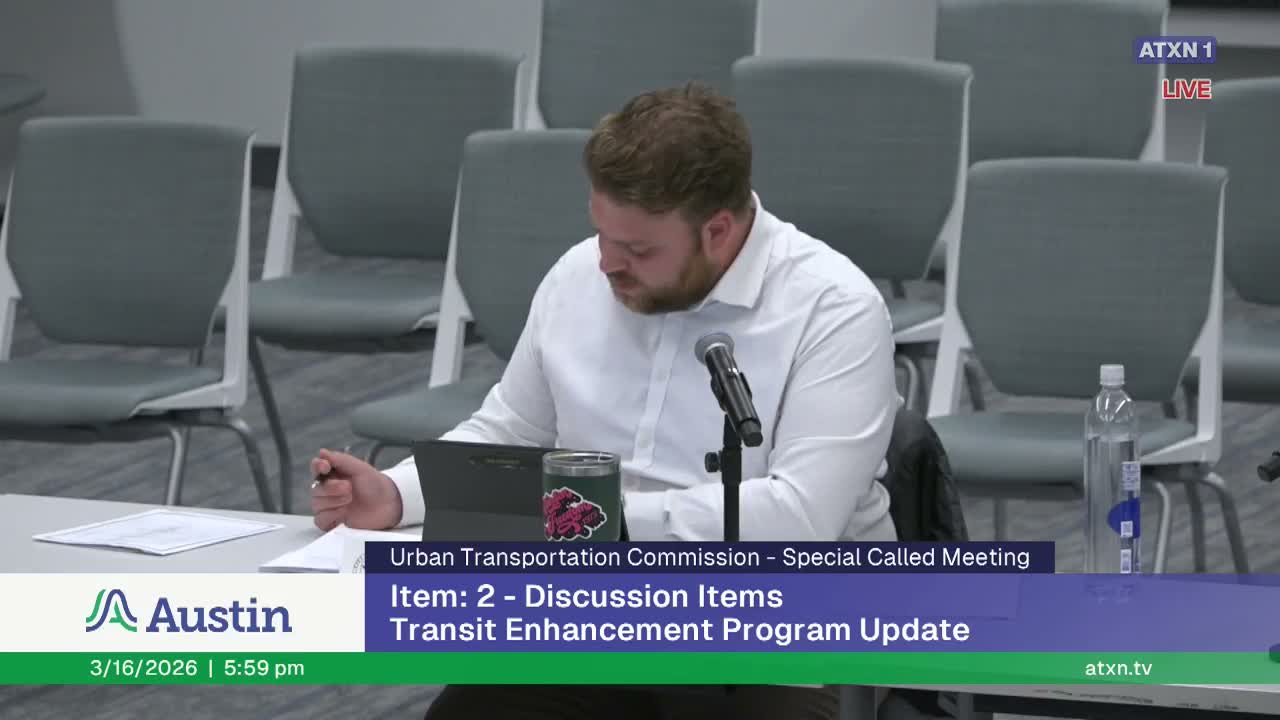
Transportation Officer Michelle Marks briefed the Urban Transportation Commission on the Austin Core Transportation (ACT) Plan, describing recommendations to reallocate space on downtown one‑way corridors for transit and bike facilities, planned 6th Street engineering, and upcoming action at City Council next Thursday.
Michelle Marks, Transportation Officer for Austin Transportation and Public Works, told the Urban Transportation Commission the ACT plan is a small-area transportation plan that will be amended to the Austin Strategic Mobility Plan and is scheduled for consideration at City Council next Thursday. She said the plan updates a prior downtown mobility plan, incorporates extensive community engagement (engaging "80 some odd groups"), and recommends priority capital projects, supporting projects and programmatic improvements across downtown corridors.
Marks walked commissioners through key recommendations and trade-offs. The ACT plan identifies a small number of remaining one‑way corridors downtown that are critical east–west connectors and that the plan recommends keeping one‑way operations on some heavy-lift streets (notably the 5th/6th couplet) to preserve the right of way needed for transit priority and protected bike facilities. At the same time, the plan recommends converting various other streets (the presentation highlighted corridors such as 7th and 8th) where context allows. "With 5th and 6th ... we get real serious problems in our transportation network real fast" if those streets no longer act as heavy lifters, Marks said, explaining why those couplets are likely to remain one‑way.
Marks emphasized a key technical point made repeatedly in the briefing: two‑way conversions require additional vehicular space for protected left‑turn pockets, so a two‑way street often needs roughly 10 extra feet of vehicular width at intersections, and choices about whether to preserve transit lanes, bike lanes, or turn pockets are context-sensitive. She also noted there is no single crash-modification factor that shows converting a one‑way to two‑way alone improves safety; instead, safety is achieved by applying countermeasures (speed management, protected crossings, left-turn management) whether a street is one‑way or two‑way.
Commissioners raised detailed questions about priorities, timeline and bicycle crosstown connections. Nadia Ramirez (CapMetro) confirmed that planning work is under way to connect a 4th Street protected facility to the existing Shoal Creek bridge and to integrate light-rail facility design with bicycle planning. Marks said preliminary engineering reports for 6th (already started) and for 7th/8th (next) will drill into corridor-level trade-offs such as where a protected bicycle lane should begin or end, or where transit priority lanes are needed.
Why it matters: the ACT plan translates strategic downtown objectives into street-level cross sections and project lists that will guide years of capital work and coordination with TxDOT and Project Connect. Next steps include preliminary engineering, corridor-level community engagement and City Council consideration.
The briefing closed with agreement that the commission would continue to review how preliminary engineering resolves design trade-offs before final adoption.