Lifetime Citizen Portal Access — AI Briefings, Alerts & Unlimited Follows
West Virginia Senate advances broad package of bills on education, courts and fees; most pass unanimously
Loading...
Summary
During a session of third readings, the West Virginia Senate advanced a wide set of bills — including measures on a federal scholarship tax-credit list, homeschool athletics, school-closure reversals and graduation requirements — recording largely unanimous votes and setting effective dates for several measures.
The West Virginia Senate on third reading on March 18 advanced a large package of bills covering education policy, court and administrative fees, public-safety programs and volunteer fire department rules, with most measures passing by unanimous or near-unanimous recorded votes.
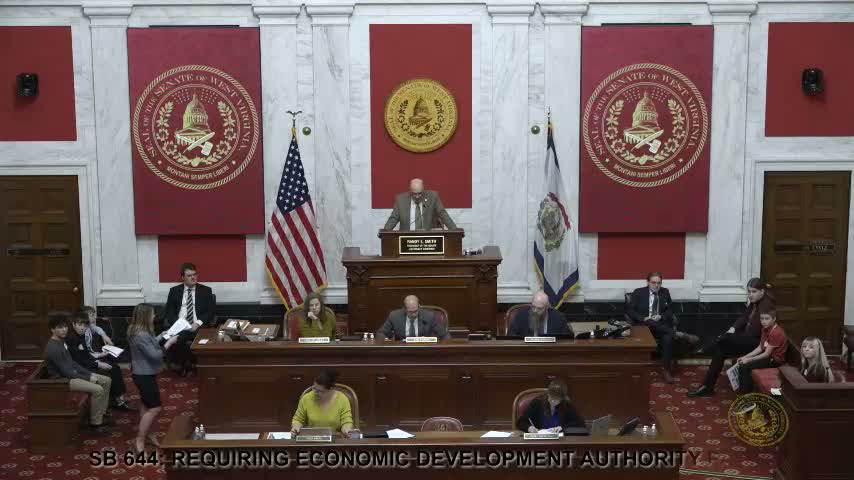
The Senate approved an engrossed committee substitute (Senate Bill 6-44) that requires the state’s Economic Development Authority, through the Secretary of Commerce or a designee, to participate in the Federal Tax Credit Scholarship Program, identify qualified in-state scholarship-granting organizations and publish an annual list to the U.S. Treasury. The measure passed with a recorded vote of 30 yeas, 0 nays, 4 absent; the Chair declared the bill passed and later the Senate voted to make it effective from passage.
Lawmakers also approved the West Virginia Homeschool Student Athletics Participation Act (committee substitute for Senate Bill 6-89), which allows recognized homeschool athletic organizations to participate in regular-season interscholastic contests against West Virginia Secondary School Activities Commission (WVSSAC) member schools under specified insurance, conduct and scheduling conditions, while prohibiting homeschool teams from affecting official WVSSAC rankings or postseason eligibility. That bill passed 31–0 with three absent, the Clerk recorded.
Other education measures the Senate passed included: Senate Bill 1,024, which authorizes county boards of education to rescind or reverse a permanent school-closure decision by majority vote on or before July 15 of the same calendar year (recorded 31–0, 3 absent); Senate Bill 1,044, directing the West Virginia Board of Education to promulgate common graduation requirements and establish multiple graduation pathways (academic, workforce, career-technical/skilled trades and military) (recorded 31–0, 3 absent); and a series of bills defining and clarifying school personnel transfer and long-term substitute rules (multiple bills recorded 31–0 or 32–0 where noted).
On public-safety and administrative items, the Senate passed a measure transferring the court security fund to the Supreme Court of Appeals and authorizing the legislature to appropriate funds for court-security expenses; approved expansion of a pilot to implement an involuntary commitment process (committee substitute for Senate Bill 7-41) that directs the Department of Human Services to collaborate with courts, law enforcement and behavioral-health stakeholders to evaluate alternative transportation providers and establish standards; and advanced bills to exempt volunteer fire departments from certain raffle regulations under defined conditions.
Several measures dealing with filings and fees for the Secretary of State’s office (committee substitute for Senate Bill 8-52) were read in full and advanced on the calendar; those changes include adjustments to many specific filing and service fees and the creation or continuation of special revenue accounts. The Clerk read the bill text and staff clarified specific fee amounts during the reading.
Recorded tallies were included in the record for each bill when the machine vote was used; where recorded, votes were overwhelmingly in the affirmative. The Chair regularly announced results and instructed the Clerk to communicate the Senate’s actions to the House of Delegates. At least one bill (the judges’ retirement measure) received an explicit effective date of July 1, 2026 when the Senate approved that motion.
The session concluded with scheduling announcements: the Energy, Industry and Mining committee and the Finance committee were set to meet later in the afternoon, and the Senate stood in recess until 4:30 p.m.
Votes at a glance
- Engrossed committee substitute for Senate Bill 6-44 (Economic Development Authority participation in Federal Tax Credit Scholarship Program): Passed, 30 yeas, 0 nays, 4 absent; declared effective from passage. - Committee substitute for Senate Bill 6-89 (West Virginia Homeschool Student Athletics Participation Act): Passed, 31 yeas, 0 nays, 3 absent. - Committee substitute for Senate Bill 7-41 (involuntary commitment pilot expansion): Passed, 32 yeas, 0 nays, 2 absent. - Committee substitute for Senate Bill 8-52 (Secretary of State fees and service charges): Passed where recorded; full text read on the floor. - Committee substitute for Senate Bill 1,024 (rescission/reversal of school closure decisions through July 15): Passed, 31 yeas, 0 nays, 3 absent. - Senate Bill 1,044 (Board of Education rulemaking for common graduation requirements): Passed, 31 yeas, 0 nays, 3 absent. - Additional bills passed on third reading addressed court security fund transfer, judges’ retirement changes (effective 07/01/2026), volunteer fire department audit and raffle rules, definitions of long-term substitutes and reassignment procedures for school personnel; most recorded votes were unanimous or near-unanimous as noted in the official record.
The Chair declared each recorded passage and instructed the Clerk to communicate the Senate’s action to the House of Delegates. The Senate recessed after announcements about committee schedules.