
House approves exemption for vehicle transfers between guardians, grandparents and grandchildren
Get AI-powered insights, summaries, and transcripts
Sign Up Free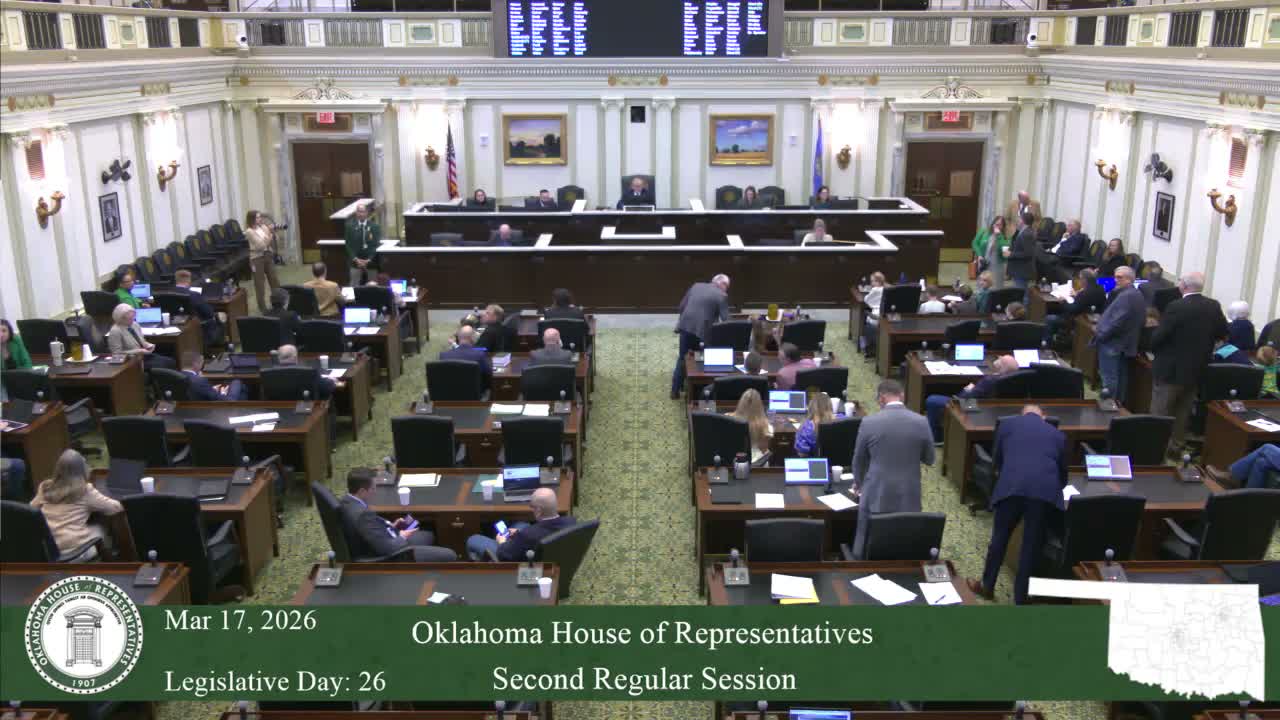
Summary
House Bill 29,67, exempting motor vehicle excise tax for ownership transfers between legal guardians/parents and children and between grandparents and grandchildren, advanced and passed after sponsor described a FY26 impact of $2.18 million and FY27 $3.28 million; members pressed for details on calculation and verification procedures.
The Oklahoma House on March 18 approved House Bill 29,67 to exempt motor vehicle excise tax on transfers between a legal guardian and child and between a grandparent and grandchild.
Representative West (Westrick), the bill sponsor, told the chamber the estimated fiscal impact for fiscal year 2026 is $2,180,000 and for fiscal year 2027 $3,280,000. He said the estimate used an average excise tax amount of about $882 per vehicle and assumed roughly a 10% increase in transfers for the exempted categories.
Representative McCain asked how the fiscal-impact figure was calculated; West responded that the $882 average is the basis and that the projection uses a baseline and a roughly 10% increase assumption. “They calculated the average excise tax amount of $882 per vehicle,” the sponsor said on the floor.
Members also asked practical questions about verification. One member asked whether the tag agent will require documents to confirm the relationship; the sponsor said that the transfer paperwork filed with the tag agent would include a signed statement attesting the transferee is a grandson or that the transferor is the legal guardian.
Other members raised concerns about whether the exemption could be used for many vehicles by a single benefactor. The sponsor said the bill contains no numerical limit on transfers and that it does not contemplate a cap.
The House approved the bill on third reading; the clerk announced a recorded vote of 69 ayes and 10 nays, and the presiding officer declared the bill passed.
The sponsor described the measure as a constituent request; no amendments were adopted on third reading.