Get Full Government Meeting Transcripts, Videos, & Alerts Forever!
Get email alerts on the Early Literacy topic
No spam. Unsubscribe anytime.
House committee advances sweeping reading bill aimed at boosting early literacy, tests and summer academies
Summary
Speaker Hilbert’s reading bill, which expands screening, summer credentialing and a future retention mechanism, cleared the committee after extended questioning about costs, staffing and timelines; sponsors cited implementation steps and an estimated $75 million cost that remains to be refined.
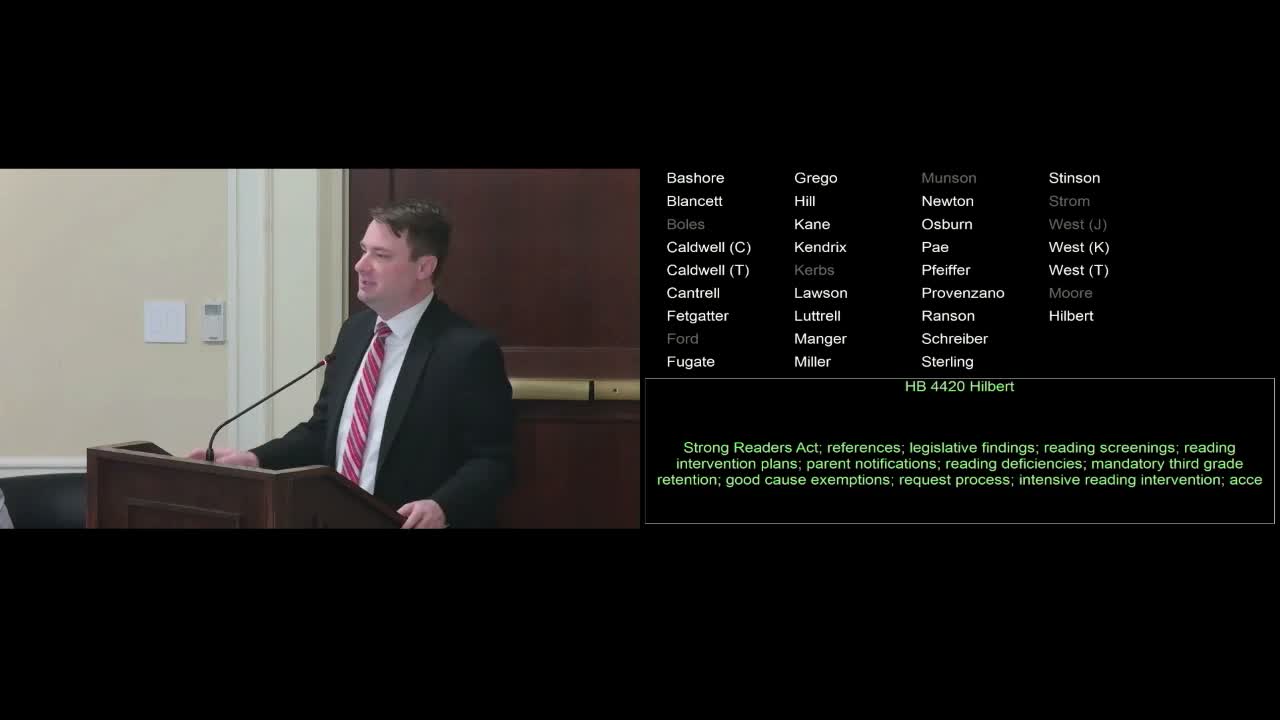
Speaker Hilbert told the committee that the bill “is the reading legislation that we have been talking about so much this session,” and said the measure would give school districts more options for summer learning academies, intensive tutoring and credentialing for reading teachers. The bill would also set a process that could lead to third‑grade retention in later years, after staged screening and interventions.
Hilbert said the measure is intended to create faster pathways for districts to train educators, including summer credentialing academies run in partnership with higher education and the Office of Educational Quality and Accountability (OEQA). “I hope we don't have any third graders retained because everyone that needed early intervention had the early intervention,” Hilbert said, describing the retention mechanism as a last‑resort outcome after earlier support.
Members pressed the sponsor for details. Representative Provanzano asked whether the retention provision would begin immediately; Hilbert said the testing that could trigger retention would first be administered in the 2027–28 school year, with the retention cohort following thereafter. Provanzano also raised parent‑engagement concerns; Hilbert said parents should never be surprised because the bill creates earlier notification and multi‑year intervention plans.
Lawmakers asked about cost and staffing. A member cited a $75,000,000 figure; Hilbert characterized that as an early estimate to be refined during budget negotiations and said some components could be staged or funded through other means. On capacity, Hilbert said existing credentials and programs under the Strong Readers Act reduce lead time, and he argued that credentialing and summer training could begin quickly if agreed funding is available.
The committee voted to report the bill out as a due‑pass. The recorded tally in committee was 22 yes and 4 no. The bill now moves to the next legislative stage where fiscal details, implementation timing and any changes to parent‑notification language are likely to be negotiated.
The measure’s key next steps are budget‑level negotiations and coordination with OEQA and higher education to define credentialing content, the summer timeline and how screening results are reported to districts and families.