Get Full Government Meeting Transcripts, Videos, & Alerts Forever!
Get email alerts on the Urban Forest topic
No spam. Unsubscribe anytime.
Hanford hears draft Urban Forest Master Plan; consultant cites 140-acre canopy loss and 30-year goal to restore 10% cover
Summary
A Dudek planner told Hanford City Council the draft urban forest plan inventories 6,486 public trees, documents about 140 acres of canopy loss (2018–2022), and sets a 30-year goal to restore 10% citywide canopy by planting about 4,500 trees (2,200 on private property), with an immediate 600-tree planting funded by a USDA grant.
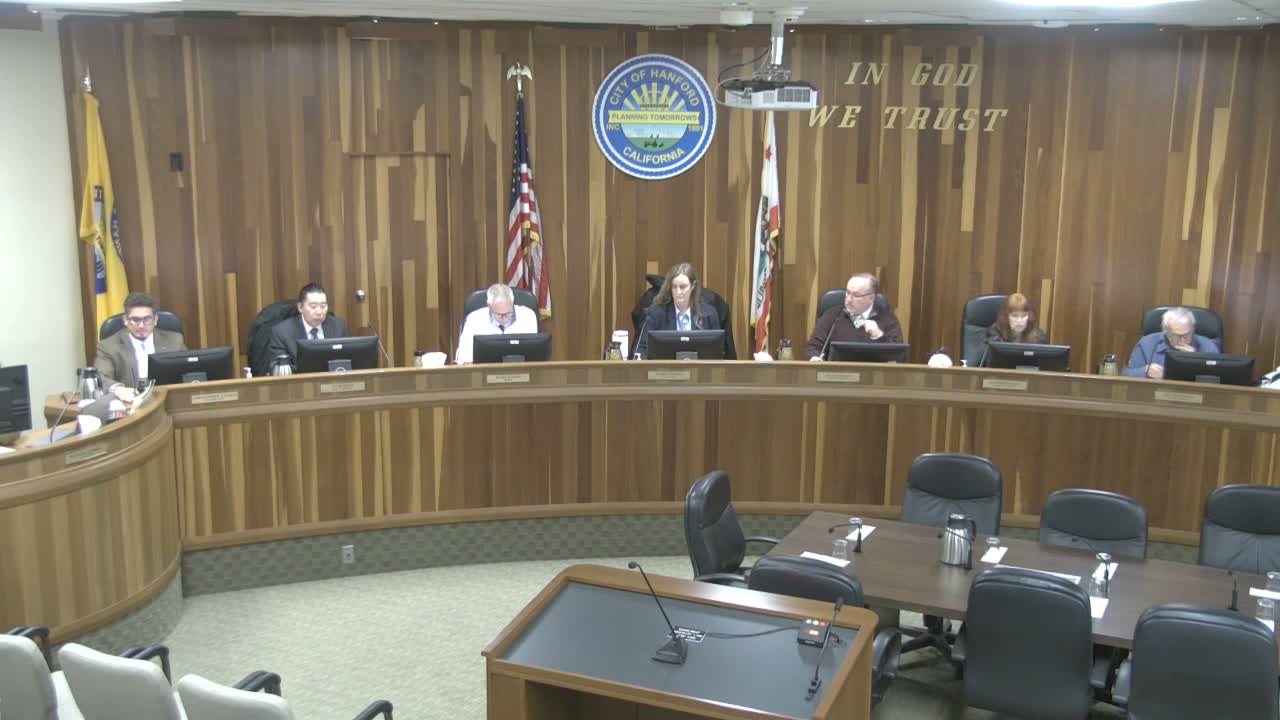
Kevin Cullinan, an urban forest planner with Dudek, presented the draft Hanford Urban Forest Management Plan to the Hanford City Council on Feb. 17, describing the plan’s inventory, goals and implementation recommendations. The presentation said the city completed a public-tree inventory of 6,486 trees and that canopy cover citywide fell by roughly 140 acres between 2018 and 2022, with most losses occurring on private property.
Cullinan said the city received a $1,000,000 USDA urban and community forestry grant in 2024 that funded the inventory, outreach and the draft plan and will pay to plant 600 trees in public spaces over the next two years. He outlined a longer-term target of increasing citywide canopy to 10% by 2055 — a level the consultant described as roughly what the city had in 2018 — and estimated that reaching that goal will require planting about 4,500 trees over 30 years, including roughly 2,200 new trees on private land and about 800 in identified vacant public-tree sites.
The plan, Cullinan said, groups goals under resilience and sustainability, community-centered stewardship, and a connected, healthy Hanford. It recommends routine five-year monitoring of canopy indicators, a species diversification strategy to reduce reliance on Chinese pistache (which dominates current plantings), new arboricultural standards for planting and maintenance, and improvements to program tracking — including continued use of the TreePlotter inventory platform while the grant covers its subscription for the initial period.
Council members pressed on implementation details during a lengthy Q&A. Cullinan said private-property outreach and incentive programs — cost-share grants, volunteer plantings, tree giveaways and partnerships with local nurseries — will be essential because the majority of canopy sits on private parcels. He acknowledged tradeoffs raised by council members and residents: fruit trees and some ornamentals provide benefits but usually require more water; irrigation and establishment labor are key constraints in Hanford’s warm, dry climate.
Brad Albert, city staff who introduced the item, confirmed that the parks-and-recreation commission recommended the plan unanimously on Feb. 9 and said the inventory and planting work already under way (including recent removals at the softball complex) will allow the city to begin planting in identified gaps.
Next steps laid out in the presentation and by staff include an urban-forest open house the following day, a public comment period for the draft that closes Feb. 20, and incorporation of council and community edits with the goal of adoption at the March 3 council meeting.
The council and public praised the plan’s data-driven approach while asking staff to pursue clear outreach and funding strategies so that planting targets on private property can be met without creating inequities across neighborhoods. Cullinan said the plan includes an appendix of funding sources and recommended tree species lists to guide future implementation.