Get Full Government Meeting Transcripts, Videos, & Alerts Forever!
Get email alerts on the Federal Funding topic
No spam. Unsubscribe anytime.
Federal lobbyist Greg Burns highlights grant wins for Hanford and flags 2026 funding risks
Summary
Greg Burns, Hanford’s Washington advocate, told the City Council Feb. 3 that federal activity in 2025 produced several wins — including a $15.5 million FAST-Track grant and a $2 million corridor appropriation — but warned reauthorization timelines and agency rulemaking leave uncertainty for 2026.
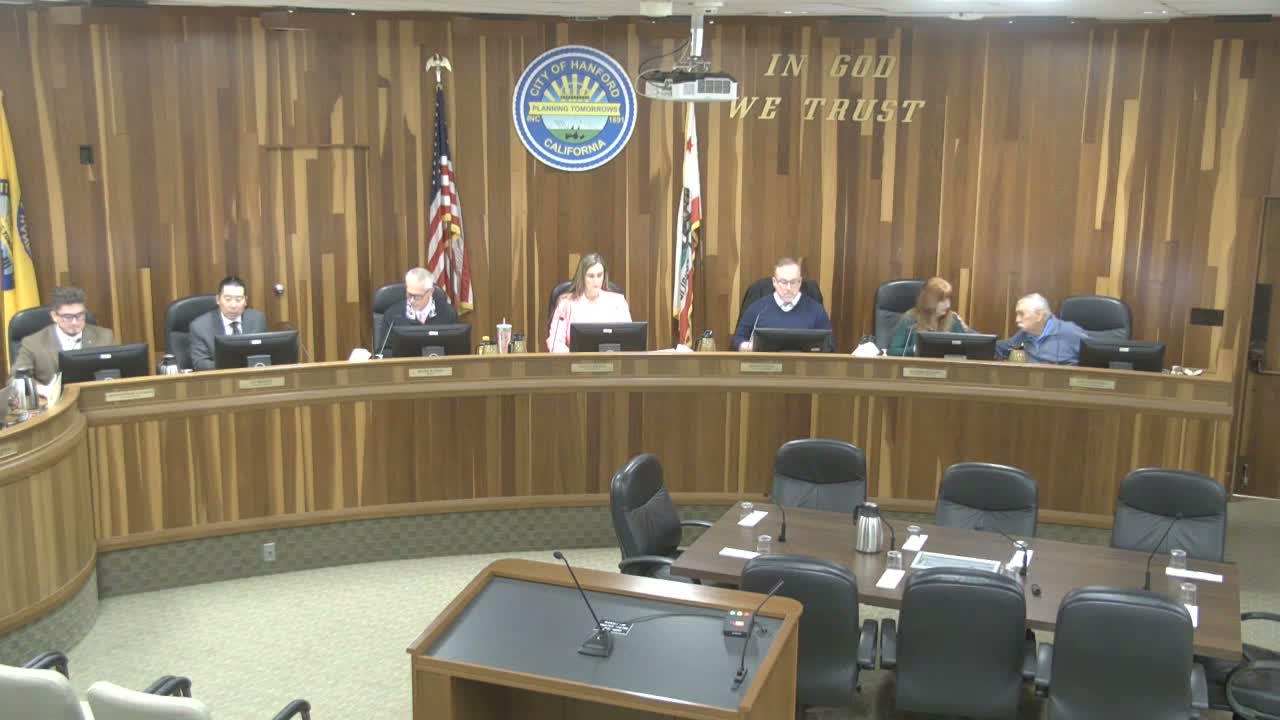
Greg Burns, a Washington-based lobbyist working on behalf of Hanford, told the City Council on Feb. 3 that the past year produced “a lot of success,” including multiple federal grants and new funding opportunities the city can use for local projects.
“I am Greg Burns. I work at Forerunner Partners in Washington DC, and I do work on behalf of the city, to help support your advocacy efforts in Washington,” Burns said, opening a roughly 30-minute briefing in the study session. He walked council through recent federal actions, litigation over executive orders and major legislative developments he expects to affect cities in 2026.
Burns listed several grants that he said Hanford secured or helped to secure: about $550,000 for a veterans-and-seniors building renovation, more than $7 million for the East Lacey Corridor Improvement Project, a roughly $1 million USDA forestry grant for a Hanford forestry program, and what he described as a $15.5 million FAST-Track grant for a corridor project. He also said a $2 million appropriation to support Grangeville Boulevard right‑of‑way acquisition cleared the House and was signed by the president the afternoon of the meeting.
The lobbyist cautioned that the federal funding environment remains uncertain. He noted the Bipartisan Infrastructure Law programs face reauthorization deadlines and said some future surface-transportation bills will likely be smaller with fewer competitive programs. “We do think that the the new bill will probably have fewer competitive programs,” he said, urging the city to track reauthorization and to prioritize programs such as the railroad grade‑separation program that funded the Grangeville planning work.
Councilmembers thanked Burns for the update and credited the combination of city staff work and Washington advocacy for recent funding results. The council also asked Burns to continue supporting upcoming FY 2027 funding requests and to help with possible park-related federal funding, which several members mentioned during their remarks.
Next steps: Burns said he will work with city staff on FY 2027 proposals and follow federal rulemaking and appropriation timelines that could affect Hanford projects.