Get Full Government Meeting Transcripts, Videos, & Alerts Forever!
Get email alerts on the Solar Wastewater Project topic
No spam. Unsubscribe anytime.
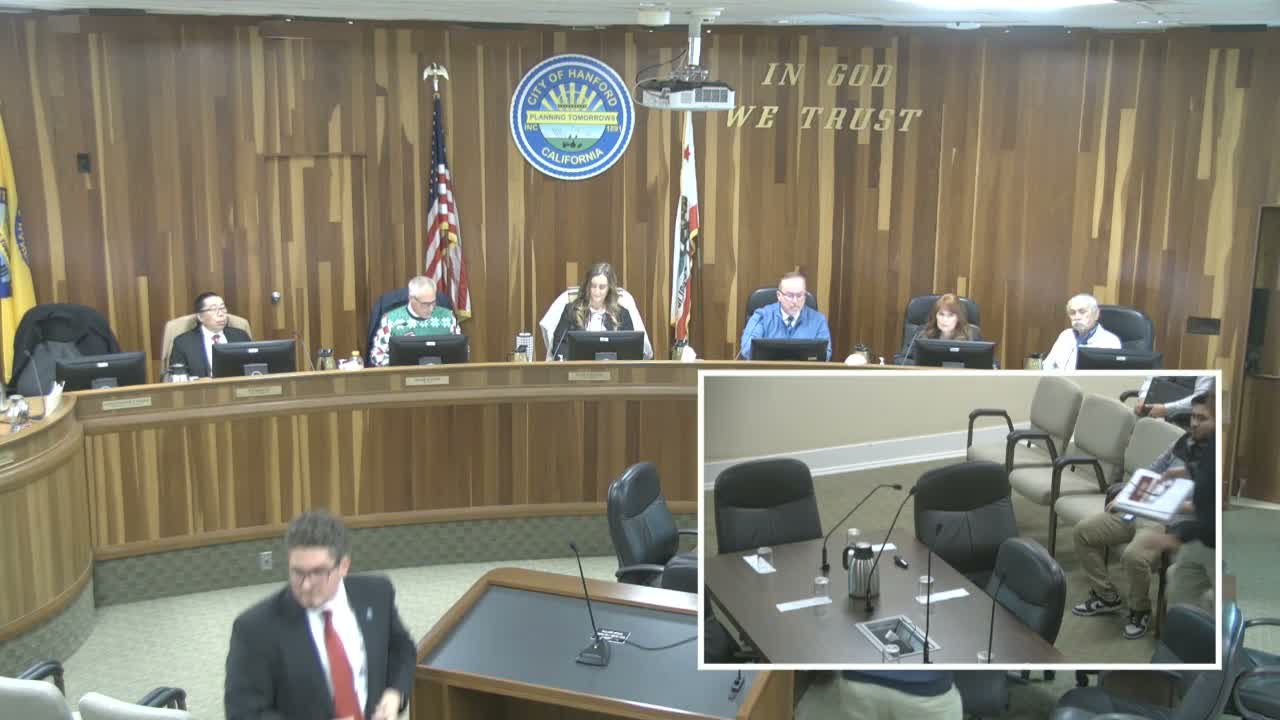
Hanford council hears rushed solar plan for wastewater plant as members press on cost and timing
Summary
City staff presented a $3.68 million standalone solar contract with Aptera for an 845‑kW system at the wastewater treatment plant, citing a looming Edison NEM‑2 deadline to lock in buyback rates. Council members questioned price, maintenance costs and whether financing would force rate increases; staff said no action was required tonight and will return in January.
Hanford staff on Dec. 16 advanced a proposal to award a $3,680,000 contract to Aptera Energy Services for an 845‑kilowatt solar photovoltaic installation at the city’s wastewater treatment facility, but several council members said they were uncomfortable with the price and with the accelerated timeline.
Frank Centeno, the director leading the presentation, told the council the project is being advanced outside the full energy‑savings package to meet an Edison net energy metering (NEM‑2) enrollment deadline of April 14, 2026, and to allow Aptera to begin construction in early January. “There is an impending deadline, by Edison … set to expire 04/14/2026,” Centeno said, describing the timing as the principal reason the solar‑only contract is before the council now.
Centeno described the solar unit as a stand‑alone measure producing roughly 1,300,000 kilowatt‑hours a year — about one‑third of the plant’s current load of about 3,700,000 kWh — and said Aptera offers guaranteed energy performance, with reconciliation of surplus or shortfalls every five years. He noted the solar‑only contract would carry a 10% contingency and that the city has paid $590,000 so far under limited notices to proceed.
Council members pressed staff on cost and procurement. One member said the solar price appeared about $1 million higher than what a private buyer might pay and questioned a $28,000‑per‑year monitoring and maintenance line item. “This is government work … we’re used to things costing more,” the council member said, but added she wanted stronger competitive bidding for future components of the larger project.
City Manager Chris Tavares and Centeno said the city retained an outside reviewer (Cummings Group) to benchmark prices and that the proposed price was within public‑sector averages the consultant found. Tavares also warned the council that financing the solar‑only piece from enterprise funds could require deferring capital projects if the larger wastewater upgrades are not pursued concurrently.
No vote was taken. Staff said the item was brought for council discussion only and will return at the Jan. 20 meeting with financing options and a combined pro forma that includes the wastewater upgrades — a package that staff says could change the net cost by roughly $700,000 when combined. The mayor and several members said they were inclined to move forward to capture incentives and NEM‑2 credits but asked the city to press for better pricing and clearer warranty/maintenance protections.
What happens next: Staff will return in January with financing proposals and updated pro formas for both the solar‑only option and a combined wastewater/solar package; if the council approves the larger package later, staff indicated a Prop. 218 process and longer financing timetable may be required.