Get Full Government Meeting Transcripts, Videos, & Alerts Forever!
Get email alerts on the Facility Planning topic
No spam. Unsubscribe anytime.
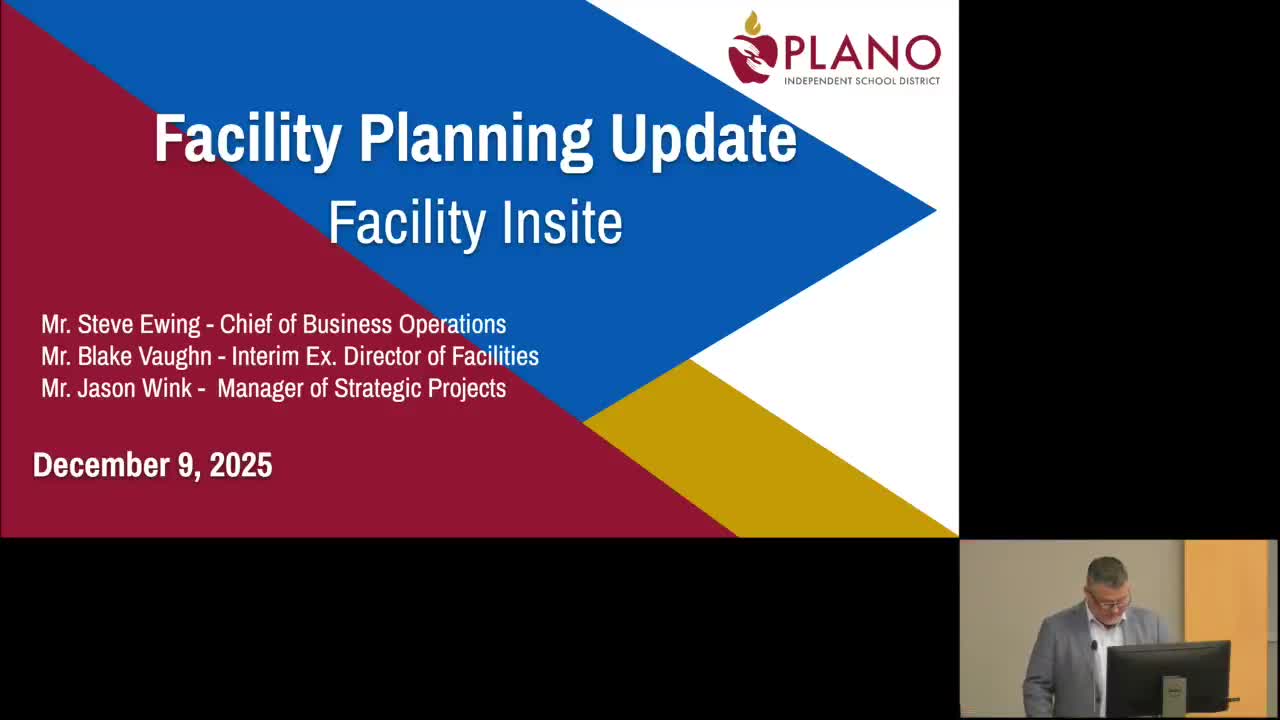
Plano ISD previews Facility Insight software to guide long‑range capital and bond planning
Summary
Deputy Superintendent Johnny Hill and Chief of Business Operations Steve Ewing previewed a capital‑planning tool, Facility Insight, showing initial data for 42 elementary facilities, a $269 million assessed replacement value and 61 projects with an estimated escalated cost of about $296.75 million; presenters emphasized data are preliminary and SOPs for data entry remain to be developed.
Plano ISD administrators gave trustees a preview of Facility Insight, a capital‑planning and facility‑assessment software the district is using to consolidate facility data, forecast costs and support future bond planning.
Steve Ewing, chief of business operations, described Facility Insight as a tool for data‑informed decision making, organizational improvement, long‑range capital planning and historical tracking. He said initial entries cover 42 elementary facilities totaling about 3,250,000 square feet, with an assessed replacement value of roughly $269,000,000 and 61 projects identified at this stage. Ewing cautioned that the figures are initial and not final: "This is initial data ... it's not a final number," he said.
Presenters explained how Facility Condition Index (FCI) and visual assessments factor into prioritization. Johnny Hill described FCI as a benchmark that helps determine whether to repair or replace components, and staff said an FCI over roughly 15% typically warrants close review. The team showed how the system can break down campuses into many line items and systems (rooftop units, ductwork, controls, etc.) to allow targeted interventions rather than whole‑site decisions.
Trustees asked how the district will maintain consistent data entry and ensure prioritization reflects criticality (for example, HVAC failures that close schools versus structural items that may be longer‑term). Steve Ewing said the district currently has no formal SOPs for data entry and that creating written SOPs is a next step; staff also described an annual escalator input (currently 6% regionally) for projecting future costs.
Administrators said Facility Insight will support both short‑term maintenance actions and long‑term bond phasing, and they noted the district maintains a contingency/accelerator fund (about $800,000 per year in the current program) to respond to emergent repairs.
Staff emphasized that more campuses and building‑level entries (middle and high schools) will be added over time and that trustees and the community will be briefed further as data and SOPs are completed.